
In the wake of the devastating 2019–20 bushfire season, fire crews and emergency services across the country have been busily preparing as summer approaches.
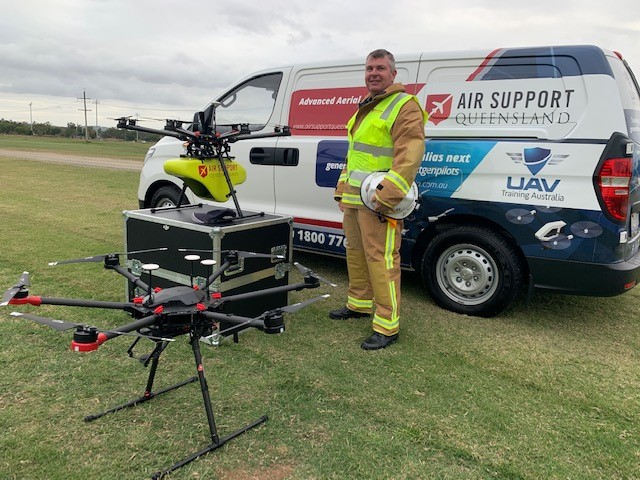
In Queensland, fire crews, park and wildlife and forestry staff have been training to use remotely piloted aircraft systems (RPAS) to watch fire-prone areas and predict fire behaviour.
Air Support Queensland’s CASA approved training organisation—UAV Training Australia—has been working with local agencies to provide remote pilot licence (RePL) courses in drone operations. Queensland Fire and Emergency Services (QFES) fire crews, HQ Plantations fire crews and Queensland Parks and Wildlife rangers have undertaken these courses during the cooler months in preparation for the official fire session.
Wayne Condon, chief remote pilot and CEO of UAV Training Australia, says using drones to gather intelligence in high fire-prone areas and emergency management is the way forward in bushfire operations.
‘Our latest drone platform has all the equipment you need including primary flight displays, advanced sensor fusion algorithms for live pinpoint missions, radio metric thermal imaging technology and laser range which identifies and follows moving subjects,’ he says. ‘Compared to manned aircraft, drones use fewer resources, can be deployed more frequently and can stay aloft up to 55 minutes.
‘The demand for training and approvals has increased significantly in preparation for this year’s bushfire season to ensure safety both on the ground and in the sky. This has included remote pilot licences, English language proficiencies and aeronautical radio operator certificates—all necessary qualifications for forestry, parks and wildlife, fire and emergency services personnel to have.’
Under the regulations, people must be qualified with an aeronautical radio operator certificate and English language proficiency to communicate on an aviation air-band radio frequency. This includes RPAS pilots as well as aircraft maintenance engineers, airport safety and emergency personnel.
The pilots must complete specialised training courses mandated by CASA under the new Manual of Standards (MOS) 101. The training can vary depending on the type, category and operational requirements but allows people to fly remotely piloted aircraft that weigh more than 2 kg for commercial operations.
CASA expanded its suite of digital services in myCASA in August. This allowed Wayne Condon to lodge English language proficiency notifications as well as remote pilot licence and aeronautical radio operator certificate applications, online. These permissions were granted and emailed to his students within minutes.
‘This hit at a time where we had at least 30 aeronautical radio operator certificates to put in myCASA for QFES alone. Imagine the amount of paperwork and signatures going back and forward … but this is now so easy,’ he says.
‘Embracing technology and automation so that both industry and CASA can benefit—this is where it needs to be going. Now, with myCASA, student approvals are done within minutes.’
Firefighters across New South Wales and the Northern Territory have also used myCASA to get approvals for their remote pilot licences and aeronautical radio operator certificates.
The use of drones is becoming popular among fire crews for surveillance and, with more digital services available in myCASA, it’s now easier than ever for industry to get licences, permissions and approvals.
Other services now available in myCASA include flight crew licence reprints, fireworks display applications, pilot licence applications and flight review notifications. Remote pilot licence holders with iPhones can also download and trial a digital licence into their Apple Wallet with an option for Android users coming next year.

Comments are closed.