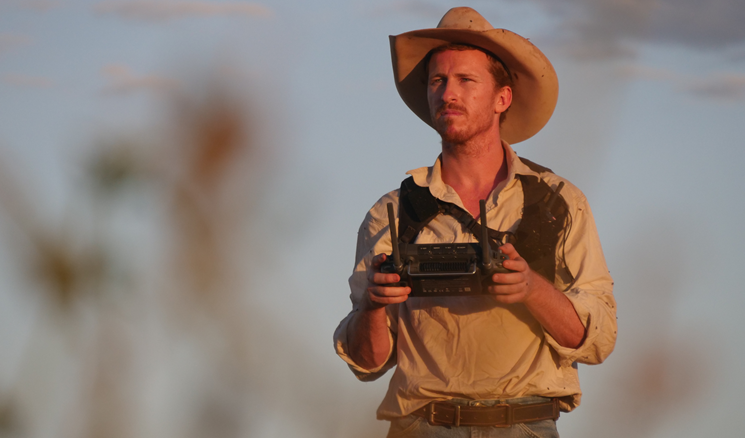
Luke Chaplain bought his first drone on a uni trip in Hong Kong. It was a far cry from his home in regional Queensland where he grew up mustering cattle. The little red drone that did backflips certainly helped Luke flip the cattle mustering industry with his company SkyKelpie.
Building SkyKelpie from the ground up
SkyKelpie helps producers run safer drone musters. The team sells fit-for-purpose aircraft, teaches aerial stockmanship and helps people build skills before they step into a paddock to try drone mustering for the first time. ‘Treat drones like aviation equipment, not toys,’ Luke says. ‘That mindset keeps people safe and animals calm.’
Luke started with small trials on his family farm and filmed what worked. These became lessons, which became a course and later a simulator. SkyKelpie grew from those early tests into a safety-first program for cattle mustering work.
Today Luke trains musterers across Australia. He matches operators with the right drones and runs practical workshops on stations. He is also prototyping vision-based livestock detection. The aim on every job is to keep people safe and animals calm. ‘I’m a big believer in low stress livestock handling and drones are a really good application for that,’ he says.
Safety at the centre
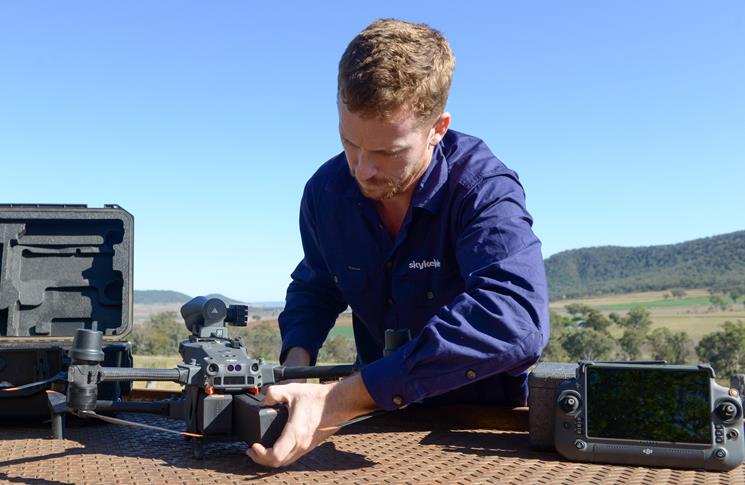
Safety sits at the centre of SkyKelpie’s work. Each mission is briefed, paddock boundaries are mapped and flights stay within visual line-of-sight and below 120 m, with airspace and local requirements checked.
Luke holds a remote pilot licence (RePL) and operates under a remote operator certificate (ReOC). He also has authorisations for extended visual line-of-sight (EVLOS) and site specific beyond visual line-of-sight (BVLOS) on his home farm.
Training for drone musterers
The Aerial Stockmanship program pairs classroom and SkySim. Classroom sessions cover the tech, rules, briefings and low-stress stock-handling. SkySim then builds the flying: orientation, wind, emergency drills and checklists, with mustering scenarios unlocked only after the base levels. ‘People don’t always read the instructions,’ Luke says. ‘So, we built levels that teach step by step.’
Breaking new ground
A standout achievement of Luke’s career was gaining mobile remote operation centre authorisation as part of his EVLOS approvals. ‘SkyKelpie was one of the first to get a mobile remote operation centre authorisation,’ he says. This allows a drone pilot to operate their drone from a different location. ‘We pursued it for a Brisbane conference, and the process with CASA was a really pleasant experience.’
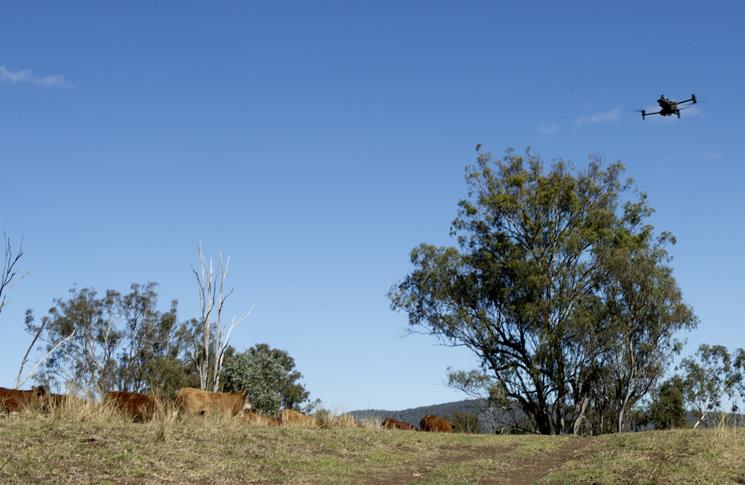
On the ground the positives are clear. Pilots scout with a drone first, locate cattle, then guide the mob towards water or yards; the ground team moves only when it’s safe. Several stations have reported to Luke they are having fewer risky rides and near misses. Two properties recorded annual savings of about $80,000 and $100,000, with a drone kit that cost about $12,000. ‘The numbers help,’ Luke says. ‘But getting everyone home safe matters most.’
Luke’s safety tips
Luke’s advice for other drone flyers is simple:
- learn the rules and why they exist
- plan every flight and use a short checklist
- protect people first
- know your airspace and keep listening
- keep learning and ask for help when unsure.
For Luke, drones connect good stockmanship with good airmanship. ‘Work inside the rules and think ahead,’ he says. ‘A drone will help you do both.’
If you would like to feature in Drone Flyer Diaries, please email us.