
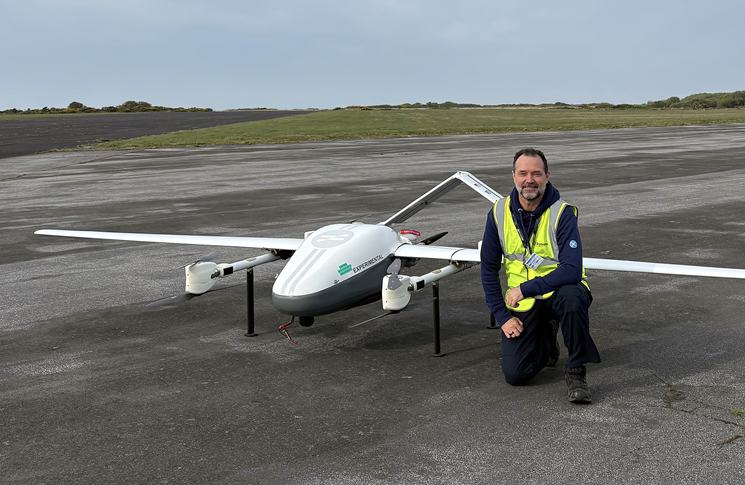
Grant Eaton wasn’t looking for a career in drones, but a chance encounter fired his imagination. He is now a highly qualified chief remote pilot responsible for safety in a large and expanding company. He went from the depths of the ocean to the sky, using his training to strengthen drone safety.
A chance encounter with a 3DR drone on a scuba diving course became his turning point. The former RAAF C-17 loadmaster was seeking a career in hospitality, but his first exposure to a drone changed the course of his professional life.
Eaton holds a remote pilot licence (RePL) and is now flight operations manager for Skyports Drone Services in Australia and acts in the role of chief remote pilot. The role enables the company to draw on his technical expertise and his safety philosophy.
He joined Skyports after working at Aviassist, where he qualified for his remote pilot licence. He also worked at Toll Uncrewed Systems as an instructor and in operations support.
At Skyports, Eaton oversees one other remote pilot and operations that cover a wide range of industries including offshore, maritime, rural and remote areas, survey, inspection and surveillance. These include aerial inspections and deliveries, each with its own safety issues to manage.
Skyports holds a remotely piloted aircraft operator’s certificate (ReOC).
‘We have helicopter, powerlift and fixed-wing all up to 25 kg, Agras medium category, multi-rotor up to 150 kg, and we’re working on BVLOS, which is still outstanding,’ he says.
For Eaton, that scale means safety processes and training must work across every aircraft type and mission.
As chief remote pilot, it falls to Eaton to ensure operational safety extends across all applications and operations. It is no easy task given the changing nature of the drone industry.
‘We’re lucky in having a small team at the moment because I can deploy on operations, which means I can control safety aspects,’ he reflects.
Eaton and Skyports recognise the safety critical nature of drone operations, especially when it comes to maintaining control of the aircraft and ensuring customer demands don’t take the aircraft outside the safety parameters.
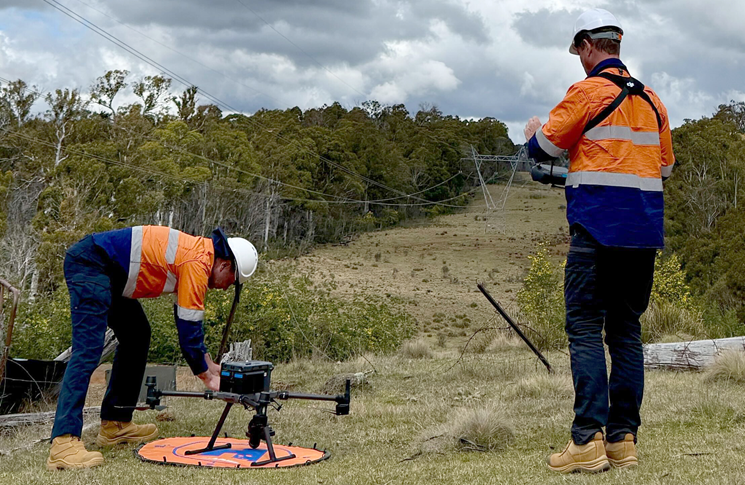
‘Everything is geofenced,’ he says. ‘In our pre-flight check, one of our steps is to announce the parameters, so if the drone is outside the parameter we can adjust it before flight.
‘Customer demands that are outside safe operations come up a lot. What we try to do is refer to the manuals. It’s not a case of being unwilling, it’s a case of sharing the knowledge about what is required.
‘If I say we can’t go within 30 metres of people, they may ask why, and we can step them through that.’
With drone and electric vertical take-off and landing (eVTOL) aircraft set to grow in the next 5 years, Eaton says the industry needs accurate data to support proper risk assessments. eVTOL aircraft use electric power to take off, land and hover.
‘It seems that people are wary of just about every scenario,’ he believes, ‘but the data is proving that drones are not dangerous.
‘So, we need that to drive decisions, it’s important for the future.’
Eaton’s years dealing with drones has given him a strong knowledge base. He shares his experience to help new operators speak up, learn from mistakes, and improve safety without blame.
‘The piece of advice I would give is to understand and execute on a just safety culture, we are all human and make mistakes, but better that everyone can learn from these experiences, rather than be exposed to repeating the same mistakes themselves.
‘Application of knowledge is power.’