
Aaron Pollard has loved flying and being around aircraft for as long as he can remember.
‘I have loved aviation since I was really little. My dream was to become a fighter pilot with the Royal Australian Air Force,’ he explains.
‘The dream I had originally didn’t quite work out but I wasn’t ready to give up on it yet.’
For Aaron, the next logical step was to fly commercially. He signed up in 2020 only to have COVID-19 turn his life upside down as aviation in Australia was put on hold.
‘I managed to get a job in retail to keep myself afloat and after a couple of years, decided to find out how aircraft worked,’ he says.
‘Ultimately, it’s my dream to become an air crash investigator with the Australian Transport Safety Bureau, so I thought learning how aircraft work and what it takes to keep them flying safely would be a good start. I believe engineers are the backbone of our aviation industry and our contributions are often overlooked. Now I love what I do and have discovered a real passion for ensuring safe flight.’
Aaron completed his Certificate IV in Aeroskills (Mechanical) at Aviation Australia and was lucky enough to land an apprenticeship as soon as he finished.
Keen to make up for lost time, he managed to complete what is usually a three-year apprenticeship in just a year and 10 months, by working smarter and a little harder.
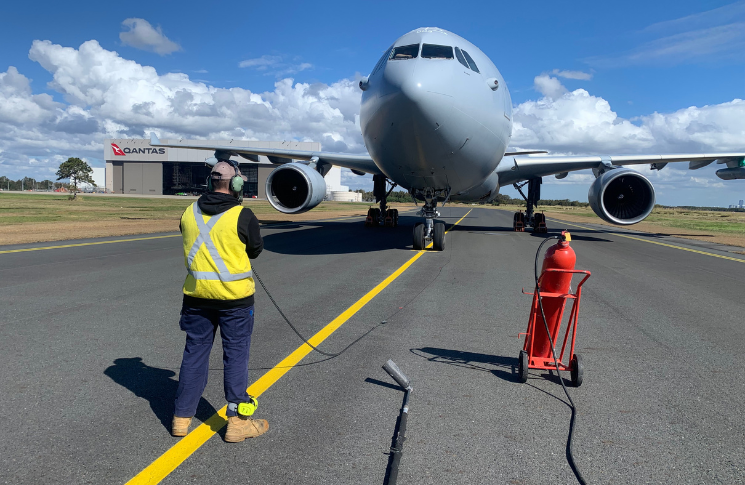
‘I did my 10 months at Aviation Australia and I loved it,’ he explains. ‘I was fortunate enough to get an apprenticeship with TAE Aerospace and then Northrup Grumman Australia so I had the chance to work on the Royal Australian Air Force’s Boeing F/A 18 Super Hornet, EA-18G Growlers and Airbus KC-30A multi-role tanker transport.
‘It usually takes up to 3 to 4 years to finish your apprenticeship, but I did it a bit quicker by putting in a fair bit of overtime and keeping a close eye on the maintenance schedules to get the experience I still needed.
‘Now I want to get my B1.1 licence to be promoted to a licensed aviation maintenance engineer at Alliance Airlines, where I work now, to work on their Embraer E190 fleet.’
That goal received a significant boost when Aaron was awarded the CASA aircraft maintenance engineer scholarship. The $5,000 support is helping him complete the remaining modules and practical components required for the B1.1 licence.
Aaron expects having his B1.1 will bring more opportunities.
‘It means I’ll be able to do more, be more useful and hopefully, be used more. I’ll be able to certify work as an individual so I can go out to a grounded aircraft, if necessary, to do repairs and certify them.’
Aaron had already completed essays or exams for 3 modules and 4 of the practical components necessary for the B1.1 licence, at his own cost.
Hoping for the best, he’d already booked in to complete another 8 practicals with Aviation Australia and was really pleased to be one of the lucky 4 chosen for the scholarship.
Right now, Aaron works both day and night shifts at Alliance. The fleet comprises Embraer E190 and Fokker 70 LR and 100 jets, operating charter and fly-in, fly-out operations for mining clients.
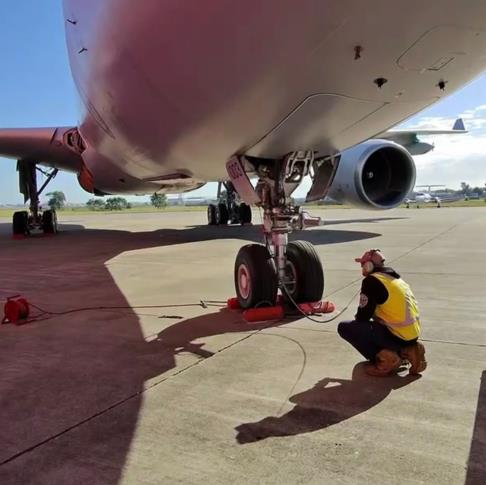
A typical evening’s work could include servicing the engines, lubricating the flight controls and rectifying any defects the flight crew have reported.
‘Any defects need to be rectified as soon as possible to get the aircraft back to flying, and my job is making sure it’s done correctly and safely,’ he adds.
‘It’s a really interesting job. You never know what is going to come up when you walk into the hangar each night.
‘My apprenticeship as a Defence contractor set the standard of very high workmanship. My standards haven’t changed and, at Alliance, we all turn out high-quality work while still getting aircraft out on time to make their next flight. It’s awesome to be a part of that.’
Once he’s achieved his B1.1 licence, Aaron will set his sights on the B2 (allowing individuals to certify maintenance on electrical, instrument, radio, and navigation systems), aiming to make himself a well-rounded engineer.
‘Everyone plays an important role in aviation, no matter where they work, but if we can’t fix ’em, pilots can’t fly ’em,’ he says.
‘I love that I now know how aircraft work and I’d recommend this career to anybody.
‘You work a hard night shift and go home, you’re dead tired and you check Flight Radar and see that aircraft you were working on earlier is back in the air and flying again. I don’t ever think about what could have been.’