
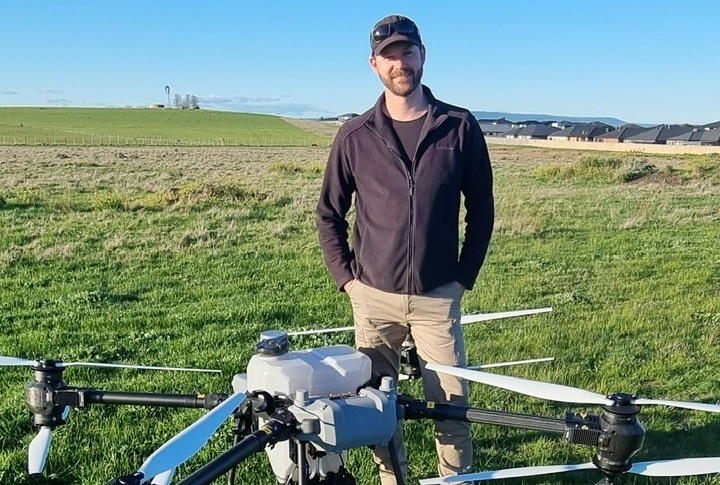
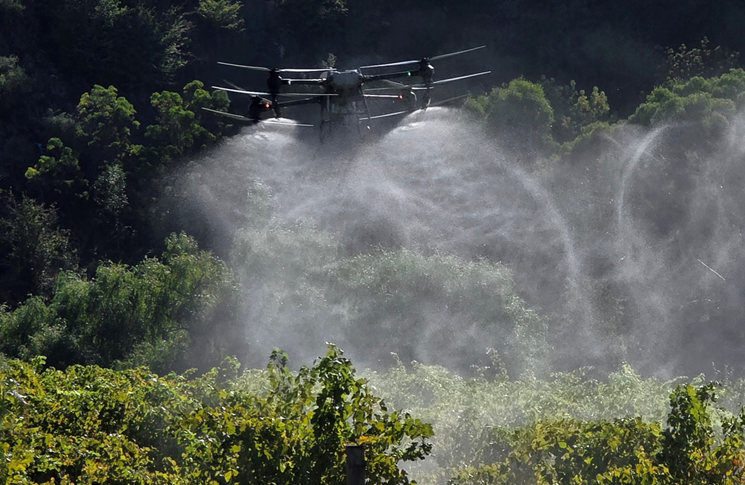
Agricultural drones are becoming a more practical and safer tool for farmers managing time-critical work. Ricky Connelly and his team at Velterra Drone provide spraying, seeding and mapping services that help growers work faster, lower risks and operate more precisely in challenging conditions.
Velterra is an agricultural drone services business working with broadacre farmers, vineyards, orchards and vegetable growers.
‘Our main customers are farmers and vineyard managers who need fast, accurate application of crop protection products in situations where traditional ground rigs may be too slow, too heavy for wet paddocks, or too risky for sensitive crops,’ Connelly says.
He says Velterra’s role is simple. ‘At its core, Velterra exists to give growers access to precision aerial capability without the cost and complexity of owning and operating the aircraft themselves.’
Sharing the airspace
Connelly says safe integration with crewed aviation is built into every operation.
In Australia, commercial drone operators must hold a remote pilot licence (RePL) and operate under a remotely piloted aircraft operator’s certificate (ReOC) unless working within an approved excluded category. Agricultural operations also involve strict procedures, including airspace checks, NOTAMs and weather review, and maintaining visual line-of-sight.
‘When operating near non‑controlled aerodromes, we broadcast on CTAF and if we sight crewed traffic, we descend and land immediately,’ he says.
Although agricultural drones generally operate below 5 metres, Connelly says separation relies on planning, situational awareness and conservative decision-making.
‘The safety culture in professional drone operations mirrors traditional aviation. Plan thoroughly and never assume you are alone in the airspace.’
Safety tips from the field
Connelly says safety is built into every agricultural drone operation. His approach highlights several practices that help keep drone work safe:
- Plan thoroughly and never assume you’re alone in the airspace. This includes checking airspace, NOTAMs and weather before every job.
- Maintain clear separation from crewed aircraft. When operating near non‑controlled aerodromes, his team broadcasts on CTAF. If they see crewed traffic, they descend and land immediately.
- Keep visual line of sight and operate conservatively. Agricultural drones often fly low, but situational awareness and conservative decisions remain essential.
- Follow aviation procedures and licensing requirements. Commercial agricultural operations require the appropriate certificates and strict adherence to aviation rules.
Efficiency and safety
Connelly says drones improve efficiency by reducing soil compaction and crop damage. They also allow access when ground equipment cannot enter paddocks due to moisture or terrain.
‘A drone can be operational within minutes and can treat specific zones identified through mapping, rather than blanket‑spraying entire fields,’ he says.
Safety is a key benefit. Operators are not exposed to chemicals in the same way as with traditional boom spraying, and there is no need to drive through dense crops or uneven terrain.
In vineyards and orchards, drones reduce the need to operate machinery in tight rows or on steep ground. Used correctly and in the right conditions, drones can apply lower water volumes with precise droplet placement. This helps reduce off-target drift.
‘It’s not about replacing existing systems – it’s about adding a safer, more targeted tool to the grower’s toolbox,’ Connelly says.
More than flying
Connelly says flying is only one part of the job.
Professional agricultural drone operators need knowledge of aviation law and airspace, meteorology, chemical handling and risk assessment. They also need maintenance skills, data interpretation capability and strong communication when coordinating with landowners, agronomists and nearby aerodromes.
‘In agriculture, understanding crop growth stages, droplet size selection and spray quality is just as important as stick‑and‑rudder skills,’ he says.
Looking ahead, Connelly believes drones will continue to integrate into mainstream aviation support roles.
‘The goal isn’t just to fly drones. It’s to contribute to a mature, safety‑driven uncrewed aviation sector that complements general aviation rather than competing with it.’
If you would like to feature in Drone flyer diaries, please email us.