
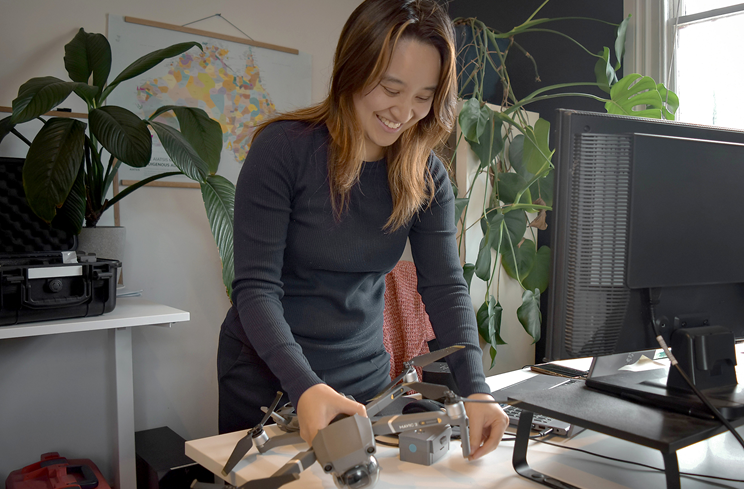
Helen Nguyen-Mullen uses drones to map and record archaeological dig sites, capturing artefacts, documenting excavations and helping preserve sites of cultural significance. It’s precise, meaningful work that sits at the intersection of technology and history. And it all stops the moment conditions aren’t safe to fly.
If it’s not safe to fly, we just don’t fly,’ she says.
As a GIS Officer at Andrew Long and Associates, Nguyen-Mullen consults developers and landowners on cultural heritage and archaeological services, including work with indigenous communities. For her, archaeology and technology go hand in hand, and so do flying skills and safety.
Nguyen-Mullen is clear about her responsibilities once the drone is in the air.
‘Safety starts off with me putting safety culture first,’ she says. ‘There can be a lot of pressure to get the job done, because we just take the photos, but there is still a lot more work that comes after.
‘But I tend to say that if we can’t fly today, then we’ll come back tomorrow.’
Nguyen-Mullen’s role involves flying the company’s drone over archaeological digs and heritage sites to survey and photograph the area once work is complete.
‘It’s mostly taking photographs and creating mosaics,’ she says. ‘Typically we create 2D mosaics of a site and occasionally take video. That enables us to create 3D models that show contours around the pits to help document the landform or excavation.’
Safety first
Safety starts well before anyone sets foot on site.
‘We discuss the job with the project managers to understand the requirements and where the drone needs to be flown,’ Nguyen-Mullen says.
Pre-flight preparation covers permits, stakeholder consultation and a formal risk assessment.
On the day, conditions are checked again.
‘We need to think about the landing and take-off zones; do we need permits? Who among our stakeholders need to be consulted about the drone flying? And as always we do a proper risk assessment of the site as well,’ she says. ‘After all of that and we get the OK to go on site, we also do an on-site assessment on the day because the flight conditions and the weather can change.’
Most heritage digs are held in open paddocks, which removes some hazards, but the sites have their own challenges. Ground staff are off-site for the duration of planning, flying and packing up, removing the risk of conflict with the drone.
‘There are already enough unexpected factors without unauthorised personnel on top of that,’ Nguyen-Mullen says. ‘One of the most challenging things about some of our missions has been dealing with wildlife. Even though sites are fenced, it’s impossible to keep out birds!’
Helen’s safety tips
Nguyen-Mullen has safety advice for new operators:
- Know the limits of your drone. It helps you explain to others why you can’t fly, or why you’re at the upper limit of what the drone can handle. It also helps you plan for the unexpected, which always happens.
- Have a spotter next to you while flying. It’s nearly impossible to watch for hazards and fly at the same time. An extra pair of eyes makes the whole mission safer.
- Always make sure your home point is somewhere safe. The automated home point may not be where you want it. Have an alternative landing zone ready, it’s one of the best safeguards against something unexpected mid-flight.
- Be willing to call it. It’s up to you as the pilot to say it’s safer to come back another day than to fly ahead. Safety starts with you.
If you would like to feature in Drone Flyer Diaries, please email us.