
Western Australia’s fisheries, farms and coastline stretch across more than 2.5 million square kilometres. Much of it is remote, exposed or hard to reach by boat, vehicle or light aircraft. Increasingly, the first set of eyes on a job is via a drone.
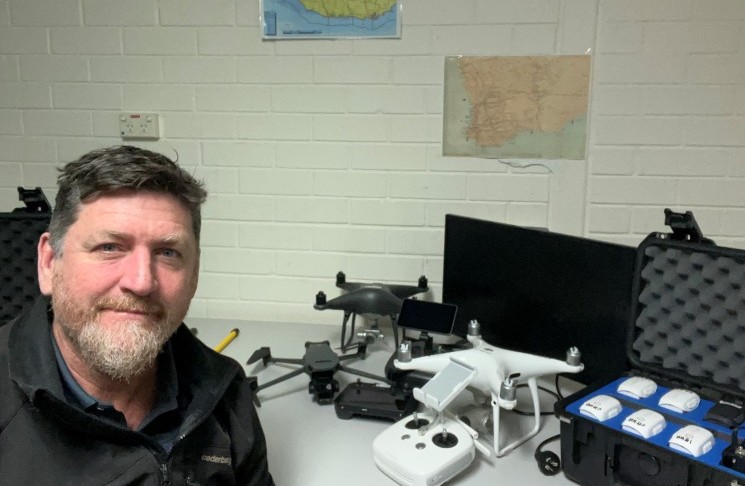
This is the world Mathew Hilyard operates in every day.
As chief remote pilot for the WA Department of Primary Industries and Regional Development (DPIRD), Mathew leads the department’s drone program statewide.
‘My role is to oversee the governance, safety and regulatory compliance of DPIRD’s remotely piloted aircraft system (RPAS) program, while leading and coordinating the department’s drone operations across Western Australia,’ Mathew says.
‘A big part of the role is working with business areas to identify opportunities where drone technology can improve safety, efficiency and data collection.’
Mathew spent years as a fisheries and marine officer, working in remote and challenging environments, before drones drew him into a new career.
‘Drones offered a completely new perspective and created opportunities to gather information more safely, efficiently and effectively than ever before,’ he says.
‘I became increasingly involved in exploring how drones could support DPIRD’s work and, over time, that interest developed into a career.’
Eyes from the Kimberley to the south coast
DPIRD’s drones support animal welfare and fisheries compliance, agricultural and marine research, biosecurity surveillance and shark hazard mitigation.
Capability is spread from the Kimberley in the north right down to the south coast, with around 100 pilots operating under the department’s remotely piloted aircraft operator’s certificate (ReOC). Keeping their operations safe and professional across such a large state is a significant part of Mathew’s job.
‘The optical advantage of working from altitude allows us to safely and efficiently observe large areas, providing situational awareness that simply isn’t possible from the ground or sea,’ he says.
Sensors including light detection and ranging (LiDAR), multispectral and thermal cameras are used. They let the department map landscapes, assess vegetation and animal health and monitor environmental change, often faster and more cheaply than other methods.
Drones also keep people out of harm’s way, allowing staff to assess hazardous areas, such as animal enclosures, without setting foot in them.
Looking ahead
‘I think we’re only just beginning to see what’s possible with drones,’ Mathew says. He believes a major area of growth will be beyond visual line-of-sight (BVLOS) operations and drone-in-a-box technology, which could bring more automated monitoring to remote parts of the state. He also points to growing interest in aerial spraying for weed control and biosecurity work.
His advice to anyone considering a remote pilot licence (RePL) is not to stop there. ‘It’s important to recognise that the licence is just the starting point,’ he says.
‘Safe drone operations rely on good flight planning, risk management, maintaining proficiency and currency, understanding emergency procedures and ensuring your equipment is well maintained.’
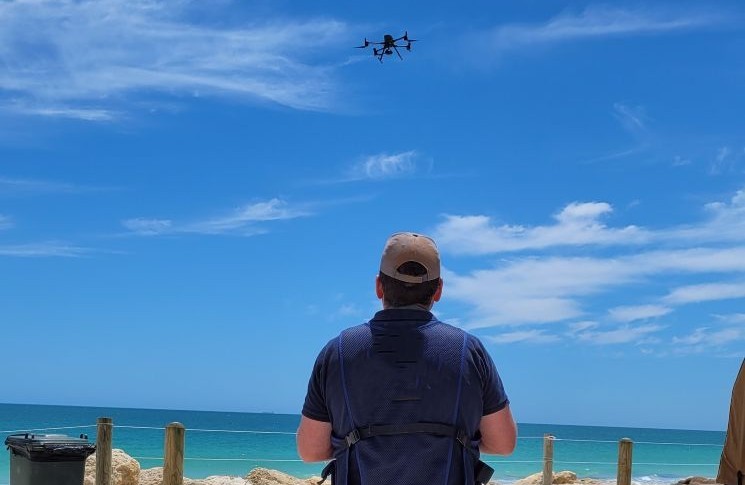
Mathew’s safety tips
- Preparation is critical. Before every job, understand the airspace, check the weather, identify ground hazards and build a clear plan.
- Keep your aircraft well maintained. Routine maintenance and pre- and post-flight inspections, within the manufacturer’s recommendations, are what make safe operations possible.
- Know your limits, and your aircraft’s. If conditions are not suitable, wait or come back another day.
- Understand your limitations more broadly. These can be regulatory, environmental, equipment-related or human performance factors, not just how well you can fly.
- Lean on the community. Seek out other remote pilots and industry professionals, ask questions and learn from their experience.
If you would like to feature in Drone flyer diaries, please email us.