

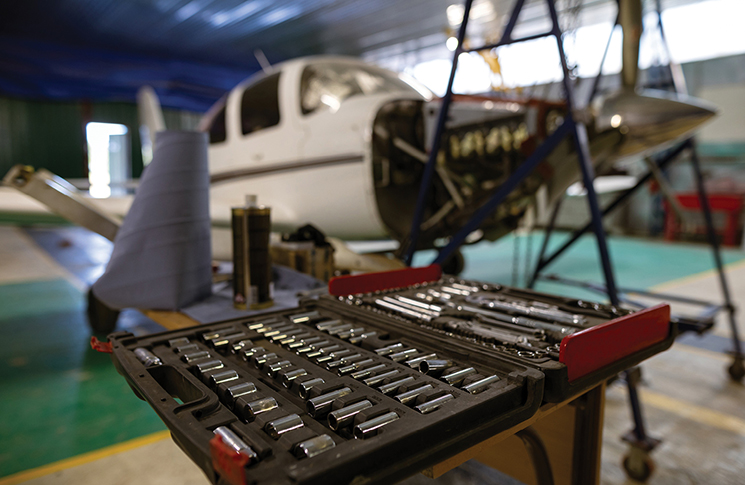
- If you are trimming plexiglass to fit into a non‑pressurised light piston aircraft, what is the best method to use?
- a reciprocating saw with a fine blade
- a circular saw with a coarse blade
- a band saw with a metal cutting blade
- a band saw with a fine-tooth blade
- The US FAA final rule for the Modernisation of Special Airworthiness Certification (MOSAIC) of light sport aircraft (LSA) became active in the US in July 2026. Which statement below is correct?
- these rules have been adopted fully and immediately by CASA
- these rules will never by accepted by CASA
- CASA is considering these rules positively for integration into the Australian environment
- CASA is considering these rules but will be unlikely to adopt them into the Australian environment
- Which of the following is not a benefit of the US FAA final rule for the Modernisation of Special Airworthiness Certification (MOSAIC) of LSA?
- LSA can have IFR capability
- LSA can have higher take-off weights
- LSA can have faster cruise speeds
- LSA can fly in class C and D airspace
- What are the effects of increasing altitude on a non-turbocharged piston aircraft?
- manifold pressure increases with altitude
- fixed-pitch propeller RPM increases with altitude
- indicated airspeed increases with altitude
- power increases with altitude
- What is the most likely effect of increasing altitude on a turbocharged piston engine aircraft with a constant speed propeller?
- manifold pressure remains constant until the critical altitude
- manifold pressure decreases above 6,000 feet
- propeller rpm increases with altitude
- propeller rpm decreases with altitude
- In a light aircraft that has a turbo-normalised engine, which of the following statements is true?
- the manifold pressure increases one inch per 1,000 feet to cruising levels
- the manifold pressure decreases one inch per 1,000 feet to cruising levels
- engine power drops off during the climb
- engine power is maintained from take-off to normal cruising altitude
- For a multi-engine aeroplane with an MTOW greater than 2,800 kg used in commercial operations, when must it normally be reweighed?
- every 2 years at the next scheduled maintenance inspection
- at the first maintenance release inspection or first scheduled maintenance inspection following the third anniversary of the last weighing
- every 4 years regardless of maintenance schedule
- only when directed by CASA
- When determining an aircraft’s empty weight and empty weight centre of gravity (CG), what does CAO 100.7 require?
- two consecutive and independent weighings with the load completely removed from the scales between weighings
- one weighing using calibrated scales
- three consecutive weighings with the aircraft repositioned each time
- one weighing verified by an independent LAME
- For an aeroplane, a load data sheet must be renewed before further flight if a modification results in:
- any increase in empty weight
- an empty weight increase exceeding 5 kg
- any change to the equipment list
- an empty weight increase exceeding 0.5% of MTOW or 10 kg, whichever is greater
- What calibration requirement applies to aircraft weighing scales under CAO 100.7?
- the scales must be calibrated every 6 months
- the scales must be calibrated within the previous 12 months by an approved organisation or the manufacturer
- calibration is only required after repair of the scales
- calibration is only required for aircraft with an MTOW greater than 5,700 kg
- For an operator establishing fleet (weight and CG) values for a fleet of aeroplanes under CAO 100.7, which statement is correct?
- fleet (weight and CG) values may be established using only the newest aeroplane in the fleet
- fleet (weight and CG) values must initially be established using the current weight and CG of each aeroplane in the fleet
- fleet (weight and CG) values are based on the manufacturer’s published empty weight for each aeroplane
- fleet (weight and CG) values may be established using the average weight only; CG is calculated separately for each flight
- When changing a tyre on a light aircraft, what is the normal practice?
- align the tube stem opposite the red dot on the tyre
- align the red dot 45 degrees clockwise from the stem
- align the tube stem with the red dot on the tyre
- the relationship between the tube stem and the red dot is not significant
- Nose wheel shimmy is a constant problem on light aircraft. Which one of the following is correct?
- some wear in the torque links is acceptable and won’t contribute to the shimmy
- dynamically balancing the nose wheel does not assist in reducing nose wheel shimmy
- the shimmy damper should be fully serviced and working in accordance with maintenance manual limits
- new-style shimmy dampers that are not fluid filled, are expensive, and are not worth installing in preference to the OEM shimmy damper

