

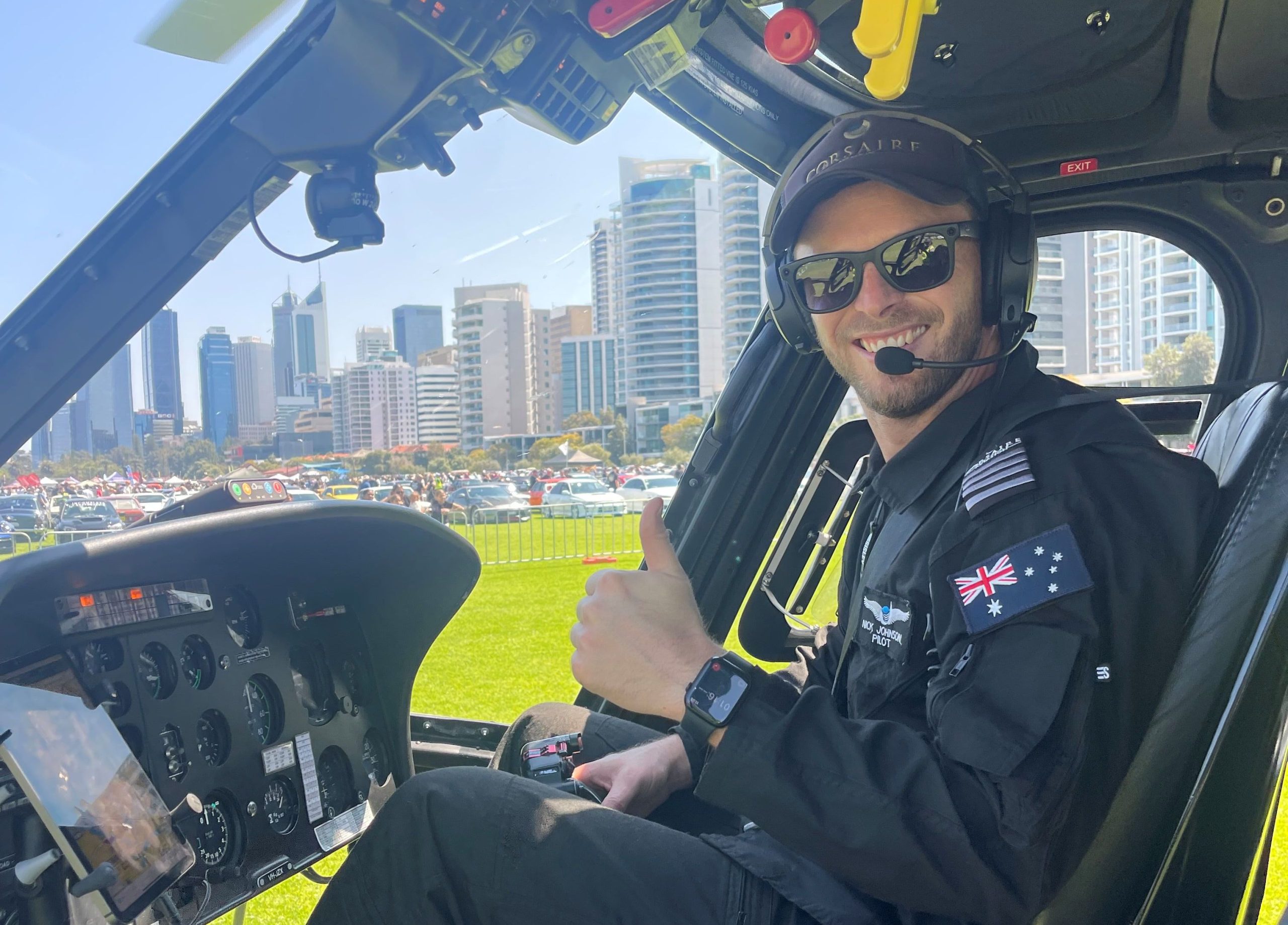
Name: Nick Johnson
Role: Safety Manager (Group) & Quality Manager (Flight Operations) / Commercial Helicopter Pilot
Company: Corsaire Aviation Group
Tell us about your operation and your role as a safety manager
Corsaire Aviation Group is a reasonably diverse aviation business based in Western Australia. Across the group we have fixed-wing charter, helicopter operations, flight training and supporting maintenance activities, with bases and operations out of Jandakot, Newman, Dongara and Exmouth. That diversity is probably what makes the job so interesting. The risks and operational pressures associated with flying a helicopter in the Pilbara are quite different to those of a fixed-wing charter flight, or maintaining a new aircraft type, but we still need a consistent and universal approach to managing safety.
I’m a commercial helicopter pilot as well as the group’s safety manager and quality manager for applicable flight operations. I’ve been in the aviation industry for 9 years now, and in a safety capacity for the past 4, starting as a safety officer for the rotary division and progressing into the SQM role after receiving the CASA safety scholarship in 2025. I’ve always had a particular interest in safety even in my previous career as an electrician, however, it wasn’t until I knew a couple of people involved in fatal aviation incidents that my desire to contribute to aviation safety peaked. I have acted on that desire and am very passionate about ensuring everyone goes home safely at the end of the day. The safety manager role is a great platform to achieve that positive contribution.
My role covers the practical running and improvement of our safety management system including reporting, investigations, risk assessments, management of change, safety meetings, audits, assurance and helping operational managers close the loop on actions. The quality side brings an extra focus on whether what we say we do in our manuals is actually what happens in practice. I am still able to maintain my currency across all our flight line operations and find that operational/out in the field experience further assists my ability to assess risks and safely manage aviation operations.
What was your focus when you first started in the role?
When I first moved into the role, my priority was to get a genuine understanding of how the business operated, beyond what was written in the manuals. I already had a pretty good understanding of the rotary safety requirements, but becoming responsible for the wider safety system meant looking across multiple operations and trying to understand where the real exposures, inconsistencies and opportunities were.
I started from the ground up, reading our SMS manual word for word, understanding it and understanding what it meant for both myself, other employees and our organisation as a whole.
I then looked at how we practically did the things the manual said, and continued ensuring they were being done, or strengthening areas that had room for improvement.
I also wanted to make the system more approachable. There can be a perception that safety management is mainly paperwork, particularly in a busy operational environment. Getting employees involved in the SMS was a big focal point. One of the key methods of achieving this is through our reporting processes. I wanted staff to see that putting in a report or raising a concern could genuinely lead to a change. We achieved this by responding to people, following through and communicating what happened as a result.
What has been your biggest challenge as a safety manager, and what did you learn from it?
One of the biggest challenges has been finding the balance between maintaining a robust, compliant system and keeping it practical for the people who actually use it. We’re a relatively small team supporting a fairly broad operation, and the same managers and pilots who contribute to the safety system are also trying to keep aircraft, training and client work moving. There’s never a shortage of things you could investigate, audit, review or rewrite.
I’ve learnt that the volume of safety activity isn’t necessarily a measure of how effective you are. You can spend a lot of time generating forms, action items and meetings without changing the risk. I’ve had to become much more disciplined about prioritising, getting the right operational people involved and making sure actions are realistic and effectively completed.
Another challenge is turning manuals and risk registers into living documents that staff genuinely know, understand, and use. This becomes particularly difficult as businesses expand and operations become more complex.
I’ve learned that short and direct training, email correspondence, toolbox meetings and open communication are effective ways of getting these items out onto the hangar floor. It’s really pleasing when you can see the resulting positive safety culture eventuating from these sorts of implementations.
Can you share an example of where your SMS helped improve a safety outcome?
One of the more positive outcomes I’ve seen from our SMS has been the improvement in proactive safety reporting and our Management of Change (MOC) processes.
We’ve placed a strong emphasis on encouraging personnel to report hazards, raise concerns and suggest improvements before they develop into more serious issues. It’s been pleasing to see greater engagement across the organisation and a willingness to speak up.
Our MOC process has also been particularly valuable in managing operational changes, whether that’s introducing new aircraft, expanding operations or making changes to existing procedures. It allows us to identify risks proactively, involve the appropriate personnel and ensure suitable controls are in place before changes are implemented.
For me, that’s where an SMS adds real value. It should be less about creating a paperwork burden and more about establishing practical processes and procedures that genuinely help identify, manage and mitigate operational risks.
How have you built support for safety across your organisation, from operational personnel to senior leaders?
I think credibility is a big part of it. Having a flying background helps because I can talk to pilots and engineers about what a task actually involves, but that only gets you so far. People need to know you’re prepared to listen, that you understand the pressures they’re under and that raising a concern won’t automatically turn into a blame exercise. We have 3 cultural pillars built into our SMS that have helped achieve this, a reporting culture, a just culture and a learning culture.
We also use regular safety discussions, toolbox meetings, safety bulletins, safety share emails (CASA and the ATSB are great resources for this), investigation feedback and formal safety committee meetings to keep safety front of mind.
At the leadership level, an area of particular focus has been communication. Open and timely communication is a key piece in any successful business or practice, and that certainly stands true for safety. ‘The only failures are the ones we don’t learn from’ is one of my favourite sayings, and emphasises the importance of sharing learnings, positive safety outcomes, investigation findings (where appropriate) and areas for improvement alike.
How do you decide where your time will have the greatest safety impact? For example, how do you balance operational pressures with safety priorities?
I try to ask a fairly simple question, ‘where can I make the biggest difference to the risk we’re carrying right now?’ That normally means prioritising issues with the potential for serious consequences, emerging trends, significant operational changes and matters that could affect personnel or aircraft. A quick risk assessment using our company approved matrix is a good tool to use when answering this question.
The diversity of the group makes the balance of operational pressures and safety priorities particularly important. We have remote operations, different aircraft types, training activities, charter commitments and people working across several bases. I use reporting trends, audits, operational feedback, risk assessments and regular direct conversations with managers and crews to build that picture. I also try to avoid assessing risk purely from behind a desk. Context matters enormously. As a safety manager, we are never going to know or understand every little detail for every operational piece, so it’s really important to be inquisitive and ask questions if you’re unsure.
What CASA resources have you found most useful and why?
The most useful resource I have found is CASA’s safety hub newsletters and online training material. The safety hub newsletter and its contents are a particularly convenient and effective way of passing on relevant safety information to pilots and staff. There are practical and scenario-based learning exercises in there which enhance overall safety and understanding of different operational envelopes.
The online training available through the AvWorx portal is also particularly useful, with an honourable mention to the human factors and non-technical skills workbooks they have available for both flight operations and engineering divisions.
Looking back, where do you think you added the greatest value as a safety manager, and what difference did it make to the organisation?
I’d like to think the greatest value I’ve added has been helping connect the formal safety system to what happens operationally. Because I’ve worked as a pilot, I’m comfortable challenging a procedure that might look fine on paper but doesn’t quite make sense in practice, and equally comfortable explaining to an operational team why a control or regulatory requirement really matters.
A lot of the progress is in relatively unglamorous things such as making reporting and investigation follow-up more consistent, improving the visibility of actions, keeping risk assessments current, bringing different parts of the organisation into the same conversation and using audit findings as an opportunity to strengthen the system rather than simply close a finding.
Through those workings, there has been a positive shift in an already strong safety culture. Our reporting numbers well exceed our KPI targets, our trends for MOC development have increased drastically, management have greater oversight of safety across the broader organisation, and we have (for the first time since the business’s inception) achieved a rolling annual trend of more hazard reports than incidents which indicates proactive risk management.
If you were starting as a safety manager again tomorrow, what would you do in your first 30 days?
I’d spend the first month listening and observing before trying to change everything. I’d meet the CEO and operational managers to understand the business, then spend as much time as possible with pilots, instructors and the people doing the work. I’d want to know what they see as their biggest risks, what frustrates them about the current system and whether they trust that reporting something will lead to a fair response.
At the same time, I’d do a practical health check of the SMS, looking at the manual itself, recent occurrences and investigations, open actions, the risk register, audit findings, planned changes, key safety performance measures and the actual flow of information between operational teams and management. I’d pick a few reports and follow them from submission through to close-out.
By the end of the 30 days, I’d want a short, realistic set of priorities agreed with leadership, with clear owners and due dates. I’d also aim to close the loop on at least one issue raised by frontline staff and explain what changed. Early trust is worth a lot more than releasing a completely rewritten manual that nobody has had time to understand.
What’s one thing you wish someone had told you when you started as a safety manager?
Just because you’re the Safety Manager doesn’t mean you’re the only person responsible for safety within the organisation. Use that as an opportunity to bring people together and encourage a collaborative approach to managing safety.
You can lead the way, provide guidance and drive improvements, but ultimately, the most rewarding outcome is seeing a living, breathing SMS that everyone has bought into, actively contributes to and takes ownership of.
What is one practical action a safety manager could take this week to improve safety in their organisation?
Create a company survey based on safety related items, including questions about the greatest risks in the business, , culture and areas for improvement. This should be done anonymously and come from a genuine place of wanting to identify and improve. You’d be surprised at what a fresh set of eyes can bring to your attention.
The survey is a great starting point in identifying potential areas for improvement within any business and can lead to meaningful growth.