

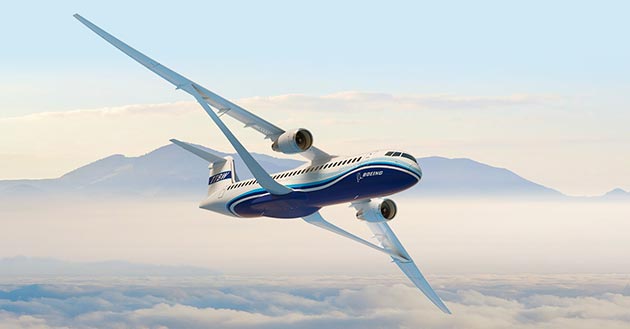
Designed to be more aerodynamic and fuel efficient, Boeing has unveiled an ultra-light wing that they hope will reduce fuel burn by 60 per cent.
Called the Transonic Truss-Braced Wing (TTBW), this new concept was presented on Tuesday at the American Institute of Aeronautics and Astronautics (AIAA) Science and Technology Forum and Exposition in San Diego, California.
For nearly a decade, the world’s largest aeroplane maker Boeing has been collaborating with the US space agency NASA as part of the Subsonic Ultra Green Aircraft Research Program to develop concepts that will reduce aircraft noise, emissions and fuel burn while enhancing performance.
The Transonic Truss-Braced Wing is a folding wing that measures 52 metres (170 feet) from end to end. The high wingspan is made possible by the presence of a truss, which supports the extended length of the ultra-thin wing in a design reminiscent of biplanes from the early years of aviation, or the evergreen Cessna 172.
Originally, the TTBW was designed to fly at speeds of Mach 0.70–075 but tweaks to the plane’s design that adjust the wing sweep angle and allow the truss to carry lift more efficiently, allows it to fly at speeds of Mach 0.8, or about 965 km/h (520 knots), slightly faster than previous designs but faster than some current passenger jetliners.

Comments are closed.