

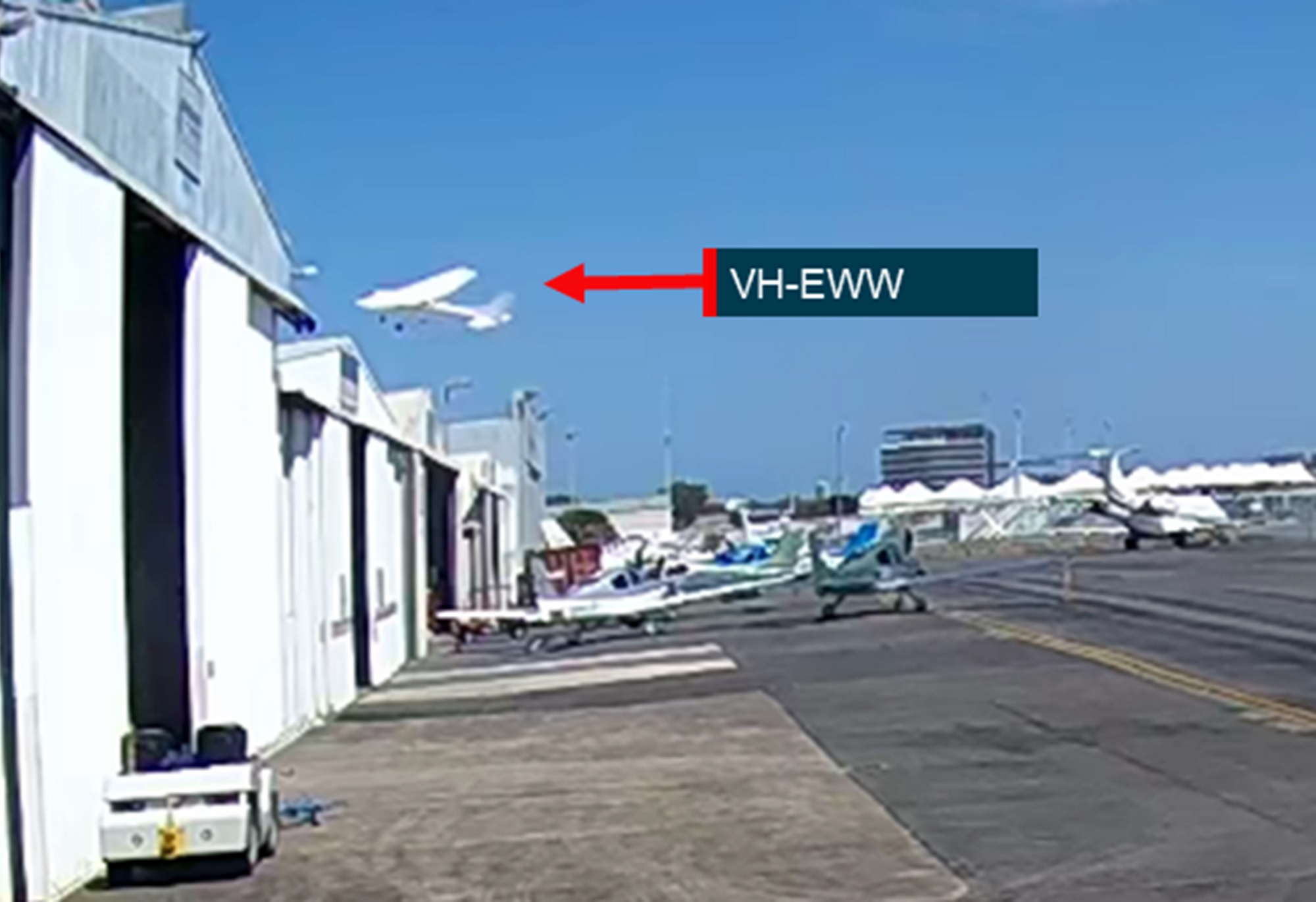
A chain of misunderstandings and miscalculations brought a student and instructor terrifyingly close to a hangar during a go-around after a tail strike. The incident happened in February this year at Gold Coast Airport, Qld.
The Australian Transport Safety Bureau (ATSB) published its report into the incident yesterday, which missed being a major news story by only a few metres.
The student and instructor were returning to the airport from a training flight when they received an initial air traffic control clearance to track direct to runway 32.
From the ATSB report: ‘About 40 seconds later, the flight crew accepted an amended clearance to track to the shorter runway 35 at “best speed”. When VH-EWW was at 1,000 ft and 1.9 NM from the runway 35 threshold, the flight crew were cleared to conduct an approach and maintain ‘best speed all the way in to crossing the runway’. Unsure how to comply with that instruction, the instructor directed the student to reduce the throttle to idle and lower the aircraft’s nose.’
‘The aircraft subsequently passed about 100 ft above the runway threshold at about 25 kt faster than the normal approach speed,’ ATSB Director Transport Safety Stuart Macleod said.
It floated along the runway before it touched down and bounced once.
As the end of the runway neared, the instructor took control of the aircraft from the student. The instructor attempted to brake and turn the aircraft onto a taxiway beyond the end of the runway. During this manoeuvre, the aircraft veered off the taxiway towards a ditch. In response, the instructor applied back pressure on the control column and full power for a go-around, during which the rear fuselage and tail struck the ground. Security footage shows the aircraft missing hangars by a few metres. The flight ended with a right circuit and landing on runway 32.
The ATSB found the aerodrome controller issued the ‘best speed’ instruction to the VH-EWW flight crew to facilitate traffic flow and allow it to land before an inbound Boeing 737. The controller had expected the Cessna crew would maintain a higher speed until the aircraft was a bit closer to the airfield than normal, and then reduce speed appropriately to make a safe landing.
McLeod said, ‘Although not standard phraseology, air traffic controllers may ask pilots to maintain “best speed”, and it is up to the pilot to determine what is best in this context, and more generally advise if an instruction is unclear or cannot be complied with.’
The ATSB final report notes the aircraft exceeded the speed for a stabilised approach, but the instructor did not conduct a go-around prior to landing, or while on the runway.
‘When operating in visual meteorological conditions, if an approach is not stabilised by the height specified by the operator – or generally by about 500 ft above the ground, or the approach becomes unstable after that point, go around,’ Macleod said.
‘Pilots are to always be ready to conduct a go‑around during the approach if any desired flight parameter, such as aircraft configuration, vertical speed, airspeed, or attitude, cannot be achieved.’
Controlled aerodromes and operations
Controlled aerodromes and operations is one of the special topics on our Pilot safety hub.

Comments are closed.