
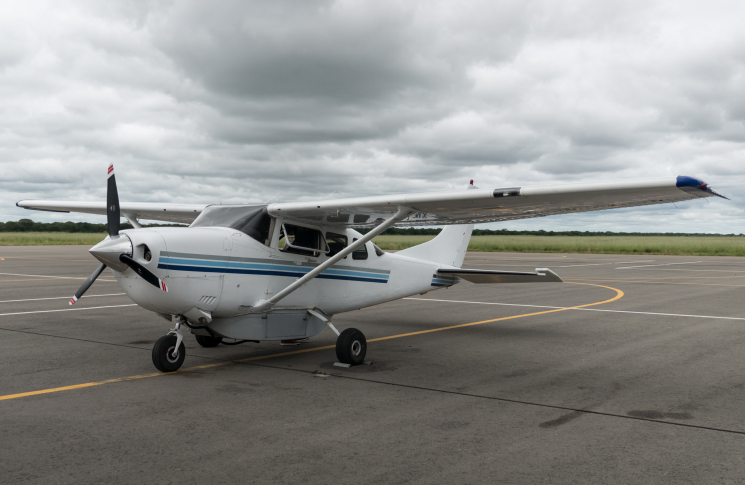
With 5 souls on board (including 2 daughters), risk-averse private pilot Robin Hilliard flew a Cessna 206 into Shellharbour Airport in NSW.
Nearing departure, a strong westerly wind developed. Hilliard asked locals what to expect near Shellharbour’s unique terrain, which is surrounded by a spectacular escarpment. They warned of possible sink caused by air falling off the cliffs to the west of the airport. Hilliard planned to use runway 26 and depart overhead to return to Bankstown. His track included 13 NM of dense bushland.
‘The pre-flight, checklists, run-ups and departure were all normal’, he says. ‘Even with the 5 of us, the 300 hp Continental made light work of the initial climb. However, nearing the escarpment, the aircraft was not climbing. With no adverse instrument indications, I assumed I’d encountered the sink.’
At 5 miles out, Hilliard felt a growing disconnect.
‘Surely sink couldn’t explain the whole loss of climb performance?’ he asked himself. ‘Does the engine sound normal? Is that a smell in the cockpit? There were no bad instrument readings. No new noises. Nothing.’
He says some great aeronautical advice came to mind. ‘If you can’t work out what’s going wrong, ask yourself what’s going right?’
‘The decision immediately made itself,’ Hilliard says. ‘I was in command of an aeroplane not climbing well, approaching bad terrain, with 5 people on board. Too little was going right, but I had a perfectly good runway behind me.’
With the engine still running and no clear fault, Hilliard focussed on maintaining height and carefully turned back.
But how did he come to that decision?
Decision-making
Some factors that influence decision-making include:
- experience
- attitude
- social pressures
- self-image
- emotions
- intuition
- cognitive biases, for example:
- confirmation bias: favouring information supporting existing beliefs
- anchoring bias: overemphasising initial information received
- plan continuation bias: adhering to an original plan even when conditions change
- automation bias: excessive dependence on automated systems.
The process
‘LifeFlight’s human performance manager Tarryn Ryan says the foundation of good decision-making is situational awareness. ‘And the first level of situational awareness is information gathering’.
Hilliard perceived the problem, gathered the facts and linked this with sound advice. This helped him make a safe decision, to turn back to the airfield. This process can be explained through various structured decision-making models, highlighting their importance to safety.
Structured decision-making models
‘Structured decision-making models are important because when things go wrong, they usually go wrong quite quickly,’ Tarryn says.
‘Add in our natural stress response and the ability to think rationally becomes hindered. We need to use something simple to bring us back to a more down-regulated state.’
Aviate, navigate, communicate is one of aviation’s most memorable models. ‘Hilliard demonstrated this,’ Tarryn says. ‘Focussing on what he did have and then navigating to somewhere he knew he could land.’
Here are 3 other aide-memoirs:
3Ps
- perceive the circumstances
- process the impact
- perform the necessary action.
DECIDE
- detect the change
- estimate the need to react
- choose (a desirable outcome)
- identify actions to undertake
- do the action(s)
- evaluate the situation.
PILOT
- pool the facts
- identify the problem
- look for solutions
- operate
- take stock.
The factors and the outcome
In one way, Hilliard was fortunate. As a low-hour pilot with about 300 hours, he didn’t have the experience to spend critical time working out what was going on. He briefly fell into confirmation bias by assuming the problem was the sink and was at risk of automation bias by trusting the gauges. But he avoided continuation bias.
‘Confirmation bias is a common trap,’ Tarryn says. ‘We convince ourselves what we are seeing is because of a, b, or c. Instead, we should take a breath and actively seek information that may contradict the initial assumption.’
Hilliard also had other knowledge, the good piece of advice. This gave him the push to act. It was the right decision. One of the 206’s cylinders had melted due to a blocked injector. The engine producing so little power that the resulting landing was essentially a glide approach.
Resources for flight planning
Flight planning resources are a focus of CASA’s Your safety is in your hands campaign. For more guidance, tools and tips, be sure to visit the pilot safety hub.