

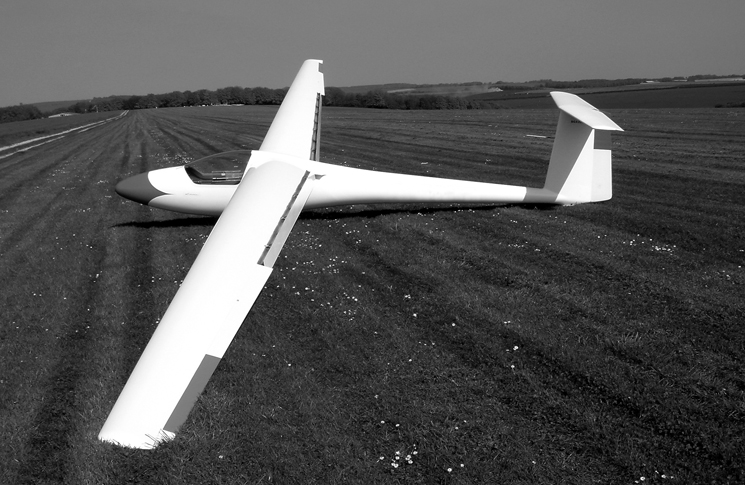
A glider jaunt turns serious.
I arrived at the airfield at around 11am on a blue, but soarable day, and found several club members already on site. The club has two single-seat gliders for club members, a Libelle and a Jantar.
The Jantar had been used at another site the previous week and was still in its trailer, so another member and I thought it would be helpful to rig it so that there were two single-seaters available. It was one of those wonderful calm days on the airfield, clearly soarable, but no one was in a rush; everybody was relaxed and looking forward to having a fly.
We proceeded to rig the Jantar, with some assistance from other members. As far as I remember, I had only helped rig the Jantar once before. Once it was together, the duty instructor attached the tail, as it was fiddly, and I connected the all the controls using the l’Hotelier connections.
Despite having around 220 hours in total (at the time) I have only really ever flown club gliders and not really been involved in much rigging and de-rigging.
I ‘daily inspected’ the aircraft as another member double-checked the controls as per club procedures. We then both did a positive check on all the controls (both ailerons, elevator, rudder and airbrakes). A positive check involves one person holding the control surface steady while another tries to move the stick. If the controls are connected properly there should be continuing resistance. It all seemed fine to us and it was towed out onto the airfield.
After lunch, I pulled the Jantar out onto the flight line and completed the standard pre-flight checks as normal. The take-off and release was normal, with the tug pilot towing me into a large thermal at around 2500 feet (QNH).
An enjoyable soaring flight followed. The thermals were all blue with no telltale cumulus marking the spot, so I pottered around and climbed to the top of the lift at around 5500 feet. I stayed relatively near to the airfield, as I was not too concerned with heading off anywhere.
After around an hour and a half, I decided to head back to the airfield and land. As I was around 5000 feet, I decided to do some manoeuvres on my way back. I often do this if I have height to use, carry out some stalls, practise my sideslipping, perhaps even a spin if I feel like it. I completed my pre-manoeuvre checks and completed three stalls. As I was preparing to practise a sideslip there was a loud bang.
Immediately the aircraft began a strong shaking and the stick felt a bit loose in my hand. Looking at the wingtips I could clearly see that they were flexing up and down repeatedly.
My immediate thought was that something really serious had happened with the controls and that I may need to bail out. That’s not a nice thought. Suddenly the ground looked a long way away and very hard and unforgiving.
Before doing anything else, I checked that my parachute straps were tight and I visually located the canopy jettison handles, thinking that if I did need to get out, I would be in a hurry. I ran through my vague recollections of the bailout advice I read years ago: how to pull the rip-cord, how to land properly, how to roughly steer the parachute etc. This all happened in just a few seconds. Funny what your head retains for possible use one day.
I then decided to explore my second option, which was to fly the glider. I gently tested the controls with very minimal movement, and ascertained that I had normal elevator control (thankfully), normal rudder control and decent aileron control. The airbrakes worked and had the effect of reducing the shaking. The aircraft was responsive; the speed was steady at 55 knots, so other than the strong shaking and tip flexing, the aircraft seemed OK. I wondered if I would be able to land it, considering that it may be flying well now, but might go all wrong at 500 feet, far too late to jump out. I tested the controls once more and could hear something loose moving around when I used gentle aileron.
So decision time—can I land this?
I thought that if I made very gentle control movements and did not do anything sudden, then I should be fine to land, but I was concerned that whatever was loose might jam somewhere, restricting the stick. Not what I wanted at 300 feet on final approach. I decided to carry out a mock approach while still at height. Better to find out now. I lowered the undercarriage and then gently opened the airbrakes to full, all while maintaining 55 knots. The aircraft was stable and flew pretty well.
OK, so the glider flies fine … let’s land.
My reasoning was that I still had plenty of height, and getting closer to the airfield would help if I did lose control and had to bailout anyway. I flew straight to the airfield and made an upwind circuit, with the gentlest of turns. I felt that maximising my chance of jumping out was the best I could do, given that was my only other option. I planned the circuit to turn on to final approach at 1000 feet which I reasoned would give me enough height to bailout if I decided I was not going to be able to land it safely.
Making my final turn the aircraft seemed fine, so I decided that I could land it and opened the airbrakes.
The approach was nice and stable (other than the shaking) and I rounded out pretty much on the threshold of the tarmac of runway 12, coming to halt just beside the launch-point. Perfect. I was never so glad to get on the ground and I couldn’t get out of the glider fast enough. So what went wrong?
Following the landing, it was discovered that the left aileron had become disconnected at the l’Hotelier connection at the wing root. L’Hotelier connections are notoriously fiddly. They are not visible once the glider is together and so you rely on feel to ensure they are connected. That and an independent check followed by a positive control check. From my recollections of how I connected them, and then playing with them once we pulled the glider apart and could actually see them, we surmised that it was possible to have the l’Hotelier fully in place, but the spring not properly locked, despite it feeling as if it was. That allows the sleeve on the connector to slowly rotate, retract and hence disconnect. That allowed me to fly for over an hour and half before anything happened.
So, what have I learned?
- It is quite amazing how your training and simple logic takes over in something like this. Yes, I was scared, but almost immediately my mind got into the task and broke things up into little tasks to complete, all with the aim of keeping my options as open as possible as long as possible. All by itself! Thanks to all my gliding instructors over the years for that I think.
- Decisions Make positive decisions quickly. My constant overriding thought at the beginning was that I could lose control of this aircraft at any time, so I needed to decide what I was doing and do it.
- Training How many times do you open and close the canopy, but not really take note of exactly how to jettison it? And where is that ripcord? Many years ago I read Derek Piggot’s account of bailing out of a glider and it all came rushing back to me up there.
- Check check and check again. L’Hotelier connections are notorious in the gliding world for a reason. They can be very fiddly. Check them multiple times before flying and get an independent check. Then check them again.
- Have a look at control connections whenever someone has one out. No amount of gesticulating and simulating with hands and fingers can emulate how these connections work.
- This is something you think happens to pilots in a rush to get airborne, desperate to get going. I was not that at all. I took my time rigging the aircraft. I had lunch. Relaxed. So it can happen anywhere at any time.
- Learning never stops.
I am fortunate that this ended well. It could have been much worse, but the incident has helped me focus on my training and has helped the club improve its procedures around rigging, as well as training pilots in how to bailout if they ever need to.
And I will continue to enjoy flying. Yes, I was scared, and never happier to be on the ground, but I still love flying.

Comments are closed.