

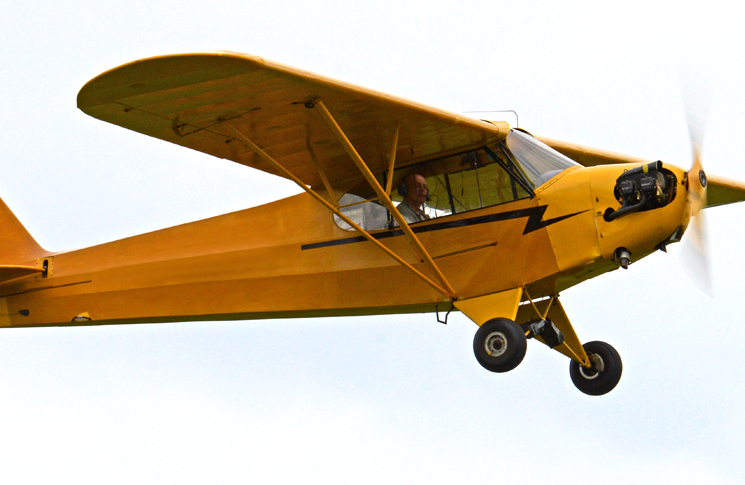
Several years ago, my father was visiting from overseas and we were both keen to attend a small fly in and airshow prior to him returning. I booked the Cub for the whole day. The destination was only about one hour away, and the flying display started at 1400. Plenty of time …
We woke up early and set off to the airfield. The weather forecast was for good conditions with a light wind but as we were getting the aircraft ready, the cloud base looked a lot lower than expected. Since we still had time to spare, I decided to wait a bit, hoping the weather would improve. Eventually after several cups of coffee, it looked slightly brighter, so we decided to give it a go as time was ticking on. By now, the wind had picked up quite a bit. It was not as forecast, but it was down the runway. At least the runway of our home airfield anyway!
After a pleasant flight we eventually arrived at the destination and landed just prior to 1400 when the airfield closed for the flying display.
After a nice afternoon watching the display and chatting to a few other owners we slowly got ready to depart. The sky looked fantastic—sunny with a few puffy clouds at about 5000 ft. The wind was however quite strong and at this airfield it was 90° across the runway and gusting.
I started the take-off roll with the stick hard back and slight into wind aileron and smoothly applied full power. The Cub started to roll normally but as soon as the tail began to lift the aircraft began to veer rapidly to the right, into the wind. I fought for all it was worth with full left rudder to prevent a rapidly approaching ground loop.
We departed the sealed runway and ran onto the grass runway which was alongside. Fortunately, there were no runway lights or other obstructions for us to hit. As we bumped across the grass the nose started to pitch forward towards the ground. I just managed to regain control enough to bring the tailwheel back down, albeit with a bump.
Just when I thought I had directional control back the aircraft suddenly began to veer in the other direction. Again, I fought it with all that I had and eventually, after a struggle, the aircraft crossed back onto the hard runway again and finally became airborne. After shakily climbing away we had an uneventful flight home and a smooth landing on a (thankfully) into-the-wind home runway.
So, what had gone wrong and why? I viewed the video footage of the take-off which my passenger had filmed. Hindsight is a wonderful thing. I could already see a few things which I should have done a lot better.
During the taxi the video showed the horizontal windsock, so the wind was at least 15 knots at 90° to the runway and gusting stronger. The Cub flight manual says max demonstrated crosswind is 10 knots. I’ve heard many pilots argue that ‘max demonstrated’ is not an actual limit. Most pilots probably think they can handle stronger crosswinds and I suppose I was one of them. In this case I had exceed the limit of my skill level. I certainly will use ‘max demonstrated’ as a hard limit now.
In any crosswind you must ensure you use sufficient into-wind aileron. When I watched the video, I realised I probably only had a quarter deflection. It wasn’t enough. More aileron means more weight on the into-wind wheel helping keep the aircraft tracking straight on the ground. It also stops the wing from lifting.
If it is all going wrong on a take-off then close the throttle and stop. For some reason stopping never crossed my mind but was probably the safest thing to do.
I suppose the sun and fabulous looking sky had lured me in to thinking it was great conditions for flying. Combined with the fact that we needed to be home, we decided to give it a go.
Get home-itis. We have all heard about it and like me, most people think they won’t succumb to it. I was one of them!
It can creep up on you very easily without you even noticing. Always be aware of it, even on small trips. There is always another day to fly or another way to get home.

Comments are closed.