

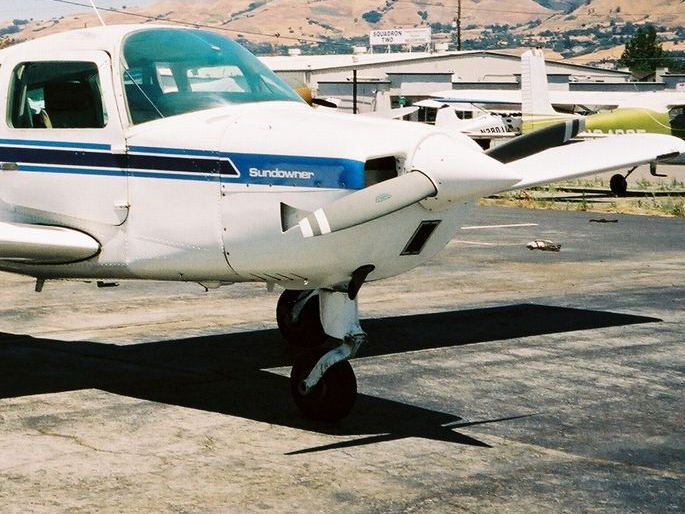
A much-anticipated first flying lesson ends badly in this close call, first published in 2012
Name withheld by request
I was 18 years old, and each day I drove past the airport heading to work. From the road you can see the hangars and the aircraft parked on the apron, with at least two or three aircraft flying circuits above. Sometimes I counted up to six aircraft, sometimes more.
My birthday was a few months away. What better present to give myself than flying lessons?
The following weekend I went to the airport, where in those days every second building housed a flying school. For no particular reason I chose a school that used Beechcraft Sundowners–four-seat, low-wing, fixed undercarriage, with a Lycoming 0-360 engine.
The staff were friendly, and after a brief chat, we scheduled a trial instructional flight for the next day. Less than 24 hours later, I was back at the school meeting the instructor who would take me for the flight, and just minutes after I was airborne and heading towards the local training area.
Yes, I thought, this is definitely for me.
In the next few weeks I attended the necessary aviation medical, filled in forms, bought text books and booked my first lesson.
Then the morning arrived.
The weather was calm, blue sky, and a mild temperature for that time of the year. It looked like a great day for flying. I was scheduled for the first lesson of the day and it was the first time that day the aircraft would be used.
I met my instructor and we had a pre-flight briefing. Then it was out to the aircraft, where I was shown how to perform the pre-flight inspection and check the fuel for water. My anticipation and excitement were growing with every passing minute.
Finally we climbed into the aircraft and I sat in the left seat. We made ourselves comfortable, adjusting seats and seatbelts.
My instructor then commenced the start-up procedure, while talking me through it. I sat as an interested observer taking in as much as I could.
Everything was going to plan. My instructor flicked the master switch on and turned the key. I expected the dials to come alive, lights flash and the engine burst into life, but nothing happened. Everything was quiet and the dials were still. No response from the aircraft at all … silence.
‘Dead battery’, said the instructor. My anticipation and excitement evaporated in an instant.
Just as he spoke, another aircraft from the school was taxiing into a parking position close to our aircraft. Its pilot was a student who was about to obtain his PPL. My instructor then said, ‘I will show you how to hand start an aircraft’, and called the other student pilot over. He explained the dead battery situation and his intentions to hand start the aircraft and asked for help to start our disabled aircraft.
I was now an interested spectator with absolutely no idea of what was about to occur.
The student pilot sat in the aircraft and instructor gave him instructions about the start-up procedure.
The instructor stood directly in front of the aircraft, grabbed hold of the propeller blade on his left-hand side and proceeded to turn the propeller several revolutions opposite to its normal direction. He gave more instructions to the student pilot in the aircraft and then, with his right hand, pulled down forcefully on the right propeller blade in the normal direction. The propeller turned and the engine coughed briefly but did not start.
More instructions to the student pilot, and the process was repeated. The instructor performed his previous procedure of turning the propeller in the opposite direction, then grabbing the right-hand blade of the propeller with his right hand and forcefully pulling down on it.
What happened next took place in a split second at high speed.
When the propeller blade was at about four o’clock, the engine spluttered then backfired, and the propeller blade went in the opposite direction to the instructor’s forceful pull. The suddenness and speed of this change of direction caught him completely by surprise and he was still hanging onto the leading edge of the propeller.
His arm extended upwards and he only managed to release his hand when he appeared to be at full stretch.
He was still able to stand, but was pale and slumped over, grabbing at his bleeding right hand with his left one and grimacing in intense pain. In that split second he had suffered deep cuts to four fingers on his right hand.
His right arm was hanging limp and he said he thought that his arm was broken, indicating an area close to the shoulder. Blood was dripping through his fingers onto the tarmac and his pain level appeared to increase. He did remain conscious and was able to make his way to the office some 25 metres away with the assistance of the student pilot. The staff gave him first aid help and an ambulance was called. I stayed with the aircraft until another instructor came over to lock it up.
Needless to say, my lesson and the instructor’s other lessons for that day were cancelled.
This incident certainly did not put me off learning to fly, or off that flying school. My first lesson was rescheduled for the following week with another instructor, who turned out to be the CFI.
I never saw the injured instructor again and the incident wasn’t discussed with me or ever spoken about again.
I have often wondered why the instructor decided to show a brand-new student a complicated, high-risk, dangerous procedure that had claimed many victims. Why didn’t he just ask the LAMEs who shared the school’s hangar to investigate the flat battery?
Fast forward to the present day: had this accident occurred now, I imagine I would have been debriefed, required to fill in incident reports and offered access to counsellors. How times have changed.

Comments are closed.