

Monarch Airlines flight OB301
Piper PA31-350 Navajo Chieftain
Young, NSW
Friday 11 June 1993
The destruction of a regional airliner 27 years ago revealed widespread shortcomings at the heart of Australia’s regulatory system
Turning and turning in the widening gyre,
The falcon cannot hear the falconer;
Things fall apart; the centre cannot hold;
Mere anarchy is loosed upon the world
The Second Coming, W.B. Yeats, 1919
For the five passengers on Monarch Airlines flight OB301, the last minutes of their lives would have been dominated by the sensations of gently turning, rising and descending, as the Piper Chieftain made three attempts to land at Young in central western NSW. They would have heard the bellowing of the engines and the crackling overtone of propellers at high rpm and felt vibration and possibly some bumps in the moderately turbulent conditions. Through rain and cloud, they might have caught a glimpse of the airport, a tiny point of light in a darkened world.
About 7.18 pm the few family and friends waiting at Young Airport saw what appeared to be an unusually large Queen’s Birthday bonfire flare up several kilometres away. As minutes passed with no sign of flight 301, the real reason for the fireball became horribly clear—the flight had crashed, killing the passengers and two pilots. Thirteen months later, the Bureau of Air Safety Investigation’s (BASI) official report described the impact in clinical detail.
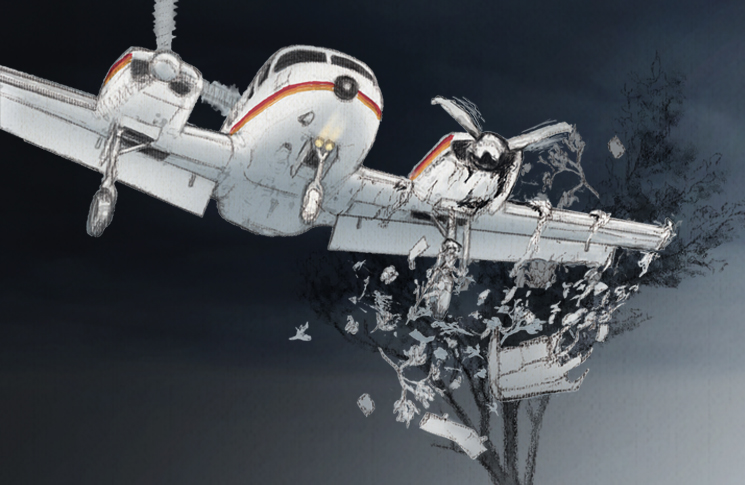
‘The aircraft had approached the accident site on a track of 270 degrees in a wings level attitude, in or near horizontal flight at an estimated groundspeed of less than 140 kt. The landing gear was either extended or nearing the completion of the extension cycle, and the flaps were in an intermediate approach position. The aircraft initially flew through the crown of a tree, some 12 m above ground level, removing the outboard end of the left wing and aileron, and one blade of the left propeller. It then continued for 50 m, descending slightly and rolling left, before the left wing brushed the side of a second tree about 13 m above the ground, which sloped downhill in the direction of flight. About 40 m further on the aircraft collided with a third tree and disintegrated. Both wings, the tail section and the cabin roof were torn off and the left engine separated from the wing.
The fuselage then fell onto a boulder, 10 m beyond the tree and split into two pieces. The wreckage was confined to a generally small area suggesting that disintegration of the aircraft as a result of tree impact had dissipated most of the aircraft’s kinetic energy. The forward section of the fuselage came to rest on the right wing. Both were subsequently incinerated by a fire fed from an estimated 366 litres of avgas remaining in the wing fuel tanks. No evidence of in-flight fire was found.’
An off-duty firefighter who had been waiting for his son at the airport went back on duty as soon as the boy arrived on another flight that landed very soon after. Shortly before 8 pm he and his team found a survivor strapped to her seat in the wreckage, about 2 km from the airport. She was a boarding school pupil coming home for the weekend, but she died from burns and impact injuries early the next morning after being transported to Sydney.
An ‘organisational accident’
Superficially, the accident seemed an open-and-shut case of human error: the pilots had let the aircraft descend too much on a circling non-directional beacon (NDB) approach and hit the ground in a form of crash so common it had its own acronym, CFIT, standing for controlled flight into terrain.
But the BASI inquiry was informed by the developing theories of Professor James Reason of the University of Manchester. Reason’s higher-level thinking about the matrix of circumstances that produced accidents would later acquire a tasty analogy—the Swiss cheese model. Defences against accidents had metaphorical holes in them, like cheese, and sometimes these holes lined up. Reason provided a framework to link general weaknesses of an organisation—the things pilots and engineers grumble about in the tearoom—with specific accidents.
The report summarised Reason with evident enthusiasm. ‘Central to Reason’s approach is the concept of the “organisational accident”,’ it said, ‘in which latent failures arising mainly in the managerial and organisational spheres combine adversely with local triggering events (weather, location, etc.) and with the active failures of individuals at the “sharp end” (errors and procedural violations).’ A fourth element of the model is defences, which are often found to be missing after accidents.
Latent and blatant: Monarch and its regulator
In Reason’s model, latent failures arise from deficiencies in managerial policies and actions within organisations. Often these organisational factors are not immediately apparent and may lie dormant for a considerable time. However, some of Monarch’s latent failures were widely known, particularly by those it owed money to.
From the report: ‘The operation of the airline was apparently inhibited by consistent financial problems. These problems resulted in a high turnover of maintenance staff, the majority of flight crew being employed on a daily or casual basis, fuel purchasing problems, continuing aircraft equipment deficiencies, and inadequate training.’
‘There is considerable evidence from creditors to show that the company apparently had significant difficulties in meeting financial commitments as they became due,’ BASI said, adding, ‘Payment was generally able to be obtained only after numerous requests had been made to the company, including threats to withdraw services.’
The threadbare operating environment influenced safety standards among pilots and engineers by making training and standard setting more difficult.
BASI found, ‘There was a perception by a few pilots that to complain to management about operational problems could result in action being taken against them. As a result they did not do so. They believed that if they refused to fly an aircraft, other pilots would. There were many pilots waiting for an opportunity to join Monarch. These inhibitions were reinforced by the fact that most pilots were employed on a casual basis.’
Maintenance was similarly dysfunctional, with the LAME responsible for certifying Monarch’s maintenance operations withdrawing his services.
One paragraph of BASI’s report was particularly damning: ‘The inference could be drawn from the way in which Monarch operations were conducted that there was a significant management bias towards commercial considerations at the expense of safety.’
One of the jobs of an aviation regulator is to ensure commercial considerations never overrule the imperative of safety, but the investigation found Australia’s Civil Aviation Authority (CAA) had not done this.
It would be reasonable to think the CAA’s job was to ensure that whatever else happened, safety standards would still be monitored and enforced, but the organisation did not see itself in this light. The safety regulation and standards division of the CAA had ‘a safe and viable industry’ as its vision and described itself as ‘a customer orientated team, providing consistent, timely and effective regulatory functions, at a minimum cost’ in its mission statement.
A 1992 memorandum from a CAA airworthiness manager to his staff made this attitude, and its shortcomings, brutally clear. ‘You are a servant of the Industry whether you like it or not. Even when performing your regulative role, you are still a servant of the industry to which you owe your existence.’
The BASI report said, ‘Even when deficiencies were identified, the CAA appeared reluctant to take action to change the way in which Monarch conducted its operations. This was evidenced by a history of airworthiness and flight operations concerns, numerous meetings with inconclusive results, and the absence of a co‑ordinated strategy to follow through and resolve the deficiencies identified.’
Event triggers: a dark and (moderately) stormy night
The Bureau of Meteorology estimated the weather at Young airport at 7.20 pm was: surface wind 310 degrees at 11 kt gusting to 19 kt, 4 octas stratus at 800 feet above aerodrome level, 6 octas stratocumulus at 1200 ft and 6 octas cumulus at 1500 ft. Visibility was 10 km, reduced to 5000 m in light rain. Temperature and dewpoint were both nine degrees and the barometric pressure 1004 hPa.
Crews of other aircraft that landed that night said the cloud base was about 200–300 ft below the minimum circling altitude and described conditions in the circuit as very dark, with moderate turbulence and insignificant windshear.
CASA senior aviation technical writer Stuart Jones was the pilot of the air ambulance called out to take the girl to Sydney. He remembers challenging conditions and a missed approach on arrival, with a pilot under training.
‘We had a substantial workload at the end of the flight, but we were in a fully functional, pressurised, turbine aircraft,’ Jones says. ‘Until we descended, we may as well have been in an office, calm and above the weather. But the Chieftain crew would have been down at 6000 feet, bouncing around, hand flying in and out of rain and trying to stay below the icing level.’
Jones also remembers the rhythmic windscreen wipers on the King Air on short final, and the sound of squalling rain on the roof of the local hospital as the girl was treated. He met her parents only briefly but has never forgotten their shock and disbelief, how weak his words of comfort sounded, and the effort, when climbing back into the seat, of focusing coldly and calmly on the return flight. ‘I sometimes think about her,’ he says. ‘She would have been in her forties now, possibly with school-age kids of her own.’
They believed that if they refused to fly an aircraft, other pilots would.
Active failures: human error writ large
The Chieftain crew allowed the aircraft to descend below the minimum circling altitude, for a visual circling approach, as other aircraft did that night before successful landings. (This was permitted if visual reference could be maintained and the runway lights seen.) There was about 750 ft between the cloud base and the ground but flight 301 kept descending until it hit the earth. The investigation concluded it was most likely the continued descent was unintentional from a pilot in command said to be ‘level-headed, methodical, and precise’, by those who knew him.
‘This error may well have been due to the flight crew encountering a situation for which their training had not adequately prepared them,’ it said. Because the locking status of the landing gear could not be determined, there was the possibility the crew might have been dealing with a gear problem, but no positive evidence for this could be found.
Defences: holes in the panel
The crew’s workload was found to be a factor in the unintentionally continued descent. Manoeuvring for a circling approach was made more difficult by a missing cockpit instrument. The horizontal situation indicator (HSI, which combines a direction indicator and a VOR display) was inoperative because the autopilot computer/amplifier that powered it had been removed for repair. This meant the pilot in the left seat had to look over to the right-side direction indicator. A pilot who flew a similarly configured cockpit as part of the BASI investigation reported increased workload from this distorted instrument scan, and reduced flight accuracy. By carrying passengers, the flight was operating in contravention of the permissible unserviceability issued by the CAA. A ramp check at Sydney Airport six weeks before the crash had discovered this and led to the resignation of the chief pilot, but changed nothing else. The new chief pilot was unaware of the inoperative HSI.
Monarch had required flights with no autopilot be flown by two pilots—but had done nothing more about the issue. The BASI report found the airline had provided no training to cater for two-pilot operations, and its operations manual did not mention them. The only guidance concerning flights conducted with a second pilot was provided in a memorandum to all Monarch pilots from the chief pilot on 20 April 1993. The memorandum stated in part: the second pilot is there to fulfil the functions of the autopilot, and the PIC (pilot-in-command) is in command of the aircraft at all times.
Such was the industrial climate at Monarch that few if any pilots objected to this demeaning, inefficient and unsafe division of labour. The concept of the pilot-monitoring, assisting, verifying and making altitude call-outs, went unexplored.
Bleak lessons
In keeping with Reason’s model, BASI named no single factor as the cause of the crash—the final uncommanded descent was merely the culminating factor. Both weather and climate were implicated. Weather being the atmospheric conditions over southern NSW that evening, and climate being something less visible but equally real: the priorities, assumptions and values under which the airline and its regulator operated.
This climate changed. It wasn’t just seven people who were slammed into a low hill near Young—it was an airline, a regulator and a way of thinking.
The CAA had already been investigated by former Qantas director of flight operations and CAA board member Alan Terrell, whose report found aviation safety standards had fallen, and led to the resignation of another CAA chairman. The Monarch disaster and the Seaview Airlines crash the following year set in train events that brought about the dissolution of the CAA and the formation of a new regulator: the Civil Aviation Safety Authority. Instead of an airy vision statement attempting to balance safety and viability, CASA chose four crisp and uncompromising words: safe skies for all.

Comments are closed.