

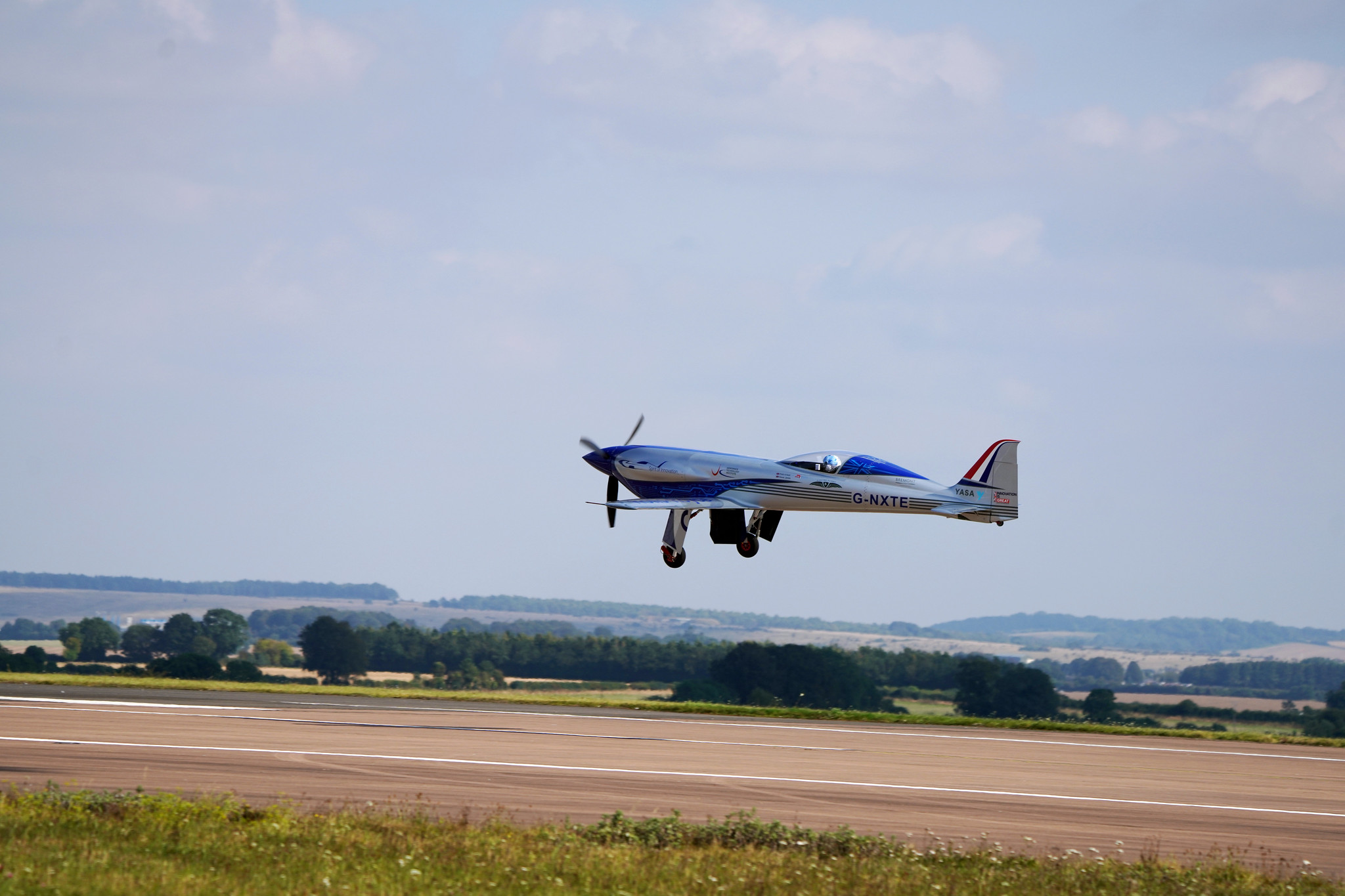
The future of aviation will be at least partially electric. For many this conjures up grim visions of autonomous insect-like drones and urban air vehicles blackening the skies like a scene from a Terminator film. But electric aviation can be elegant, at least to look at, as Rolls-Royce showed last week.
The engine maker announced the first flight of its all-electric Spirit of Innovation aircraft. The single-seat technology demonstrator made a 15-minute flight from the UK Ministry of Defence’s Boscombe Down site in Wiltshire, England. The aircraft, based on a Sharp Nemesis NXT pylon racer, has the most power-dense battery pack ever assembled for an aircraft, Rolls-Royce says. The battery pack’s 6000 cells put 400 kW (536 bhp) at 750 V through the electric powertrain to drive three electric motors turning a single propeller spinning at 2400 RPM. By comparison, the Lycoming TIO-540 piston engine in the conventionally powered Nemesis NXT makes 260 kW (350 bhp). Maximum planned power of the combination has been reported at 750 kW (1000 bhp) with range of 200 miles (174 nautical miles, 320 km). The three axial-flux electric motors, made by YASA, a part of Mercedes-Benz, have an efficiency of 90 per cent, Rolls-Royce says.
Rolls-Royce says it is ‘offering our customers a complete electric propulsion system for their platform, whether that is an electric vertical take-off and landing or commuter aircraft.’
Rolls-Royce says it will use the technology from the project (known as ACCEL) and apply it to products for new markets. ‘The characteristics that “air-taxis” require from batteries are very similar to what is being developed for the Spirit of Innovation so that it can reach speeds of 300+ mph (480+ km/h) – which we are targeting in our world record attempt,’ the company says.
Rolls-Royce and aircraft maker Tecnam are working with Norwegian domestic airline Widerøe to deliver an all-electric passenger aircraft for the commuter market, which is planned to be ready for revenue service in 2026. Many of Widerøe’s routes are particularly suitable for electric operations as they involve relatively short flights, which replace long coastal land journeys around fjords, or slow sea voyages across them.

Comments are closed.