

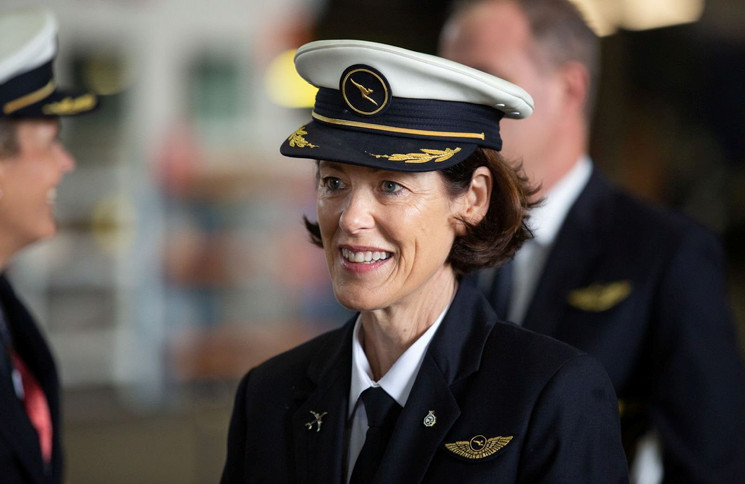
Debbie Slade began her flying career by shooing sheep off a grassy paddock to do circuit training
Closing the gate on the sheep was long before she held the rank of Captain and became one of Qantas’ long-standing pilots.
Debbie Slade didn’t come from a family of aviators but did grow up in a house with 2 brothers. The boys were sent to Scouts and she went to Girl Guides. Slade preferred Scouts. ‘I thought it was most unfair because the boys abseiled and rock climbed, while the girls learnt to sew and cook,’ she says.
Thankfully, her family found a great little flying camp run by the New Zealand Scout Association, called Walsh Memorial Scout Flying School – still operating for 2 weeks every January. It is nestled on the side of a runway that doubles as a sheep grazing paddock. ‘I know – only in New Zealand!’ she says. So, her flying career began at 15 years old, under the tutelage of a ‘lovely ex-World War II flight instructor’.
‘I did one lesson and I was hooked,’ she says. ‘It gave me something to work towards; [it provided] a single-minded focus that I didn’t have for anything else.’
While her parents were supportive of her flying dream, in 1983 even the Air Force wasn’t taking female pilots. So, like any parent who wants the best future for their child, they encouraged Slade to attend university on the promise that if she still wanted to be a pilot after graduating, they’d support it.
Cut to 1985, when she graduates with a Bachelor of Science degree and her piloting dream intact.
Living the dream
Like many aspiring aviators, becoming a commercial pilot was a financial challenge for Slade. Coupled with less opportunity and limited industry connections, she worked harder to find opportunities.
Slade remembers most people being very supportive. ‘I look back on it and, even though I was the only female in every class, I don’t remember it being a problem – for every detractor, there were 2 supporters,’ she says. ’And today, passengers don’t bat an eyelid when they see female pilots and it’s great to see more and more coming up through the ranks’.
From contemporaries in class or mentors within the airline, Slade feels there was (and still are) plenty of people championing her forward.
It’s a good time to fly
‘You can’t be what you can’t see,’ Slade says. ‘Twenty-five years ago, there were no female pilot role models. Now, they’re everywhere, from Instagram to ads to the movies. This is great for young ladies to see what’s possible!’
Putting social media aside, what excites Slade more is that there’s much more flexibility nowadays to be a parent and a pilot.
‘When I started, there were less flexible working arrangements,’ she says. ‘Coming back to work with a 12-month-old baby, knowing tomorrow I was on standby and I might need to fly to London in three hours … I thought, how do I do that?’
Not to mention back then, women were not permitted to fly if pregnant. Now female pilots fly through part of their pregnancy with medical consultation. Plus, with more part-time and flexible work arrangements available today, pilots can better manage childcare, home life and a career.
A legacy of love
Even with 32 years as a Qantas pilot, Captain Slade hasn’t lost her enthusiasm.
‘I started with Qantas in 1989 as a Second Officer on the brand-new Boeing 747-400s and, 12 years later, I finally achieved my greatest goal, becoming a Captain – it was pretty monumental for me,’ she says. ‘You work towards it your entire career and, when it happens, it’s pretty amazing.’
Her passion is palatable as she recounts all the experiences flying for Qantas has given her. From travelling the world, experiencing new cultures, food and architecture, to developing professionally.
Slade says a flying career ‘keeps you on your toes, alive and busy’.
‘You’re constantly studying and renewing your licence every 3 to 4 months. You can’t be complacent. You have to be prepared to evolve.’
One of the ‘really cool flights’ that Slade captained was when Qantas had one of their A330s painted in the new livery in California and was ferried back to Australia.
‘Rather than coming back through Honolulu, we came via a lesser-known airport in the Hawaiian islands and refuelled in the middle of the night, so no-one saw us,’ she says.
‘We had our lights off on the tail so no-one could see the paint job and then we flew into Sydney, where we were pulled into the hangar for a big unveiling. It took us 18 hours and then, to walk off fresh-faced to the media [laughs] … it was so much fun.’
Support gives you wings
- Find a mentor. Being mentored by a female pilot is great, but it doesn’t have to be a woman. When Slade first joined Qantas, one of her greatest mentors was a senior male captain (now passed). ‘I could always go and talk to him,’ she says. ‘He sat and listened and provided advice that was right on point.’
- Find a support group. From Facebook groups to Women in Aviation chapters and scholarships, many more avenues provide opportunity in 2022.
- Give it a go. ‘If your attempts don’t work out, try another avenue, be resilient.’ Slade says. ‘If you fall, dust yourself off and keep going – but find people who encourage you and lift you because there are always hurdles on the way.’
- Circle of influence vs Circle of concern. Focus your energy on things you can influence rather than the things outside your control.



Comments are closed.