

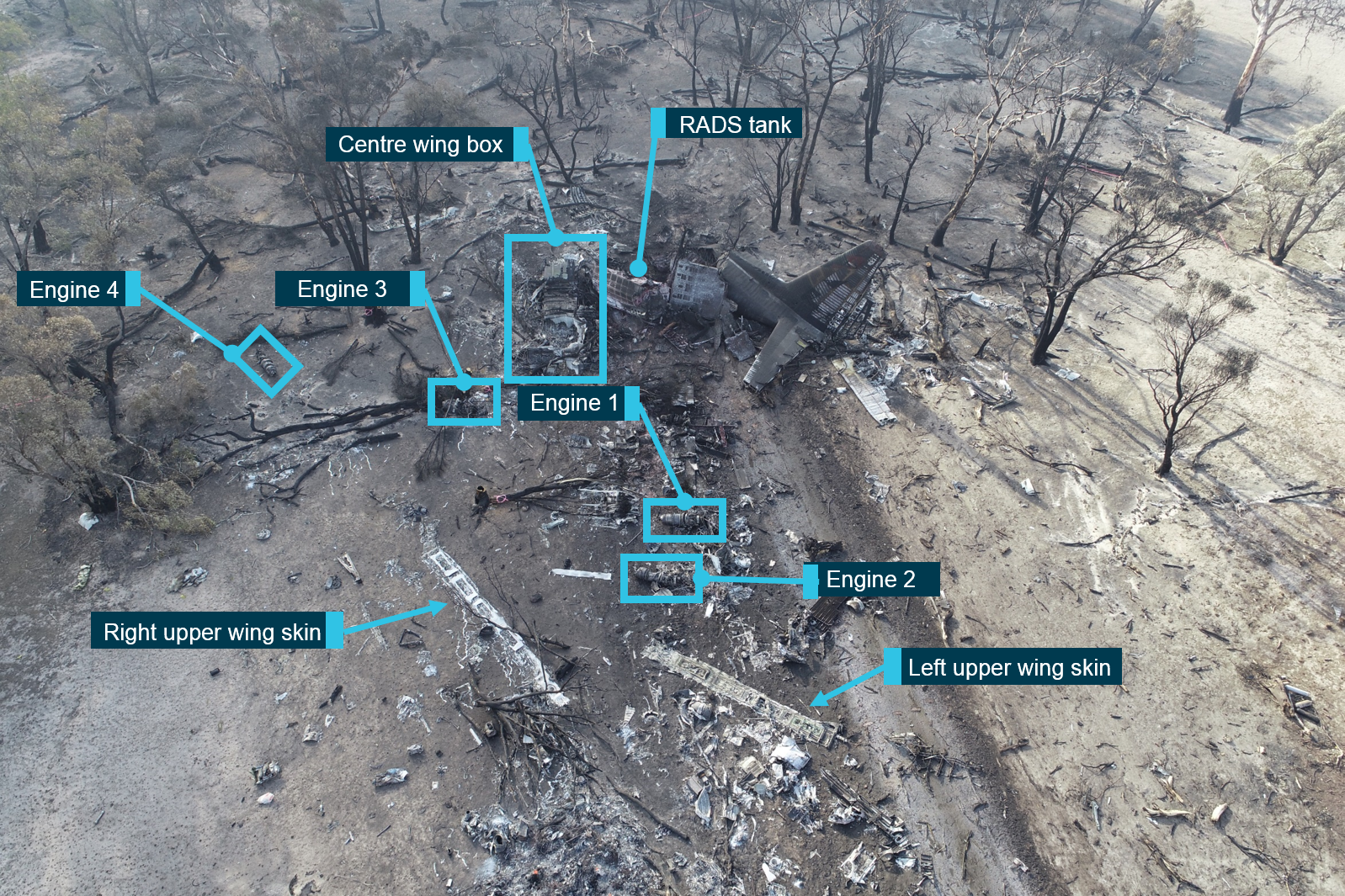
A lack of complete situational information and defined procedures contributed to the crash of a Lockheed C-130 Hercules during the catastrophic bushfires of January 2020, the Australian Transport Safety Bureau’s (ATSB) final report into the crash says.
The crash, at Good Good fire-ground, at Peak View, near Cooma, NSW, killed 3 US aircrew on 23 January 2020. The ATSB report, issued this morning, was delayed by lack of information from the aircraft’s cockpit voice recorder, which stopped working before the final flight.
The EC-130 crew had flown from Richmond, near Sydney to drop fire retardant on a site near Adaminaby. But the crew assessed this drop site as not suitable and accepted an alternative drop at Good Good. They flew several precautionary circuits before committing to a drop. After making a partial retardant drop the aircraft made a left turn and climbed for about 10 seconds to about 170 ft above drop height. Soon after it descended and made a significant left roll just before ground impact. The ATSB found the aircraft was very likely subjected to hazardous environmental conditions including low-level windshear and an increased tailwind component and it was likely the aircraft aerodynamically stalled before hitting the ground.
The C-130 Hercules had attempted a drop on a day when the smaller ‘birddog’ lead aircraft had declined the flight to Adaminaby, and a Boeing 737 tanker was returning to Richmond from Adaminaby after assessing the conditions there as unsafe for a drop.
‘This information was not communicated by the RFS [NSW Rural Fire Service] to the C-130’s crew,’ the report says.
The Boeing 737 Tanker pilot called the C-130 and had a conversation which according to recollection included that the 737 was ‘getting crazy winds’ and ‘you can go take a look’ ’but I am not going back’.
ATSB chief commissioner Angus Mitchell said responsibility for the safety of aerial firefighting operations had to be shared between the tasking agency and the aircraft operator.
The ATSB found that the tasking agency, the RFS, had limited large air tanker policies and procedures for aerial supervision requirements and no procedures for deployment without aerial supervision. In addition, the RFS did not have a policy or procedures in place to manage task rejections, nor to communicate this information internally or to other pilots working in the same area of operation.
The investigation found that the operator Coulson Aviation’s safety risk management processes did not adequately manage the risks associated with large air tanker operations, in that there were no operational risk assessments conducted or a risk register maintained.
Mitchell said the accident highlighted the importance of having effective risk management processes, supported by robust operating procedures and training to support that shared responsibility.
The ATSB noted Coulson Aviation and the RFS had taken proactive safety actions before the report was issued. Coulson’s changes included introducing a pre-flight risk assessment tool, a new three-tiered risk management approach, and windshear procedures and training.
The RFS had committed to undertake a comprehensive review of RFS aviation doctrine and undertake detailed research to identify best practice (nationally and internationally) relating to task rejection and aerial supervision policies and procedures as well as initial attack training and certification. The ATSB issued 3 safety recommendations to the RFS and 2 to Coulson Aviation.
The chief commissioner paid tribute to the crew: pilot Ian McBeth, first officer Paul Clyde Hudson and flight engineer Rick DeMorgan Jr. ‘All three were far from home helping to defend lives and property, during the worst fire season in Australia on record,’ he said.



Comments are closed.