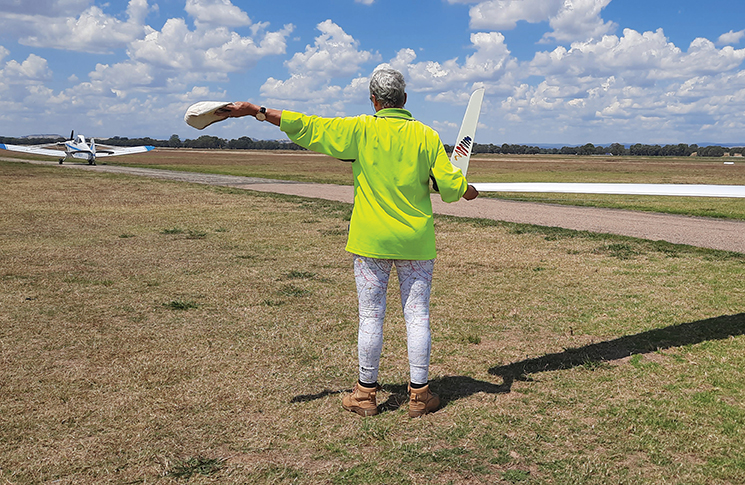
image: Tug and sailplane combination ready to go | Angela Stevenson
Gliders don’t behave the same as a powered aircraft, so best not to expect them to.
Researching this article, I found myself in the front seat of a glider in Benalla in central Victoria, waiting for the tug. It was a hot, thermally day and the tug had been hard at work.
Remembering the November 2022 fatal mid-air collision of a glider and an ultralight aircraft near Gympie, I was glad to be sweating on the ground – not in the air.
Six or 8 sailplanes had departed the busy airfield in the half hour before us. Then we heard a call from a powered aircraft descending to join downwind for 17. The problem was, the active runway was 08!
The pilot in the powered aircraft would be flying downwind across the active runway, 08. So launching then was not a good idea. But also, it could have been far more problematic for a glider currently on descent into or joining the circuit, or landing.
Technically, the powered aircraft pilot hadn’t made a wrong decision, given the wind was light and variable on the ground – just a poor one, considering it was obvious that 08 was active.
Same but different
Gliders are slick, light, slippery and long-winged. They are specifically designed to climb in the air without engine power and stay up there. To those who fly them, they’re very cool; to those of us who don’t understand them, they’re alien.
The rules say unpowered gliders have right of way over power-driven aircraft and that’s for a good reason. Gliders don’t have the luxury of going round or climbing on demand, and flying in a straight line from waypoint to waypoint isn’t usually achievable. They are, in so many ways, different to powered aircraft.
Tugs and winches
In Australia, the most common method of launching a glider is aerotow – ‘towed by rope’ – typically behind a lower-speed, high-powered, tailwheel aircraft such as a Pawnee. An aerotow rope is usually about 180–200 feet (60 metres) long, so it pays to think of a tug + glider combination as a 200-foot-long sluggish aircraft. Since this unit is unable to manoeuvre easily, it makes sense to put a bit more airspace than normal between you and it.
The second most common method is the winch. There are also other means of launch, including vehicle tow, and about 13% of gliders are self-propelled. Aerotow and winch operations are incredibly different and present their own sets of challenges for powered aircraft in the vicinity.
Roger Krueger has been gliding since 1986 and has experienced both types of launch. He obtained a PPL in 2000 and has been a tug pilot since 2011. Benalla Airport is his usual haunt, although he has significant experience at Bacchus Marsh – purportedly the airfield with the busiest mix of glider and powered operations in Australia.
‘The best tug pilot is actually a glider pilot,’ he says. ‘Tug pilots need to really understand what the pilot on the end of the rope wants.’ And that is lift.
When the tug/glider combination has departed the circuit, it climbs as quickly as possible, avoiding flying into the sun. It is seeking thermal activity in patterns of cumulus near the airfield that will give the glider some lift before the towrope is released. This is usually at 2,000 to 3,500 feet AGL. The glider releases from the tug plane within gliding distance of the field to ensure sufficient height for emergency procedures or landing. No lift? Turn back to the field.
Roger Krueger
On a busy day, up to 30 gliders might launch from Vivienne’s home field of Benalla within a two-hour window.
Released from the glider, the tug plane returns to the field and, because it hasn’t gone far away, will likely go into a steep descent and perform a descending circuit, perhaps at full throttle to hurry back – many gliders are always waiting to be launched.
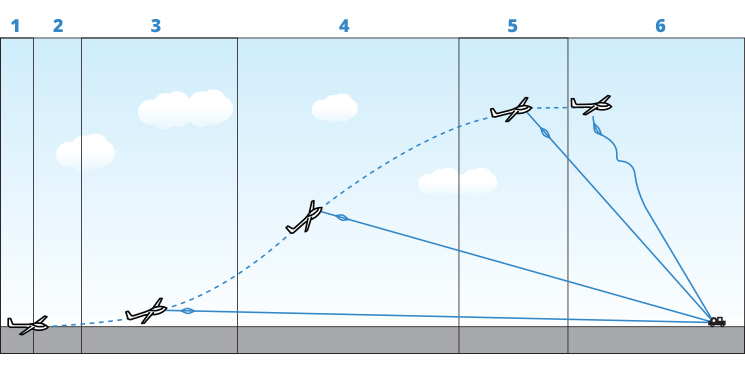
By comparison, a winch launch is more like an ‘aircraft carrier slingshot crossed with a rocket launch’, Krueger says. A 3–5 mm steel wire cable is attached to the front of the glider and reeled in at a phenomenal rate by a winch at the other end of the runway. ‘From ground zero to release in less than 60 seconds, with your feet above your head [due to the steep climb] – it’s a very dramatic way to launch!’ he says.
With the release height of the cable from the glider being up to 4,000 feet, Krueger says the key message for other pilots is there’s the cable and the glider. ‘And that wire – sure, it has a chute [drogue] attached but it’s next to invisible in the sky!’
Krueger’s best tip for pilots flying into or near an airfield with winch operations is communication. ‘Definitely call the club up first and understand how they are operating,’ he says. ‘Aside from the random things the gliders are doing, there’s that cable to worry about.’ Overflying – up to 5,000 feet – is not smart when the winch is operating.
In the air
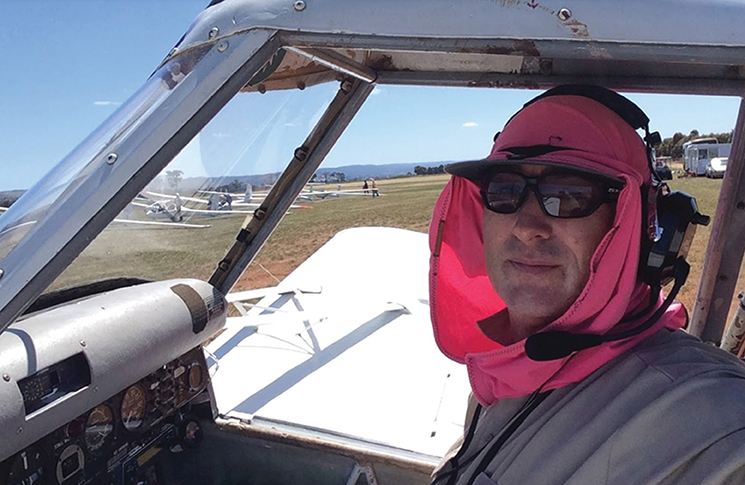
Overhead Benalla, my glider pilot Vivienne Drew is explaining what’s going on in the cockpit and the characteristics of the aircraft. She has 2,000 hours in gliders, in several countries, and flies a high-performance sailplane.
If gliders can’t find lift, they go down. The types of lift they’re looking for can be thermal, ridge, wave or convergence lift.
You’ll find gliders circling upwards under puffy cumulus clouds, along ridges where wind may be deflected upwards, in mountainous areas that provide wave-like wind conditions or in rising air caused by conflicting air masses, for example, marine and inland air. Gliders generally operate in Class G and E airspace or higher by arrangement with ATC, and powered gliders can operate in Class C or D if the pilot holds the requisite endorsement.
The process of looking for lift, finding lift, circling in the lift, departing the lift to glide to another lift and repeating, means a glider’s motion across the sky is much more random than the fuel-consumption-driven straight track of a powered aircraft.
On a busy day, up to 30 gliders might launch from Vivienne’s home field of Benalla within a two-hour window. She says on training days, emergency training procedures – including releasing at 1,500 feet to re-enter the active runway circuit – are common.
And if you’re sharing airspace with a glider, your best chance of seeing it will be from side on when it’s banking. From line astern or abeam, you’re looking at a slither of a profile. ‘They’re not totally invisible, but they’re very hard to see and there’s no strobes, no extra hints to give you a clue they are there,’ Krueger says.
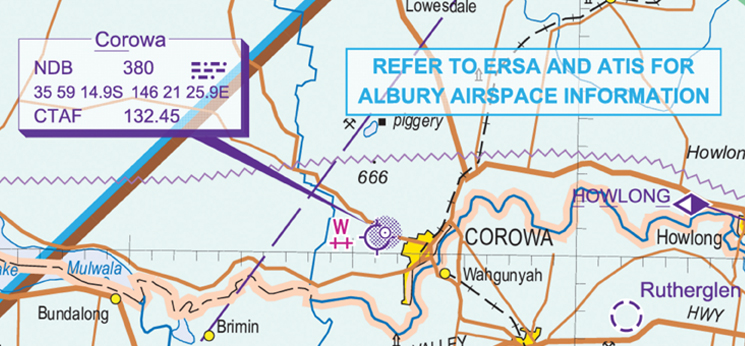
Gliding operations are marked on aviation charts with a pink ‘double plus’ symbol.
image: The stages of a winch launch
Circuits and runways
Although gliders plan to fly a circuit when landing, they cannot guarantee a neat rectangular pattern. It cannot be said any simpler, really: without an engine, every landing is for a full stop. ‘Once you’ve entered the circuit, you are totally committed to land, whatever that ends up looking like,’ Krueger says. ‘There is no option – you don’t get to change your mind.’
Gliders tend to manoeuvre near the airfield before joining circuit, setting themselves up for the right height and angle. Typically they join downwind at about 800 feet AGL and turn final at about 300 feet. They make long flat circuits at about 60 knots or less, which is closer to the runway – and lower – than powered aircraft. They can use airbrakes to increase the angle of descent but if a glider experiences sink (sometimes 1,000-feet per minute), it may have to leave the circuit and land immediately or change direction and circle to the left instead of the designated right. ‘We’re not doing it to be smart or clever – there’s simply no alternative,’ Krueger says.
Airfields like Benalla, with both north/south and east/west runways, no dead side, left and right runways and contra circuits, can prove particularly challenging. If you don’t understand how contra circuits operate, and you’re flying near gliding operations, then it’s time you read up on them. The Visual Flight Rules Guide is a good starting place.
There are rules about gliders and powered aircraft sharing runways, including about separation standards, displaced threshold (for the purposes of gliding ops) requirements and occupied runways.
Geography and cartography
More than 75 gliding operations are dotted around the country. According to Christopher Thorpe, executive manager operations of the Gliding Federation Australia, there’s been a push in recent years to get all regular known gliding sites marked on the charts – and he’s relatively confident that has been achieved.
Gliding operations are marked on aviation charts with a pink ‘double plus’ symbol. And, if it has a winch launch operation, you’ll find a W next to the symbol, for example, at Corowa. It’s also important to remember gliders often don’t land at the site they depart from – it’s common for them to have to put down in a field (and they enjoy making someone retrieve them!).
If gliding operations are in progress at an airfield, you will find a white ‘double plus’ symbol on the ground near the primary windsock.
image: The ‘double plus’ symbol for Corowa | Airservices Australia
Proper prior planning
There are plenty of things pilots of powered-aircraft can do to make flying in or near gliding operations as safe and enjoyable as possible.
Do the homework before you depart, including areas along the way where you might find gliding activity, not just departure and arrival points.
If you need to overfly a gliding operation, read the ERSA.
Understand the runways, circuit joining procedures and circuit patterns, particularly where contra circuits exist. Read the ERSA.
Read the ERSA. Read the ERSA. Read the ERSA.
Check the NOTAMs.
Call the gliding club and have a chat. But remember, it might be a ‘quiet day’ right now, but that might not be the case by the time you get there. If those puffy clouds appear, every glider pilot and their sailplane might suddenly be around.
Listen out on CTAF early and ensure you are on the right frequency. Gliding operations are on CTAF for all the usual requisite calls; they also listen out on Area and use designated frequencies to communicate between gliders.
Inbound at 10 nm, ensure you call accurately about where you are and what your intentions are. Listen for a response about gliding activity. If there are any gliders flying, someone will let you know and then you’ve got time to make good decisions.
Communicate. Gliders don’t get many options, if any, especially in the circuit, so be that person that plays well with others.
Glider pilots are passionate about their aircraft and their sport. If you find yourself avoiding airfields with gliding operations, you could be missing out on some good need-to-know aviation information and some great yarns.






Comments are closed.