
Half a century later, a glider pilot is still shaken by an encounter with the sheer power of nature.
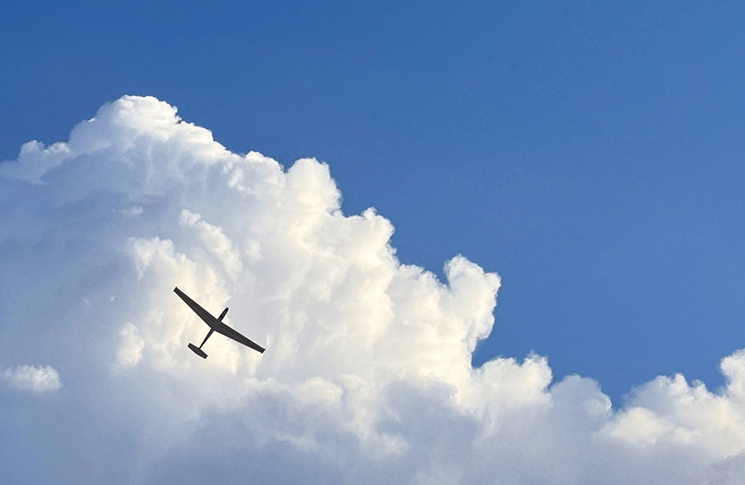
Sunday 9 February 1975: I was a young man of 33, preparing for an aero tow-launched solo flight in a LET L13 Blanik from Dubbo Airport. I had completed my pre-flight check and was anticipating 60 minutes aloft.
The chief flying instructor, who was present on the field, suggested I stay a minimum 1,000 feet away from the base of a cumulonimbus developing rapidly to the east of Dubbo. I agreed.
Both of us noticed the RAAF dropping parachutists from a C130 Hercules – and we were truly surprised! Due to the strong updrafts from the cumulonimbus clouds, some were ascending for part of their drop! It was time to get cracking.
A wing-walker kept the wings level while the tug was lining up. The tow rope release hook was checked and all was ready to go.
From memory, the tow was rough; it was soon time to go it alone using the thermal energy surrounding me.
The altimeter was winding its way up very quickly!
After release, the tug descended to the left and I performed a climbing turn to starboard. It was here that I literally fell into what would become a steep learning curve.
The vertical speed indicator was a sight for sore eyes! A dream! The altimeter was winding its way up very quickly!
Everything was moving at an incredible speed. At about 10,000 feet, the horizon had disappeared and the base of the cell had formed a bell shape.
I realised what gross stupidity on my part had been by ignoring the warning from the chief flying instructor!
It took no time at all before I was inside this monster! Then my survival senses kicked in – airbrakes deployed, nose down, indicated airspeed of about 80+ knots while I was being dragged upwards by the tail at more than 200 feet per minute.
Approaching 12,000 feet, I performed a wide turn to starboard, escaping out of the cell and into the beautiful blue sky. A quick glance upwards: before me was a wall of bubbling, cloud formations feeding on latent energy. At an estimate, the tops might have been as high as 30–35,000 feet.
From this position, all was downhill.
With the airbrakes still open, I felt like Biggles (Google him, youngsters) in an amazing spiral dive down to 4,000 feet, at which point I entered a very wide circuit. From this angle, heavy rain was falling over my departure point, obviously from the cell over-developing.
To stay on the safe side, I set the flaps and after crossing the boundary fence, popped the airbrakes. Home sweet home.
Back on terra firma, my instructor said, ‘We thought that we had lost you!’ I replied, ‘You thought you had lost me? Guess what? Check my underwear!’
Lessons learnt
Be aware of the consequences when approaching large cumulus cells.
In aviation, every instruction from your mentor is a crucial piece of wisdom earnt through experience. Learning from others’ mistakes is not just about avoiding disaster; it is respecting the gravity of every decision you make in the skies. As the saying goes, ‘Learn from others’ mistakes as you won’t live long enough to make all the mistakes yourself.’ Take heed of your mentor’s guidance; it could be the difference between safety and regret.
Weather and forecasting
Weather and forecasting is one of the special topics on our Pilot safety hub. Refresh your knowledge.
Online extra
Don’t forget to check out the audio close calls. Hear the stories come to life.
Have you had a close call?
8 in 10 pilots say they learn best from other pilots and your narrow escape can be a valuable lesson. We invite you to share your close call experience to help us improve aviation safety, whatever your role.
Disclaimer
Close calls are contributed by readers like you. They are someone’s account of a real-life experience. We publish close calls so others can learn positive lessons from their stories, and to stimulate discussion. We do our best to verify the information but cannot guarantee it is free of mistakes or errors.