
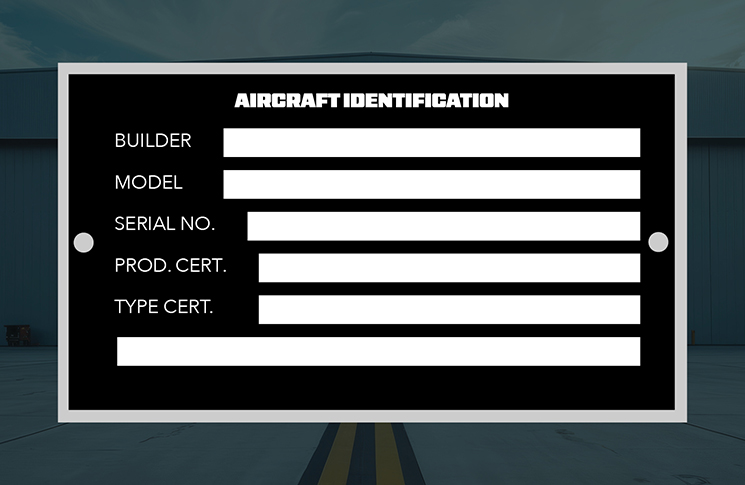
One of the many affectionate jokes about the seemingly immortal Douglas DC-3 is how on many surviving examples the aircraft data plate is the only original component. Perhaps only an engineer would laugh out loud at this but like many jokes, it contains an important truth. An aircraft’s data plate is its birth certificate and passport rolled into one. For administrative purposes, an aircraft is its data plate.
That is why all registered aircraft in Australia are required to have a manufacturer’s data plate that identifies make, model and serial number of the aircraft. CASA Maintenance Specialist Engineer Indy Weerasinghe says passenger transport takes data plates and system/component identification extremely seriously.
‘Before I joined CASA, I did do a lot of leasing work in the transport category,’ he says. ‘And the first things that the aircraft lessors would ask you is to photograph the data plates of the airframe, the engines, the landing gear and APU. Because that data plate is the birth certificate. Without the data plate, it’s a pile of metal for all anyone knows. There’s no way of tying the asset to a particular type-certificated design and a set of maintenance records without the data plate.’
This is why type-certified products require CASA’s written approval to remove manufacturer’s data plates. It is acceptable to remove the plate to carry out maintenance followed by re-installation of the plate.
However, CASA acknowledges that sometimes data plates can be detached, defaced (often from corrosion) or lost during maintenance.
‘We get a few requests a year for replacement data plates,’ Weerasinghe says. ‘We’ve had applicants who have lost them during maintenance and it is possible that over time they can come off in flight. It’s not a common occurrence but it’s not unknown; Lycoming, for example, has a service instruction dealing with it.
‘It’s the type certificate holder’s prerogative to issue a new data plate, or not,’ Weerasinghe says. ‘But where CASA comes into the equation is a ‘sniff test’ – does the request seem legitimate? If so, we provide a letter that supports the application to the type certificate holder.’
CASA Airworthiness Bulletin 02-069 Issue 1 makes it clear that issuing a supporting letter is an involved process.
‘CASA can only issue such a letter after a thorough due diligence process,’ the bulletin says.
Key areas of focus are:
- Why the data plate was removed and/or lost.
- The provenance (history and records) of the engine, with airworthiness the primary consideration.
If there is an unbroken chain of documentation, issuing the letter of support is a fairly straightforward process. ‘On one we issued this year I was able to trace back all the way to the export certificate issued by the FAA, when the aircraft was built in 2007 and then brought into Australia as new,’ Weerasinghe says.
Vigilance
AWB 02-069 says engine maintainers should continue to be vigilant of fraudulent activity that could have happened during the history of the engine. ‘For example, some engine manufacturers stamp the engine serial number on the casing. A quick check that this matches the engine data plate can help protect you from releasing an engine into service that has a questionable history.’
When fitting a replacement data plate, crosscheck any other markings (such as the stamp on the casing) and install the data plate in accordance with approved maintenance data.
Sometimes an aircraft being imported may not have manufacturer’s data plate due to de-registration procedures by the relevant national aviation authority. This situation is treated in the same way as a lost or detached manufacturer’s data plate.
Weerasinghe says legitimate data plates and documentation for rotorcraft such as Robinson helicopters is especially crucial for safety.
‘The safety concept of a Robinson helicopter, with its low inertia rotor, is founded on engine reliability,’ he says. ‘Lycoming engines used in Robinsons are derated to help them achieve high reliability. That’s one form of assurance; another is knowing the precise history and condition of the engine.
‘An engine stopping on a fixed-wing aircraft is no joke either, but you’d have a little more time to react to the situation – a heavy glider with short wings, as they say. In a piston helicopter, you have only a few seconds.’
A lot on your plate
Be very suspicious of an aircraft, engine or component without a data plate. The only substitute for a missing data plate is a thick wad of paperwork documenting a continuous service and maintenance history. Even then you will have to engage at length with CASA before you seek a replacement data plate from the original equipment maker.
‘Obviously, be very wary of buying something without a data plate,’ Weerasinghe says. ‘It’s like buying a car with no VIN number on it. You’d ask yourself, “What lawful reason is there for doing so?” and you’d walk away 9 times out of 10.’
Obviously, be very wary of buying something without a data plate.
He says CASA’s letter of support process is not meant to compensate for mistakes made in due diligence when buying an engine.
‘Don’t take this, she’ll be right attitude and trust old mate down at the pub,’ he says. ‘Get out there and take those photographs because then, if you lose the data plate afterwards, you can come to CASA and say, “I inspected it before I bought it. Here’s the evidence”.’
Take care of your data plates. On engines in particular, it is good practice to make sure they are firmly fastened, clean and free from corrosion.
And when you’ve got an engine missing a data plate, there’s a possibility it can impersonate another engine. ‘The imposter could be an engine someone has already decided should never fly again,’ Weerasinghe says. ‘It might have had hundreds of excess hours flown or been submerged in salt water – there’s no way to know. That’s worse than an imposter – it’s a zombie, a real-life zombie that could kill you.’
Reporting
If you have reason to believe that fraudulent activity has taken place, you can make a suspected unapproved part report via CASA’s Defect Report Service. Reports can be submitted online via the DRS portal or using Form 404.
Further reading
Airworthiness bulletin – 02-069 issue 1 – Missing engine data plates.