

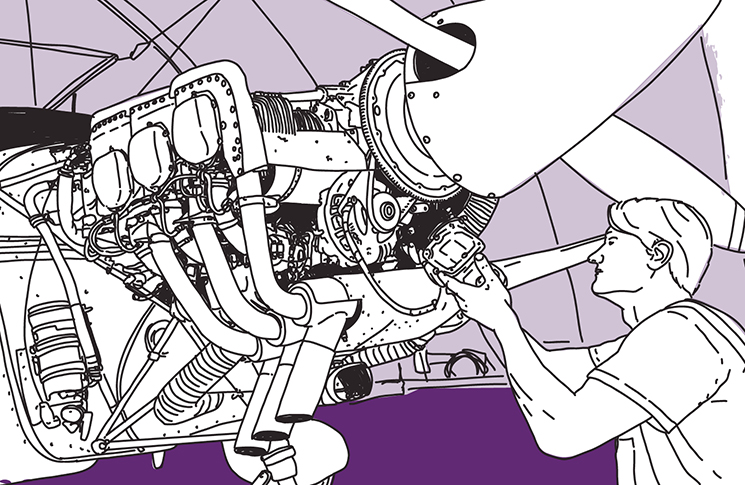
Trent Baker didn’t set out to be a pioneer in Australian aviation but that’s what he has become. As the first licensed aircraft maintenance engineer (LAME) to obtain his licence through self-study in a modular framework, he represents a new breed in the profession.
His qualification was blended from elements once thought disparate – practical experience, theoretical study, distance education and on-the-job oversight. But Baker won’t be unique for long – the modular/self-study pathway will begin producing a steady stream of qualified engineers from this year.
It’s no secret the 2010s and 2020s have been challenging years to be, or find, a LAME. A new training and licensing system under Civil Aviation Safety Regulations Parts 66 and 147 was introduced in 2011. It allowed engineers additional privileges on their licences and removed some onerous sign-off requirements. Avionics engineers no longer had to be roused from their beds to authorise a simple sign-off on a night shift; qualified engineers – engine, airframe or electrical – could now authorise minor avionics sign-offs.
‘It brought in efficiencies for operators, was more flexible and meant better utilisation of qualified engineers,’ CASA Manager Specialist Services Sam Palaskonis says.
The changes were mostly welcomed by the aviation industry. However, demographic trends, namely retirements and a slump in LAME numbers entering the workplace, hit a trough in 2015. While a boom in mining and resources stimulated aviation, it also soaked up many young trades-minded people who were tempted by the fortunes to be made in fly-in-fly-out work, over a more modestly rewarded career in a maintenance hangar. At the same time, remaining LAMEs were ageing. ‘In general, the average age of the LAME workforce has increased over the last 10 years,’ Palaskonis says.
Numbers slowly began picking up over the remainder of the 2020s as a trickle of younger engineers joined the industry, many of them from airline training programs. In 2019–20, 192 engineer licences were issued, compared with 90 in 2016–17. Then came COVID-19.
Its effects were felt around the world. The active global airliner fleet fell from 26,000 aircraft to 9,000 between February and April 2020. Maintenance repair and overhaul (MRO) spending worldwide halved, according to consultancy firm Oliver Wyman. Many engineers already in the twilight of their careers took redundancies and left the industry.
A modular solution
Industry bodies lobbied for a more flexible system of LAME training and in December 2023, CASA introduced the modular licence self-study pathway to LAME qualifications.
A modular licence means the study of aircraft maintenance is broken into modules, covering airframe, propulsion, electrical systems and instrumentation. Engineers under training are assessed continually and when they have completed the elements of a module, they can be signed off and can work on those elements.
The scheme enables people to obtain an initial licence and get into the workforce sooner than before. As they undertake training and build their skills over time, the work they are authorised to perform expands, ultimately leading to a full licence. Maintenance organisations also have flexibility to expand the licence scope of their employees to meet the needs of the business.
The airframe-only modular licence is based on completing 8 basic knowledge exams (7 for a turbine powerplant-only licence) along with signed-off experience. The issued licence comes with exclusions that can be removed as further exams are passed and experience gained.
The basic knowledge modules are:
- mathematics
- physics
- materials and hardware
- maintenance practices
- human factors
- aviation legislation
- basic aerodynamics
- piston aeroplane aerodynamics, structures and systems
- turbine aeroplane aerodynamics, structures and systems
- helicopter aerodynamics, structures and systems
- gas turbine engines
- piston engines
- propellers.
All licence holders must complete mathematics, physics, materials and hardware, maintenance practices, human factors and aviation legislation modules.
The system has the advantage of flexibility and can be made to fit individual ambitions. Someone who wants to work on piston engines, for example, need not study turbines as part of their LAME qualification. But if they want to later move to turbine qualification, they can add necessary modules through self-study learning or under a Part 147 maintenance training organisation (MTO).
Modular licences aim to alleviate the shortage of licensed aircraft maintenance engineers by simplifying licence acquisition or re-entry into the profession after extended breaks, and to facilitate military-trained engineers switching to civilian employment and foreign licence holders seeking Australian qualifications.
In the real world: Trent Baker
Four years after graduating with a university degree in civil engineering, Trent Baker decided the life of commuting to an office to sit in front of a computer as a junior design engineer was not for him.
‘I wanted to change, I wanted to do something more hands-on,’ he says.
‘About that time, I had just got my recreational pilot’s licence. So, I thought I’d give aircraft maintenance a try. I went to Aviation Australia and did the pre-apprenticeship theory course there. That was in 2020.’
He completed an apprenticeship with a flight school at Toowoomba Wellcamp Airport in Queensland, servicing its fleet of training aircraft. ‘They are small GA aircraft, so we don’t have pressurisation or oxygen or any other complex systems to work on,’ he says.
‘My employer signed me up for a diploma through Aviation Australia, so I started the diploma but one of the other people at work here started looking into the CASA pathway. I had a look at that route and realised that it would be a much quicker pathway, a lot cheaper for me to go that route just to get an initial licence.
‘I’m still enrolled in the diploma, and I plan to finish that, but it was just a much quicker and cheaper way for me to get a licence for what I needed at my current employer and if I want to add to it later, I can.’
In the medium term, Baker plans to have his licence’s electrical exclusions removed with further study and experience. ‘Once I do that, I’ll potentially look at doing my B2 [avionics] licence,’ he says.
‘But for now I enjoy just working and not studying.’
Find out more about modular licensing at casa.gov.au/maintenance
Currently exclusion removal is available via a Part 147 MTO. A regulatory change process is in progress to enable a modular licence holder to remove exclusions from their licence via the self-study pathway.