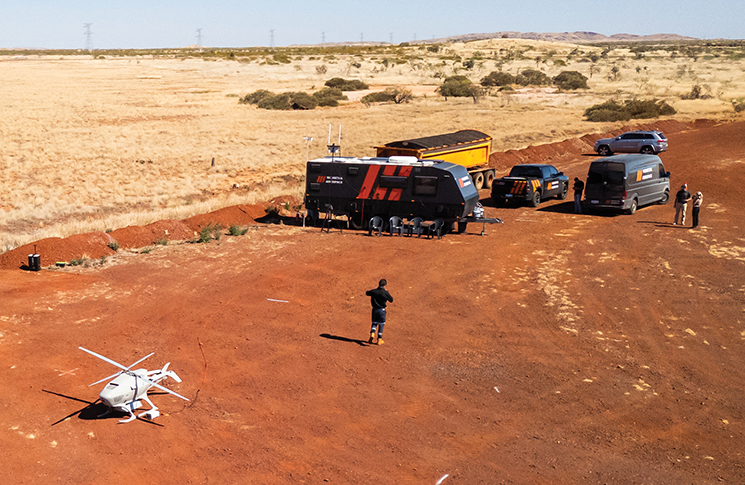
The aviation landscape is changing and the era of large drones is on the horizon.
The popularity of remotely piloted aircraft systems (RPAS), more commonly known as drones, is strongly rising. CASA now says it has issued more than 40,000 remote pilot licences (RePLs), a figure that has more than doubled since the start of the decade.
But drones are no longer just the hobby quadcopters people fly for fun.
Start-up company Wedgetail Aerospace, operated out of Jandakot in Western Australia, is at the forefront of the large drone industry in Australia: they are the first Australian company to receive CASA approval for exhibition flights using large drones.
How big is big?
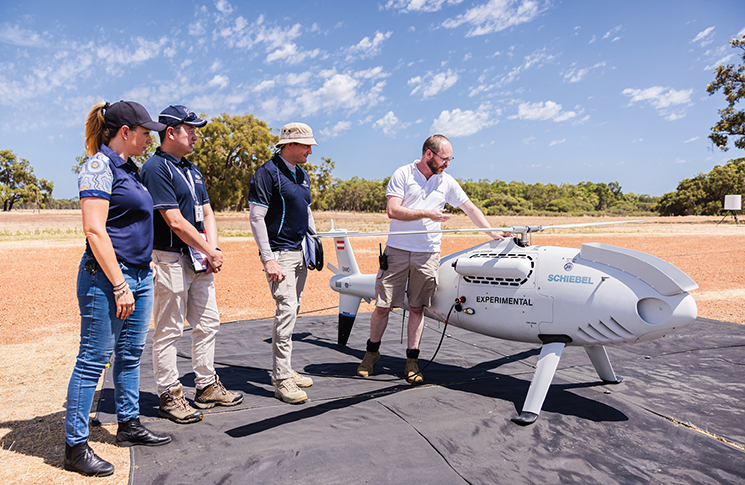
CASA classifies a drone as large if they weigh over 150 kg. An example is the Austrian-designed Schiebel Camcopter S-100. It has a maximum take-off weight of 200 kg, can reach 200 km/hr and climb to 18,000 feet. But all that capability means they can cost upwards of $1 million. The price includes the aircraft, ground control station, omni-directional antennas and backup systems.
Filling the gaps
Wedgetail was founded on the belief that drones could go where crewed aviation can’t – reaching remote areas, navigating challenging terrain, inspecting mines and stepping in during high-risk search and rescue operations. These scenarios suit the large category of drones.
‘The [helicopter drones] are very versatile. They can carry a range of payloads, sensors and cargo pods. They can stop and hover when needed. They’re very flexible,’ Wedgetail chief pilot Steve Penfold says.
As an example, the Schiebel S-100 can carry a wide range of sensors and equipment, up to 50 kg. This might be high-resolution cameras and infrared sensors for surveying power lines or inspecting large areas. It can support multiple payloads at once which offers the flexibility to adapt to diverse industries such as the energy sector one day and emergency response the next.
There is an ever-evolving role for drones, potentially supporting a safer approach to the low and slow jobs that can sometimes be too dangerous for crewed aviation.
‘I think RPAS will continue to play a role in remote and high-risk environments – such as flying at night, below the lowest safe altitude that normal crewed aircraft would fly. [This would include] long-range, low-level operations and in hazardous environments,’ Penfold says.
Planning for safety
Operating a large drone requires more than simply switching it on and taking off.
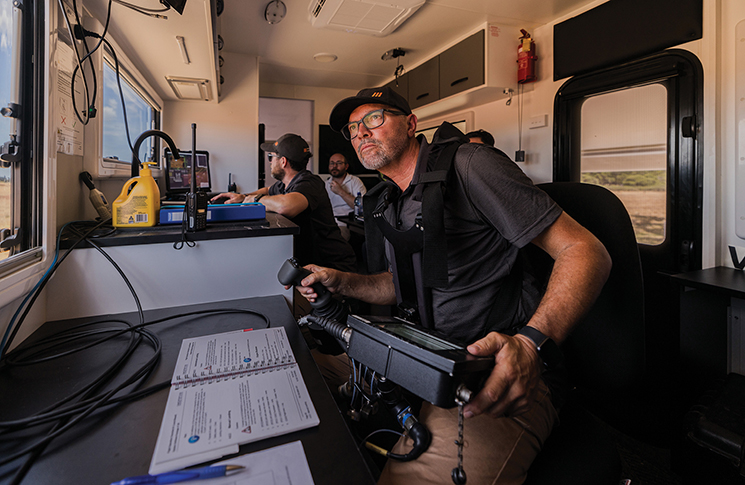
Many large drones operate beyond visual line of sight (BVLOS), meaning the pilot controls the drone remotely without having it in direct view.
Penfold says it differs significantly from general aviation in that you can’t go to the airport, file a flight plan and jump into an aircraft for the day. BVLOS operations often require months of planning.
Operators must conduct a specific operations risk assessment (SORA) which is submitted to CASA for approval. The assessment requires operators to consider all levels of safety to identify risks to people in the air and on the ground, then identify the mitigations they can put in place.
The resources used in crewed flight planning often translate into drones, such as an electronic flight bag (EFB) and the charts available in the in the Aeronautical Information Package (AIP).
‘I’ll put [the mission flight plan] on all of the maps to work out whether there’s any VFR routes or waypoints or any areas that might be restricted or have a certain intensity of crewed aviation activity,’ Penfold says. ‘Then I’ll go, OK, maybe I’ll change my plan around that particular waypoint – it might be an IFR waypoint that you haven’t anticipated near an airport. You just want to avoid pinch points or potential conflict points.
‘So using the variety of airspace charts that are available to us and overlaying your flight plan on that lets you build better situational awareness of what to expect in the area of operation.’
Lessons from crewed aviation
Penfold, who comes from a traditional crewed aviation background, says the lessons he learnt in flying have been imperative in flying medium and large drones.
‘We operate under a sterile cockpit when we’re flying our BVLOS missions so that it’s all essential communications only between the crew,’ he says.
Generating and interpreting NOTAMS, as well as using radio broadcast procedures, are also used as mitigators against identified risks in the airspace.
‘The confidence to talk on the radio to other aircraft really comes from crewed aviation,’ he says. ‘People who go through a RePL and spend some time in the field will build confidence in that. But having come from crewed aviation, you’re quite used to talking on the radio. And in my experience, it terrifies some people, so to just have a little bit of confidence in talking on the radio goes a long way to keeping things safe.’
Other safety insights include the use of a safety management system and the use of checklists.
‘When you’re in crewed aviation, you always pull out a checklist. Even when you fly a little Cessna, you usually pull out a checklist. We do the same. No matter what drone we’re flying, we’ll use a checklist. And not just to set up the aircraft, but for every phase of flight – even when you’re en route in a mission, every 15 minutes there’ll be a check to do or there’ll be a radio call to make. So having a checklist just keeps everything running smoothly.’
Exploring the possibilities
Wedgetail has showcased the potential of large drones through some of their projects. A recent trial was flying a drone between Karratha and Roebourne Airports in the Pilbara region, approximately 33 km.
‘It was a big step, really,’ Penfold says. ‘It wasn’t a huge distance but it actually proved the concept – we could fly a helicopter drone with a cargo pod and transport equipment between 2 centres in a remote location and under a BVLOS flight.’
It wasn’t a huge distance but it actually proved the concept.
The company has also trialled its aircraft for geophysical surveys which require long-range endurance and the ability to fly at low levels.
Pushing the limits
As a relatively new technology, using large drones is not without its challenges.
In Australia, regulatory pathways for commercial operations using large drones are complex and still evolving. CASA is working to create a pathway as outlined in its recently refreshed RPAS and Advanced Air Mobility Strategic Regulatory Roadmap.
But the regulatory challenges haven’t stopped Wedgetail from looking toward the future.
‘We’re going to continue to expand our long-range, long-endurance RPAS operations,’ Penfold says. ‘We want to continue to train on newer types as they come along. There are a lot of exciting technologies coming out in the powered-lift space, in the aeroplane and even in the multi-rotor space.’ 
Further reading
See the RPAS and Advanced Air Mobility Strategic Regulatory Roadmap.