

Your take-off was flawless. Your approach? Textbook. And then – taxi time. One hand on the stick, while the other completes post-landing checks. Next, your mind drifts off to how buttery your landing was, just as your post-flying buzz kicks in.
The radio crackles, intercepting your thoughts and the tower bellows your call sign: ‘Hold position! Traffic crossing ahead!’
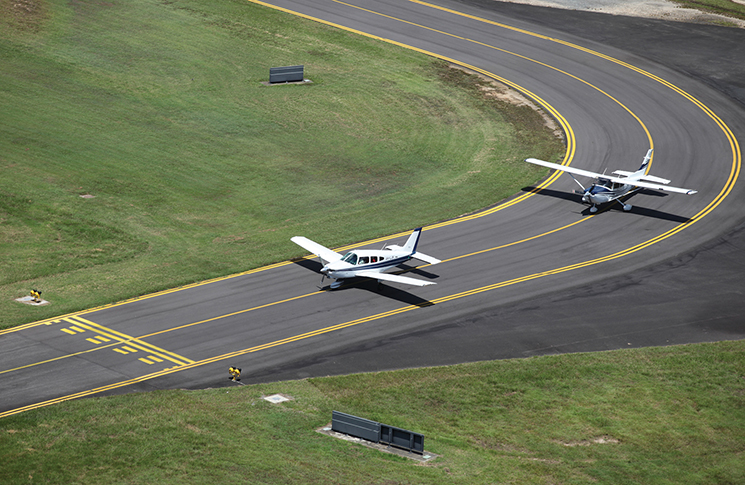
Your stomach drops. You hit the brakes and glance up. Yep. There’s the Piper Warrior you missed! The instructor and student pilot throw you ‘that look’ as they pass you down the taxiway to the holding point.
Phewwww! That was close.
No harm done (this time). But that’s the point – taxiway safety is rarely dramatic until it is. Those quiet, in-between moments on the ground? They’re a minefield of tiny decisions, habits and distractions that, stacked together, can bite you when you least expect it.
Taxiway hypnosis
Taxiing is often the neglected stepchild of pilot planning, particularly in familiar surroundings. But remember the principle of ‘aviate, navigate, communicate’ still applies during ground operations.
We rehearse rotations, brief approaches and visualise the perfect flare. But taxi? That’s just the thing we do on the way to the important stuff, right? Not exactly.
Here’s the behavioural trap – our brain shifts gears once the wheels leave or touch the pavement:
- after take-off, adrenaline spikes and attention sharpens
- after landing, tension releases, and mental checklists start closing like browser tabs at the end of the day.
Meanwhile, you’re still moving a tonne of aluminium through an active environment, sometimes within metres of other moving metal. It’s not downtime. You’re still doing complex, high-consequence choreography – and one misstep is all it takes.
Sharpen your taxi game
Here’s how to turn those in-between moments into a display of quiet mastery:
Brief the ground phase
Before the prop spins, picture your route. Listen to the ATIS when relevant. Know your runway. Check the windsock. Visualise hold-short points, hotspots and exit strategies, like you’re rehearsing a routine. Precision starts with mental rehearsal.
Go sterile
Taxiing isn’t the time to discuss lunch options or weekend plans. Adopt a sterile cockpit rule: no non-essential talk until you’re clear. If anything, your passengers will be impressed by your professionalism.
Look, talk, check
Make it a rhythm:
- look – scan before you move
- talk – clear, confident radio calls
- check – confirm your clearance matches your mental picture.
Smooth, simple, safe.
Build situational awareness
Taxi diagrams aren’t just for students. Trace the route with your finger. Say it out loud if you need to. The pros don’t guess, they prepare. But remember, situational awareness isn’t just navigating the airfield and other moving traffic; it’s everything in your environment including: a setting sun, poor visibility due to a sudden downpour that blurs all taxiway markings, plane spotters snapping photos, excited passengers, parked aircraft, helicopters, birds, wildlife. You name it – anything around you is a potential hazard, especially if you’re pre-occupied with controls and dials and have your head in the cockpit.
Stop for distractions
If something unexpected happens – someone transmits over your call, a passenger asks a question as you’re listening for the ATIS or your phone’s vibrating in your pocket and you failed to hear the full clearance – don’t assume. Reset your mind. Ask the tower to repeat the clearance (yes, again) and politely ask your passenger to wait, because your current state will influence everything that comes next. Lingering distractions can snowball into critical errors later in the flight.
When behaviour becomes muscle memory
What separates the calm pros from the flustered ones isn’t talent, it’s proficiency and practice. The more disciplined you are in your taxi habits, the less room there is for cognitive drift.
Think of it like aerobatics: you wouldn’t improvise a barrel roll at 500 feet. Instead, you practise, drill and embed muscle memory at height. So, when you go lower and the stakes are higher, you’re prepared. Taxiing deserves the same deliberate precision.
But even if you become or are the calm pro, you must stay vigilant and present. Because as your hours go up and you’re familiar with the aerodrome, you can fall victim to a psychological term known as automaticity. One definition of this is, ‘Automaticity is the ability to do things without occupying the mind with the low-level details required, allowing it to become an automatic response pattern or habit. It is usually the result of learning, repetition and practice.’
Once we’ve repeated an activity enough, it becomes habitual – it runs on autopilot. The brain no longer needs to consciously direct every step, which frees up space to think about other things.
That’s how you can chat with your instructor and taxi, when once you couldn’t, or taxi to the holding point without rehearsing your radio call. And when you’re the ‘calm pro’ or somewhere in-between but comfortable, it’s easy to go through the motions of being cleared to holding point A8, runway 29R – when it’s 11L. Remember, autopilot isn’t active listening.
Intentionality is your power pack
The best pilots treat the ground phase with the same focus as a precision approach. They brief it. They know that safety isn’t a switch you flip at 200 feet AGL. It’s a thread that runs from chocks-off to engine shutdown and safely tucking away the aircraft.
But here’s the catch: staying sharp isn’t just about procedures. It’s about knowing when your focus has slipped and how to reset before a small lapse snowballs.
For example, an instructor asks a student taxiing directly toward the fuel bowser, ‘What would you do if a brake failed right now?’ The student should realise how little margin there is. One slip in focus, one brake failure while swinging the tail around and you could end up rolling nose-first into the bowser, a fireball waiting to happen. Ideally instructors will practice distraction management and won’t begin a flight debrief until the aircraft is parked and shutdown.
That’s the point of the reset. It doesn’t have to be dramatic. It’s about staying ahead of the aircraft, even on the ground.
So next time, before you release the brakes to taxi, ask yourself, ‘Am I here? Or am I distracted?’
If you sense even the tiniest distraction, hit reset; because on the ground, sharpness is every bit as vital as in the air.
CASA Aviation Safety Advisor Terry Horsham reinforces the point that pilots should try to reduce distractions during taxiing.
‘Runway incursions are an increasing problem worldwide,’ he says.
‘Taxiing is a time for heads up and looking out. Monitor your speed and be prepared to stop and ask if you become unsure of your position on
the aerodrome.’
Final approach: stories that stick
Taxiway incidents rarely make the headlines, but they do become hangar gossip across the airfield. In fact, taxiing is often a stage where complacency hides – and you don’t spot it until it’s called out, or your Foxbat is nose-to-nose with a King Air.
The lesson?
Taxiing feels simple until it isn’t. Every flight starts and ends on the ground. So taxiing is a skill worth honing. And, while it’s never going to make the highlight reel of your flying career, it’s part of every flight.
So, taxi like a champion. Be disciplined and present. And, let’s keep those in-between moments routine but uneventful – the way they’re meant to be.
Controlled aerodromes and operations is one of the special topics on our Pilot safety hub. Refresh your knowledge at casa.gov.au/pilots