
When most people think about firefighting, they picture crews in full safety gear making their way into a burning building. What they might not picture is a drone operator standing nearby, feeding real-time intelligence to the people making the decisions.
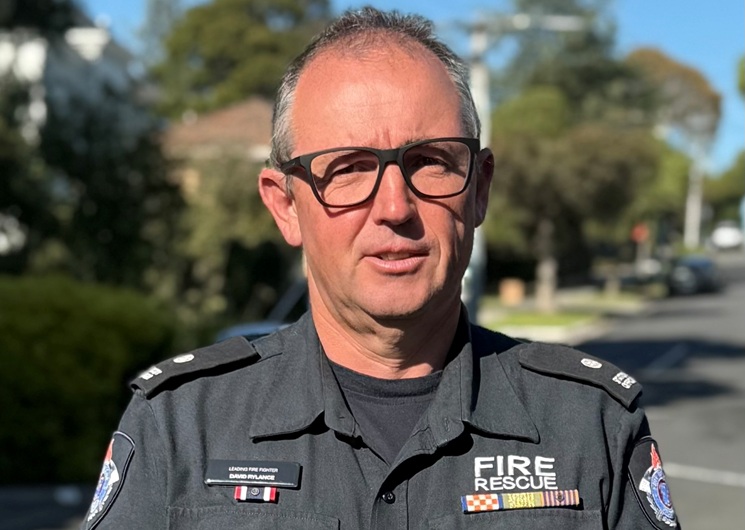
That is exactly what David Rylance does.
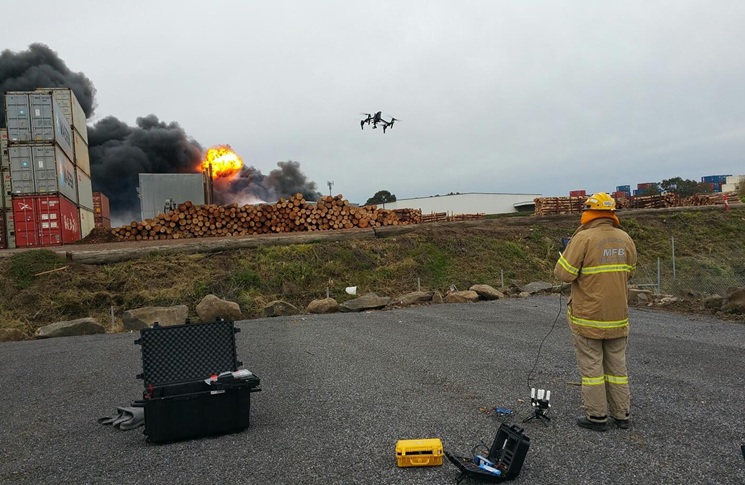
As chief remote pilot at Fire Rescue Victoria (FRV), he coordinates drone response to incidents across the state, from structure fires to hazardous materials incidents. No 2 days look the same. When an incident management team calls for support from remotely piloted aircraft systems (RPAS), his job is to get eyes on the situation quickly.
‘We work closely with incident controllers and incident response personnel to provide timely intelligence to aid swift decision-making,’ Davis says. ‘This ensures firefighter safety by closing critical gaps in information without compromising the welfare of our team on the ground.’
This is central to everything FRV’s drone program does.
Eyes where firefighters can’t go
When there is danger in sending in a person, a drone becomes essential.
‘RPAS offer the greatest advantage operationally by reaching areas deemed unsafe for firefighters to enter, either due to the landscape or structural integrity of a building,’ David says. ‘A drone is small enough to access hard-to-reach areas and the technology can provide much needed intelligence to the emergency management team in real time.’
Thermal and optical sensors allow the team to detect hotspots and fire activity invisible to the naked eye. The most common callouts are to structure fires – in those high-risk environments, RPAS really earn their place.
Must-have versus nice to have
Deciding what technology is necessary versus nice to have is a constant conversation. David says the answer starts with the reality that FRV attends a wide range of incidents and doesn’t always know all the variables when a callout comes in.
‘To keep firefighters safe, FRV RPAS require additional capabilities to that of a standard drone, including thermal and optical sensors to allow visibility and heat detection in an instance that may not be safe to send a firefighter into,’ he says. ‘We know technology is rapidly advancing and the list of nice-to-have capabilities will continue to grow, which is why we continue to engage with the aviation industry and test emerging technologies to assess if there is viability for emergency response.’
Most recently, FRV tested beyond visual line-of-sight (BVLOS) operations in an emergency scenario, producing a research report with recommendations for the broader industry.
Firefighters first
All FRV’s drone pilots are trained firefighters. To earn their place as remote pilots, they complete specialist aviation training, obtain a remote pilot licence (RePL) and undergo induction on FRV’s specific systems and processes. To stay operational, they must complete a flight of at least 30 minutes every 90 days.
David also develops and delivers internal training and runs information sessions about FRV’s drone capabilities for both internal and external agencies. He says education is key to making sure the people on the ground understand what the drone team can do for them.
David’s safety tips
Before launch, know your variables and brief your team thoroughly. Plan for conditions to change mid-flight, because things on the ground rarely stay the same.
Know your drone’s capabilities before you rely on it. Be clear about what it can and can’t do. Don’t wait until it matters most to find its limits.
Stay current through regular practice. FRV’s standard is 30 minutes of flight time every 90 days. This is not a paperwork exercise. It can be the difference between confident operation and fumbling under pressure.
Looking ahead
Keeping pace with rapidly evolving technology is one of the biggest challenges the program faces. But David is quietly optimistic about where things are headed. ‘I see FRV RPAS continuing to explore ways we can assist in keeping our people and the community safe, by providing reliable and timely intelligence to the people that need it, when they need it, to provide a quick resolution of the incidents we’re called to,’ he says.
In a job where seconds matter and the stakes couldn’t be higher, having a drone overhead can mean the difference between a good outcome and a tragic one.
If you would like to feature in Drone flyer diaries, please email us.