
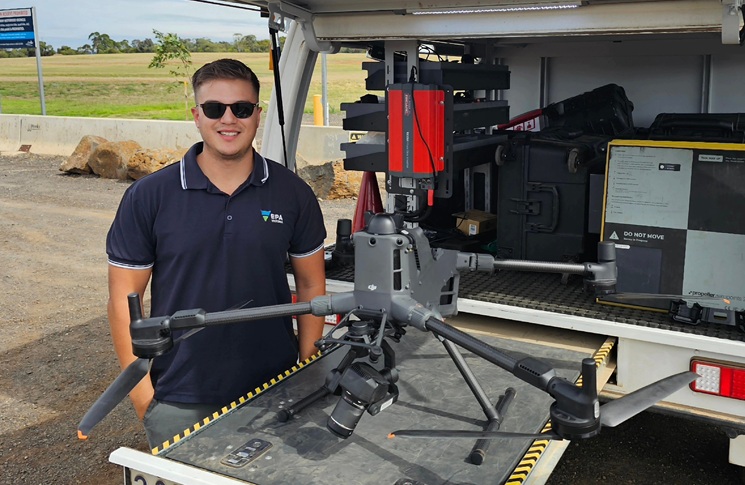
Nehuen Salina’s office changes every day. As Environment Protection Authority (EPA) Victoria’s Chief Remote Pilot, he operates drones in some of Victoria’s most challenging environments to protect public health and the natural world.
But EPA drone operations are often conducted in areas where the risk to aircraft and operator is high. Think emergency situations, polluted ground and populated areas. Maintaining safe operations is central to Nehuen’s role, and it’s a challenge he takes seriously.
EPA Victoria operates around 30 drones across a wide range of tasks: evidence collection, surveying, thermal imaging and deploying ground-penetrating radar. They are valuable resources when it comes to protecting Victoria’s fragile environment.
‘No day is the same,’ he says. ‘One day I could be in Melbourne; the next in Mildura or Geelong. It’s constantly a life-on-the-road kind of job, which I love. Every day is different, and every day we’re collecting evidence to minimise the harm to human health and the environment.
‘It’s a very rewarding job using advanced equipment, and I’m happy to be part of a team that shares the same goals for our environment.’
The organisation holds a remotely piloted aircraft operator’s certificate (ReOC) up to 25 kg. All team members hold remote pilot licences (RePL) up to 25 kg multi-rotor, and the team is working towards an extended visual line-of-sight (EVLOS) approval.
Their work is critical to protecting the environment and public health. That makes safety non-negotiable, particularly when it comes to operations around people.
Safety on the job
EPA Victoria follows all CASR Part 101 rules, regardless of the situation.
‘For example, when we’re flying a survey, depending on the location, we will put a stop-work order out to maintain that space from people so we can do our thing safely,’ Nehuen says.
‘Thankfully, 95% of the areas we need to fly over are open space (landfills, farms), so there aren’t too many additional precautions that are out of the ordinary that we need to take into account.’
Sometimes operations bring EPA into contact with active emergency sites. In those cases, safety still comes first.
‘For example, the warehouse fires that happened in the western suburbs of Melbourne,’ he says. ‘There’ll be a big response from the emergency services and EPA Victoria needs to be there to monitor the flow of the chemicals used to put the fire out.
‘There’s a lot of co-ordination with the emergency services, because they use drones as well. That can be an interesting challenge because drones are becoming more common with emergency services.’
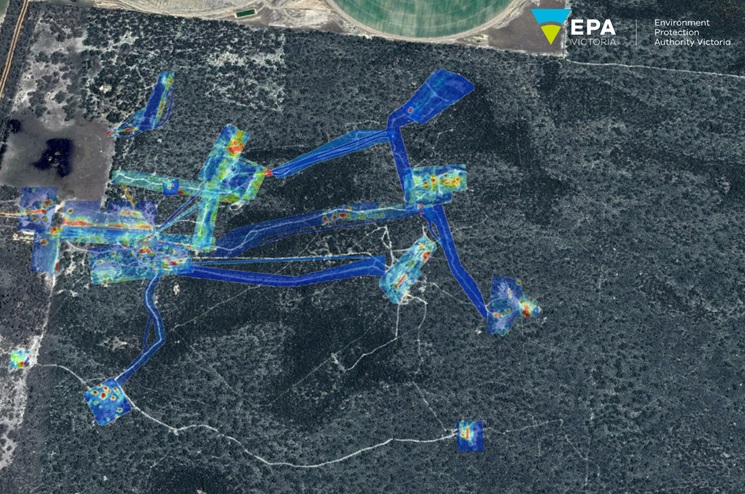
Nehuen also recalls a case involving illegally buried hazardous waste. EPA Victoria used drones equipped with ground-penetrating radar to help locate the waste. This reduced the risk of EPA workers being exposed to dangerous materials, including gas cylinders.
Nehuen’s safety tips
Working with EPA Victoria has given Nehuen a depth of experience. His advice for new operators:
- Know the rules and why they exist. Flying a drone is the easy part. Multi-tasking covers staying clear of people, avoiding controlled or dangerous airspace and operating a drone suited to your capability. That’s what makes a good pilot stand out.
- Start small. A lot of people get excited and want to get into big drones straight away, but smaller drones are easier to control. Build confidence before you move up.
- Be open-minded. Not everyone views drones in a positive light. As a remote pilot you represent the drone community. Work with the public and don’t ruin it for everyone else.
- Expect the unexpected. Anything aviation-related drills this into your head, and drones are no different. Always prepare for the worst
If you would like to feature in Drone Flyer Diaries, please email us.