

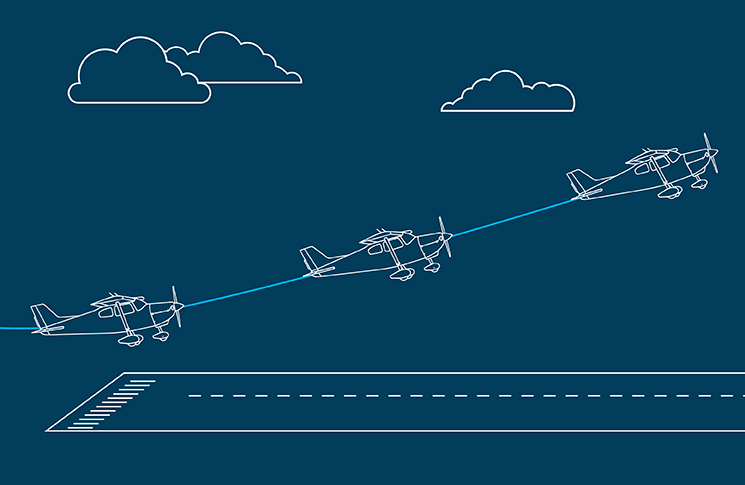
My first solo was actually 2 go‑arounds and a landing.
After flying with the head of operations earlier that morning (and finally letting go of his leg when he said I was ready), I was surprised how much faster the aircraft climbed without him on board. I reached circuit height sooner than expected and, almost immediately, my carefully rehearsed mental picture began to unravel.
I knew all take-offs were effectively a land-or-die situation, but somewhere along the downwind leg, my training cut through the nerves. I remembered something simple – I can always go around.
I was too high, so I did.
The second circuit gave me time to reassess, but the profile still was not right, so I went around again. By the third circuit, everything slowed down. The approach stabilised, the landing worked and my instructor was beaming. His reaction cemented the lesson that has stayed with me ever since – good landings start with good decisions.
Culture matters
Parafield-based instructor Emma Homes says attitudes toward go‑arounds often come down to culture rather than skill.
‘I used to teach at a flight school that was big on go-arounds,’ she says. ‘We taught a lot of international students and had to reinforce that going around wasn’t losing face. Otherwise, some would try to force the aircraft onto the runway.’
Years later, returning to flying while completing a retractable endorsement and flight review at Parafield, she experienced a different reaction.
‘I wasn’t happy on an approach, so I went around. The instructor was flabbergasted and argued with me about it. They saw a go-around culture as more dangerous than trying to fix it.’
For Homes, the takeaway is simple – forcing a landing carries far more risk than discontinuing an unstable approach.
From the tower
From an ATC perspective, go‑arounds are routine and expected.
‘A go-around manoeuvre is a perfectly valid option and is alwaysavailable to pilots,’ air traffic controller James Fisher says. ‘Controllers regard a clearance for final or a clearance to land as also authorisation to perform a go-around. We always keep the go‑around path clear.’
Fisher says controllers see them as normal operational events rather than problems. ‘Certainly, a go-around is a bit of a surprise, but also no big deal,’ he says. ‘It just means we have the aircraft in our airspace a bit longer and need to find a safe way to put it on the ground.’
His advice to pilots is to recognise early when an approach is not working. ‘What nobody wants is for a dodgy final to lead to a dodgy landing.’
Communicating clearly
Fisher says the priority sequence does not change during a go-around. ‘Aviate, navigate, communicate – fly the aircraft first.’
Controllers will usually see a go‑around within seconds and begin planning immediately. ‘On a visual approach, you should climb straight ahead and await instructions,’ he says. ‘Maintain runway centreline, climb to circuit height, configure the aircraft and then report going around.’
He adds that in busy environments, less radio chatter is often better. ‘Ironically, the busier the airport, the less we want to hear from you. ATC will already be managing separation with other traffic.’
What ATC manages behind the scenes
Fisher says workload depends on the type of operation. ‘For VFR aircraft in controlled airspace, not much changes’, he says. ‘We keep upwind open, issue instructions to other aircraft if needed and work out a plan for sequencing you back in.’
For IFR aircraft flying the published missed approach, coordination becomes more complex. ‘We initiate coordination with approach controllers and quickly decide how to get the aircraft back on the ground. That might be vectors for another approach or keeping them on the missed approach procedure.’
Forcing a landing carries far more risk than discontinuing an unstable approach.
When pilots wait too long
Fisher says delayed decisions are most common during training. ‘Instructional flights tend to run long while instructors wait for students to stop pressing ahead with a bad final.’
He adds that runway length can influence behaviour. ‘At somewhere like Avalon, with a long runway, go‑arounds are rare because aircraft can land much further down. But the decision to discontinue a bad approach always rests with the pilot.’
A practical example
OzAeros head of operations David Pilkington recalls a training flight that highlighted how easily pilots delay the decision. The student repeatedly flew approaches at 75 knots instead of the recommended 65 for the type of aircraft and called the approach stable despite being outside tolerances. Several opportunities to go around were missed before touchdown occurred near the far end of the runway,
forcing intervention.
Pilkington says the experience reinforced the importance of setting clear criteria before landing. ‘It is good practice to decide a point on the runway by which you will go around if you have not touched down,’ he says.
His briefing now places greater emphasis on stable approach criteria and early decision-making. He says one of the most effective ways to reduce hesitation is to brief go‑around triggers before every circuit session.
‘Students should know before they turn final what conditions will trigger a go-around,’ he says. ‘If airspeed is outside tolerance, if the descent profile is wrong or if spacing is not working, the decision should already be made.’
He says a common trap is believing a poor approach can be fixed late. ‘Most unstable approaches start well before short final. If you are still trying to salvage it at 200 feet, you are already behind.’
Pilkington also encourages pilots to nominate a visual decision point on the runway. ‘Pick a reference. If you are not on the ground by that
point, go around. That removes the hesitation and the second-guessing.’
He says go-arounds should be treated as routine rather than exceptional. ‘The safest pilots I see are the ones who go around early and without hesitation,’ he says. ‘The aircraft does not care about your pride.’
Build the habit early
Many instructors say the key to safe go-around decisions is normalising them early in training. That starts with clearly defined stable approach criteria and consistent reinforcement that discontinuing an approach is routine.
Students should practise go‑arounds regularly in both calm and challenging conditions so the procedure becomes automatic rather than emotional. Verbalising decisionpoints on downwind and final also helps reduce hesitation. Importantly, the decision does not need to be justified after the fact. If the approach does not feel right, that is reason enough.
Normalise the decision
For many pilots, go-arounds remain tied to ego. Yet across instructors, controllers and operational experience, the message is consistent – a go-around is not a mistake; it is sound judgement.
The earlier the decision is made, the simpler and safer the outcome usually becomes. As I learnt on my first solo, a go-around is not a failure; it is good airmanship.
Five times you should go around:
- the approach is unstable on speed, descent or alignment
- you are too high or too fast and cannot correct early
- you will land long or outside your planned touchdown zone
- traffic, spacing or runway conditions change
- something simply does not feel right.
Flight planning is one of the special topics on our Pilot safety hub. Refresh your knowledge at casa.gov.au/pilots.