
- Sikorsky S-92, VH-IPZ
- Indian Ocean north-west of Broome, WA
- Sunday 16 October 2022
‘A professional does not act out of fervour and is therefore more calm and less likely to make elementary errors.’
Frederick Forsyth, The day of the jackal
It is lonely on a ship 350 nautical miles from land and seems even lonelier when a man is soon to die from injuries received in a deck accident.
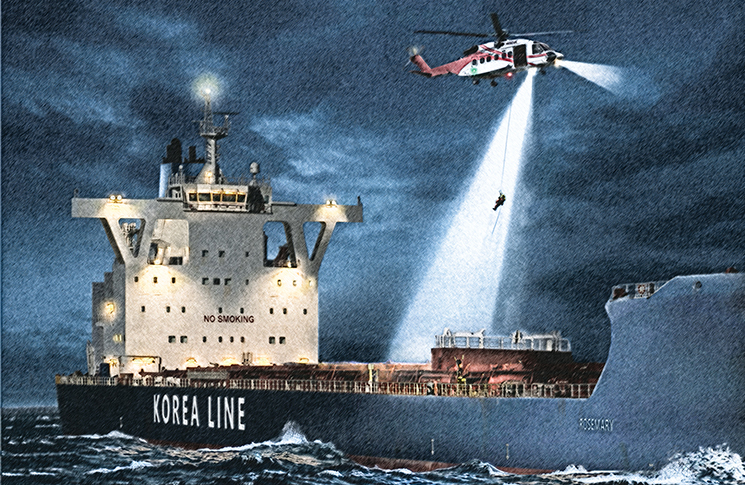
On a windy Sunday afternoon, the 292-metre bulk carrier M V Rosemary contacted the Australian Maritime Safety Authority (AMSA) in Canberra. A crew member had been critically injured. AMSA set a rescue plan in motion and the huge ship began the process of turning back towards the north-west coast of Australia.
AMSA contacted the nearest emergency medical service operator, PHI Helicopters, based in Broome. The company was an oil and gas industry aviation service that had taken on search-and-rescue operations from Broome since 2017. Its crews spent on average 50 hours a month training and preparing for this duty.
Anatomy of a prelude
At 4:34 pm, the company’s duty engineer in Broome received the medevac call-out. It would have been understandable had he dropped everything and rushed to the hangar to extract the helicopter. But his experience and real-world knowledge of human factors bade him do no such thing.
Instead, he gathered the engineering team and shared the message with them. He then returned to his task and brought it to a close, concentrating on tool control and securing the aircraft’s access panels. This was followed by a written note about the status of the task for him or any other engineer completing it to read.
The engineer then sought a quiet place away from the hubbub of the hangar. There he spoke to the AMSA control centre for a more detailed picture covering fuel requirement and special equipment needed.
Returning to the hangar, he assembled a towing team of 3 engineers. He stationed 2 at the hangar doors and the third behind him. Although he was thoroughly experienced in taking an S-92 out of the hangar, he decided to take no chances after consideration of his time on shift and the importance of the flight. He did not want a nicked rotor blade to jeopardise this journey.
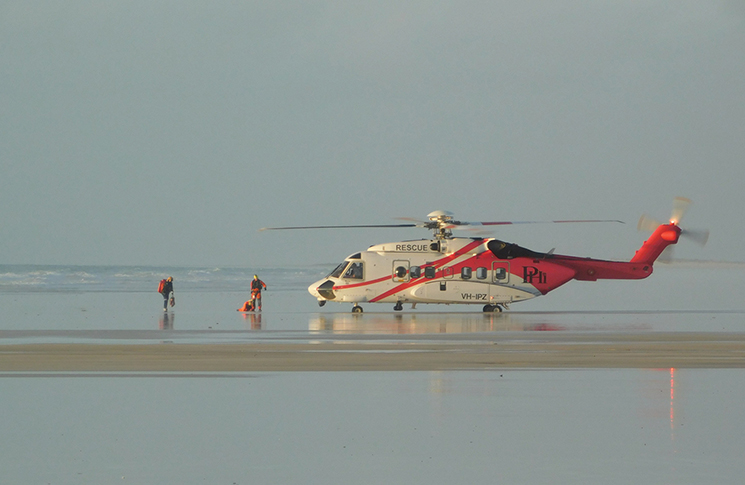
With the aircraft safely on the flight line, the duty engineer’s allocated tasks were complete, as was his duty time. He could have walked away at this point but, again, did no such thing. He proceeded to clean the aircraft windows and its forward-looking infrared (FLIR) camera housing.
Then he tested the tracker-beam searchlight, a piece of equipment he knew would be central to the evening’s proceedings – it passed. Following this, he inspected all seat belts, cabin equipment and documentation. His last duty was to call the fuel truck and supervise the fuelling.
The duty flight crew were in a resort motel 15 minutes’ drive from the airport. There was other accommodation closer to the base but PHI considered the extra investment in comfort and quiet to be money well spent. There, the 2 pilots, winch operator and rescue crew member obeyed a standing directive to do nothing more strenuous than a few laps of the resort pool in accord with the company’s fatigue risk management system. They received the activation message at the same time as the engineer and assembled, as arranged, by the crew car.
PHI flight operations manager Keith Best takes up the story. ‘It would be so easy to jump in the car to sprint towards work to go flying, but they don’t, they stop,’ he says. ‘They know they don’t do this very often and they want to do it right.
They know they don’t do this very often and they want to do it right.
‘Different companies have different ways of managing stress. For us it is a five-by-five approach: stepping back, then taking 5 minutes to think of 5 threats you may encounter and then 5 controls you might be able to apply.’
The aircraft commander applied this technique, having the crew stand and ask, ‘What have we forgotten? Is there anything in our motel rooms that we might need for the flight?’ Only after these questions were resolved did the crew get into the car, which the aircraft commander drove to the base, strictly observing the urban speed limit as part of the discipline of serenity.
There they were joined by a doctor and flight nurse from the Broome Royal Flying Doctor Service. Mission planning was deliberately thorough and took nearly 60 minutes. Questions about overwatch, frequency, weather, alternates, where exactly the vessel was and how to find it were asked and answered.
Anatomy of a journey
At 5:59 pm the S-92’s main rotor is turning and it’s in the air 6 minutes later. The return flight will be 700 nm, well beyond the S-92’s range of 592 nm, not factoring winds. But this can be managed. Although there are no fuel stops in most of the world’s oceans, the corner of the Indian Ocean north-west of Australia is the exception. In its waters floats Prelude, the world’s largest offshore gas production facility.
PHI had called the Prelude and received an immediate invitation.
Best says, ‘They could have said, “No, sorry, we can’t just turn it off – we’d lose a phenomenal amount of money”. But they said “Yes, of course you can. We will stop all activities, we will have fuel ready for you – and food, tea and coffee.”’ This last offer is declined with gratitude because full stomachs and helicopter flight by night don’t mix well. The helicopter lands on Prelude’s deck at 8:09 pm and is en route again by 8:34. After about 20 minutes, the FLIR camera begins indicating the Rosemary about 100 nm away, picking up the heat plume from its funnel.
At 9:28 pm the helicopter is approaching the ship. It’s dark – 2 hours before moonrise – and the pilots are working hard at a low-level transition from IFR to night vision goggle VFR. They must get from the safe altitude of 1,000 feet down to about 100 feet by the port (left) side of the vessel.
This is where the camera and radar altimeters come into their own but it is windy, the vessel is not on a favourable heading and, at 180,000 deadweight tonnes, will not be changing direction quickly. Regardless, the flight crew decide to ask for a change of heading to give the most favourable wind over the deck. This will allow the best flyaway should things go wrong.
The 8 minutes of this manoeuvre feel the longest of the mission but eventually the aircraft is in slow forward flight into the wind, keeping station over the side of the ship but at a 30-degree nose-away angle for best escape. The helicopter is in auto-hover mode at 80 feet, with the pilot flying it in the horizontal plane and the other monitoring the dual radar altimeters.
The rescue crew member has just graduated from PHI’s cadet program. This is her first sortie without a mentor. And her first deployment will be onto a moving ship at night. She has prepped her gear and the winch operator is beside her, going through the checklist at a measured pace, step by step.
This is her first sortie without a mentor. And her first deployment will be onto a moving ship at night.
When word comes from the flight deck, the winch operator opens the door and she clips on, checks and is crosschecked – then deploys into the darkness. Communications with the crew via intercom are crystal clear but once on deck, she has to remove her helmet. ‘I’ve never felt so alone,’ she said later.
She finds the injured sailor, with one leg removed and the other ‘hanging by a piece of skin’. A suddenly tightening cable had done the damage. The patient is lucid, wry even. In answer to the ice‑breaking question, ‘Where’s your leg gone mate?’ through a translator, he answers, ‘Lost at sea.’ The sardonic reply tells her the man is doing well under the circumstances and has been competently cared for by the ship’s crew.
The sailor’s reply informs – but does not replace – her assessment of his vital signs. She has only 10 minutes to do this and upload; if she’s not done by then the helicopter will fly away and she will join the ship’s crew. Nevertheless, she has the confidence to use the allocated time to set up a stretcher recovery for minimum stress on the patient. With one minute to spare, the beating snarl of the rotor fades into the night and the ship begins the long, lonely turn to resume its course.
When the patient comes on board, the doctor and nurse take over. But the rescue crew member and winch operator remain involved, listening to the specialists and offering assistance, suggestions and support. This is part of their participation, along with the flight crew, in a shared mental model. From their training, they know the risks have not receded.
‘You can’t sit back and think, “My piece of this is done”, it’s a team effort,’ Best says. ‘So many times when crew relax, thinking they have completed a mission, they hit wires, ground or water.’
The helicopter flies directly to Broome, arriving at midnight.
Anatomy of a culture
‘It’s on the strength of observation and reflection that one finds a way. So we must dig and delve unceasingly.’
Claude Monet
PHI’s senior aviation managers, many of them ex-rescue crew, read the incident report with admiration. Their combination of theoretical understanding and sometimes bitter real-world experience told them this was a triumph of systematic safety management, and a moment to savour amid the continuous effort of managing safety every day.
‘Culture is the largest part of this,’ Best says. ‘It is easy to place a poster on a wall or write it into a policy document, but you only truly get to examine culture when no-one is looking.’
The engineer’s actions were one among several manifestations of the elusive ‘holy grail’ of generative safety culture, where safety-focused awareness, anticipation and action permeate an organisation.
‘The actions taken by the engineer before flight, the flight crew planning process, the support from Prelude and the lifesaving actions of the new [rescue crew member] are testament to good culture, high training standards and exacting internal reflection,’ Best says.
Even so, the striving never ceases. ‘We are not afraid to hold ourselves or each other accountable where safety could be improved,’ he says.
Postscript
At the time of writing, PHI’s Broome base had completed 165 rescue missions, involving 525 flight hours and the successful recovery of
153 persons.
The sailor lost both legs but from hospital in Perth, thanked the crew and ground staff. It would be intrusive to ask which they cherished more: his gratitude or the international Sikorsky Winged S Trophy, awarded for an outstanding helicopter rescue to PHI the following year.