

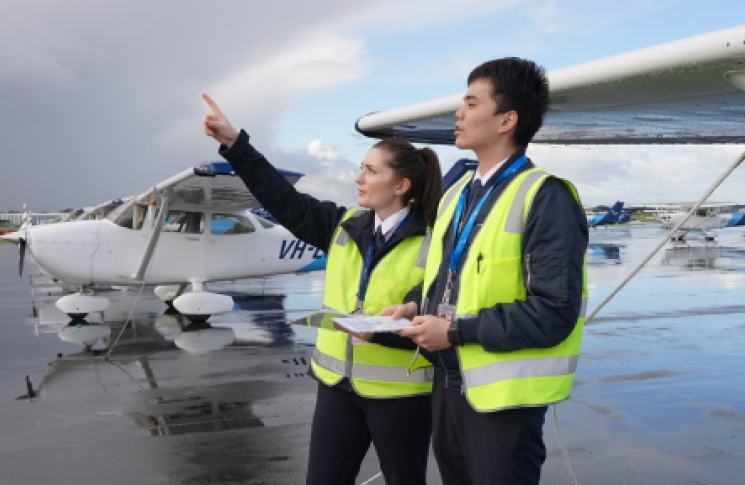
While some pilots treat weather planning as a single event, you’ve learnt to spread it out across a few days. You open your charts and review your route. Because it’s not one decision made the morning of – it’s a chain of events that reveal a pattern over time.
Look at the shape of things
About a week out, start building a picture of what the weather may do. Open a synoptic chart to get the big picture map of highs, lows and fronts. Look at the long-range forecast for the area. You’re not deciding anything yet. You’re watching for movement and changes in weather. Is the front sitting north of your track arriving or leaving? Is that low-pressure system building or easing?
If you check it once, you have a snapshot. Look 3 times across a week, and you have a narrative unfolding in real time.
Hugh McBain, Grade 1 instructor and safety manager at Royal Victorian Aero Club, says, ‘Don’t just look at the weather once and make a decision, watch how it changes and evolves. The trend is often more valuable than the snapshot. Build the habit of checking the big picture early and regularly so you can recognise the story the weather is telling you.’
When you spend a few minutes a day understanding the pattern, you’ll have proper evidence to back your ‘go’ or ‘no-go’ decision on departure day.
The picture sharpens
Three days out, check again. What’s changed? What’s the same? Are there fronts, are they moving? Will this impact your planned flight? If you’re flying to an unsealed strip and there has been rain, you may need to confirm the runway is usable.
The night before, you’re armed and ready because you’ve been watching the sky shift for over a week.
By morning, you jump into the finer details. You pull up the graphical area forecast (GAF) for your route, aerodrome forecasts (TAF), the NOTAMs and any other observations you’ve acquired. You’re using this information to fill in the details to the mental weather picture you’ve been sketching for days.
By now, it’s either confirmation or a surprise, and any surprise is to beconsidered with eyes wide open. Here’s why: In July 2025, a Beechcraft Debonair flying from Wangaratta to Moruya collided with terrain in the Snowy Mountains. The pilot, the only person on board, died. The ATSB found it very likely the pilot became spatially disorientated after flying into cloud.
What stands out is what the forecast already showed. ATSB Director of Transport Safety Stuart Godley said that based on the forecast cloud between the 2 airports, completing the flight while maintaining VFR was likely not feasible.
This information existed before the aircraft moved.The accident shows why the weather picture should inform decisions before departure. When forecasts indicate conditions that may prevent a flight from continuing under VFR, acting early keeps more options available.
Decide before you must decide
Personal minimums are your standing rules, and CASA’spersonal minimums checklistis a good place to set them.
To develop your personal minimums, you could ask yourself what are 3 to 5 adverse situations that could occur based on your current information and then provide what the solution is to each one. For example:
- If not overhead the ranges by 1,100, I turn back.
- If the cloud base is below 3,000 feet at the halfway mark, I divert to my nominated alternate and wait.
- If I take off and the weather picture looks significantly different to what I prepared for, I will return to base.
- If the visibility drops significantly, under VFR, I will assess fuel and divert my track or turn back.
Thinking through those grey scenarios and setting clear go/no-go gates or objectives will make your decision making, and any subsequent replanning, in flight much easier.
Set expectations before you fly
If you’re carrying passengers, communicate in advance, not while you’re loading the aircraft. Setting expectations early can reduce pressure later. If plans need to change, your passengers already know that this is part of safe flying.
Hugh McBain says the final decision to fly rests with you, as pilot in command. ‘You also have legal responsibilities for the safety of the aircraft and everyone on board,’ he says. ‘Set expectations with your passengers before the day of the flight, including the possibility of delays, diversions or cancellation due to weather or other operational factors. Don’t allow passenger expectations or pressure to influence a decision that should be based on safety and your responsibilities as PIC.’
Said early, it’s part of the plan. Said at the aircraft, it sounds like bad news. And no-one likes their travel plans cancelled.
Does the sky match the brief?
Once airborne, don’t just follow your planning and assume the weather information is correct. Beyond your personal or legal minimums, the task is to evaluate if what you see is what you planned for.
A forecast is a prediction. ‘Plans change and as pilots, we need to adapt,’ McBain says.
‘Think about the threat and error management chain. Changing weather is a good example. The weather itself is the threat. Continuing with the original plan despite deteriorating conditions can become the error. And, if we don’t recognise it early, it can turn into an undesired aircraft state. The key is to recognise the threat, change the plan and act early.’
Always have a backup plan. Know where you can divert to, when you need to turn back and what your options are. Good planning isn’t just about getting there – it’s about knowing what you’ll do when things don’t go to plan.
Changing the plan is part of good airmanship
When fuel is being consumed and there’s little daylight ahead, changing the plan may cost you the afternoon. Leave it longer, and you start trading your options.
‘I strive to teach my students that there’s absolutely no shame in turning back,’ McBain says.
‘Maybe your GAF reading skills need some work. Maybe you misjudged the conditions or the weather simply changed. As long as something can be learnt, the flight hasn’t been wasted. But it’s important to analyse why you ended up in the situation in the first place. Recognise what happened, learn from it and use that experience to make better decisions next time.’
If you have to stay somewhere overnight, view it as part of the adventure.
Delaying, diverting or turning back is not the plan falling apart. It’s your preparation, training and real-time judgment working.