
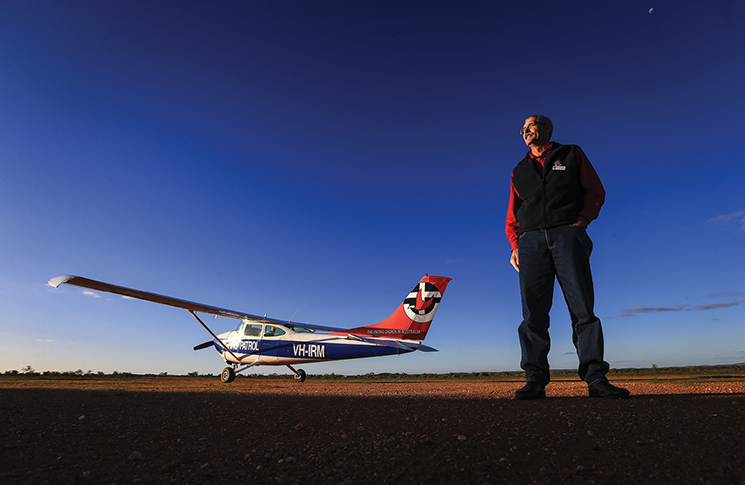
They call him ‘the flying padre’.
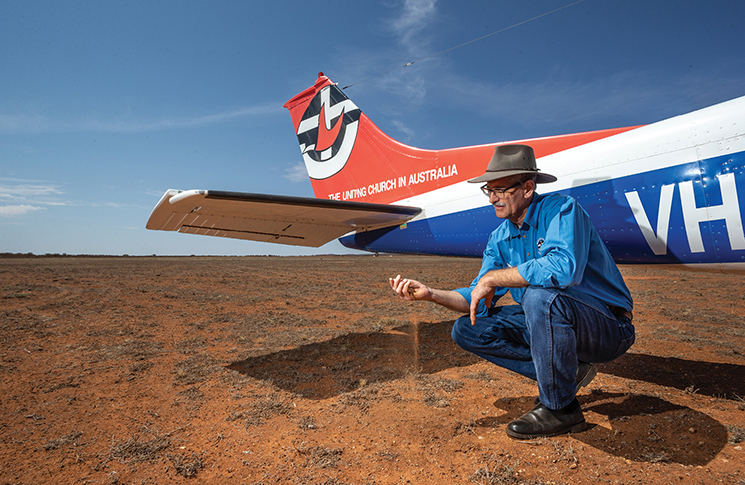
Uniting Church padre David Shrimpton has a pastoral area larger than the average minister; it takes in most of outback NSW and needs a Cessna 182 to do the rounds. From Tibooburra to Wentworth, from the South Australian border to Ivanhoe and Louth, Shrimpton delivers chaplaincy services to a very dispersed flock. Crisscrossing the vast far west of NSW, landing at sealed regional airports or rudimentary private airstrips, he has faced the challenges of outback flying for 28 years.
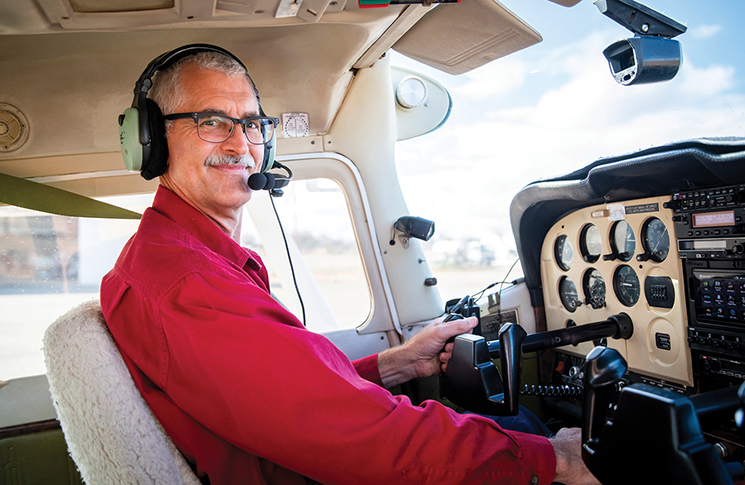
The outback is his patch, having grown up in Geelong before moving to Port Pirie and Adelaide in parish ministry roles with the Salvation Army. In Port Pirie he learnt to fly, gaining a recreational pilot certificate on a Jabiru before graduating to the C172 and later the C182 he still flies. As a pastor, Shrimpton is accustomed to listening, giving advice and sharing experiences for others to learn from.
How did you get into aviation?
My wife Jennie and I moved to Port Pirie where it was our first ministry posting. I grew up in Geelong and as a kid, I’d see planes flying around doing their circuits and think, ‘One day I’d love to do that.’ It wasn’t until I was in my late 30s that I started flying with RAAus and did about 20 hours in a Jabiru. I enjoyed that and then moved up to a C172 and C182. The Salvation Army then said to me, ‘Well, you learn to fly and we’ll be happy to help pay for your licence as one day, you may move to Darwin and fly for the Salvation Army.’ What a bonus!
We moved to Adelaide and I continued the training at Parafield. After 2 years, we were asked to go to Darwin, where I was flying into and out of Darwin International Airport. I was the flying padre in Darwin for 11 years before moving down here to Broken Hill.
I use the aeroplane for going places where it’s too far – or too slow – to drive. An hour in the air is worth 3 hours on the road. I can do a three‑day trip to places such as Tibooburra, Wanaaring, Louth, back to Broken Hill, spending time at schools and villages and calling in on a number of properties. That’s a lot easier than spending 3 hours on the road to Tibooburra, another two and a half hours to Wanaaring and another one hour to Louth – but then it could be 4 hours or more back to Broken Hill.
Do you find the places you fly to challenging?
I operate from a mixture of regional airports and private airstrips. Most regional airstrips are bitumen apart from Pooncarie, which is still gravel. The property strips are all gravel or sand or whatever it might be.
In Darwin, I was flying over an area from the Queensland border to Broome and down as far as Tennant Creek. That was more inhospitable than here in the far west of NSW. The emergency box was always in the aircraft, with food, swag and something to light a fire – all the things to be able to look after myself for a 24-hour period. Out here, if something was to go wrong and I had to put out a radio call, someone would answer within a short space of time. Whereas in Darwin, flying out of there and going out to the Kimberley and over Kakadu, if something goes wrong, you can’t rely on the radio.
What do you find are the most important aspects of planning from a safety point of view?
The pre-flight planning, knowing where you’re going and making sure someone’s going to be there when you get there. So it’s looking at the map, calling the property, doing the flight planning, looking at the weather and putting it all in place. That’s the day before, and then again on the morning of flying out. I don’t use an electronic flight bag – I stick to the maps, compass and radio. I’ve got a GPS on board and that’s held me in very good stead, but I believe it’s better to be looking outside the aircraft than inside at something electronic. There are a lot of station aircraft and they’re not always on the same frequency; they’re listening to the citizen band radio, not so much the VHF, and so I need to keep my eye out for those and not rely on an EFB to show me where other aircraft are.
Do you always put in a SARTIME?
I have a SARTIME with my wife in Broken Hill and with people I’m going to catch up with, letting them know roughly what time I’m going to be there. I text my wife once I’m on the ground and if at a property, I usually overfly the homestead.
I have mobile reception in the air in most areas but on the ground, it can be hit-and-miss. When I overnight, it’s usually in one of the small villages and they have mobile reception, so I’ll take a tablet with me and look up weather and so forth to get the briefing for the next day.
You have to plan for what you can’t plan for!
How do you cope with outback weather challenges?
I can get the weather in the morning and it’s right for the day, but the weather can change through the day or not show up on the weather report. A case in point: going to a place called Clare Station between Balranald and Ivanhoe, I can leave Broken Hill in good weather and it looks good all the way but when I get to Clare, it’s fogged in. And it’s not showing up on anything. It’s those little things you can’t plan for. You have to plan for what you can’t plan for! Conditions can be very changeable out there. Weather is a concern everywhere we fly, but this is a greater consideration across the sort of terrain that I fly over and that includes the NT as well.
When I was in my first year in the NT, if I came back in there in marginal conditions, I could talk to the tower. They would give me vectors to fly for arrival at the airstrip. But down here at Broken Hill, there is no tower. You have to be on your mettle as you’re flying around.
Have you ever failed to get back to Darwin or Broken Hill due to weather?
I haven’t failed to get back to Broken Hill due to weather. I’ve had delays getting back to Darwin due to weather and so landed elsewhere or stayed on the ground where I was and waited it out. The other thing that I obtained was a night VFR rating, which has been extremely helpful, enabling me to arrive back after dark in a safe manner, rather than pushing the envelope of last light.
I ask them if they can drive a vehicle up the strip and see how far the tyres sink in.
Obviously, you’ve got to be fairly confident about the condition of the strip when you get there, so how do you go about finding out what the strip is like, given that often non-pilots get very optimistic about their runway?
If it’s been wet, I ask them if they can drive a vehicle up the strip and see how far the tyres sink in just to ensure everything is in order. I’ll also ask them about cattle and wildlife. If something happens to one of their staff or family, the RFDS are going to come in and out of their strip, so there’s a sense that they want it to be in as good a condition as possible, because they don’t know when it might be needed.
I’ll do a precautionary search when I get to the strip to check out what it looks like. I also check for power lines, trees, runway surface and wind. If there’s no windsock, I’ll look for a windmill or for other telltale signs. I’ll also get an idea from the owner of where exactly the strip is. Some private strips can be difficult to see if they haven’t painted the tyres as edge markers or the grass has grown.
Do you need to do anything special on departure from private strips?
I give the pre-flight a little bit extra on departure, particularly checking the prop and the tyres and underneath the aircraft to make sure nothing has been damaged. Once I start up on those dirt strips, I make sure the plane keeps rolling; I won’t start and then stay stationary. Engine checks and run-ups are always done on the run and not standing still or the prop blade will pick up a stone. For taking off, I allow for the full length of the runway and apply the power slowly and use 10 degrees of flap to get off the ground as soon as possible.
Leveraging your experience flying across very remote areas, what advice would you give other pilots considering doing that for the first time?
Get in touch with an experienced pilot and get them to go flying with you. Don’t be afraid to ask them to critique your flying ability. When I was in the NT, I would meet up with one of the flying instructors from Mission Aviation Fellowship at Nhulunbuy and go out for half an hour so he could check me out. It was almost like doing a flight review every 6 months.
Once he asked me if my total time was about 1,000 hours and I said, ‘Yes, how can you tell?’ He said it was because I had become a bit complacent. He had flown with many people and could tell what their hours were by the way they flew. So, go out and have someone fly beside you. Don’t be afraid to ask for advice and a critique of how you’re flying. Don’t rely on a flight review every 2 years – I think it’s essential.
Don’t be afraid to ask for advice and a critique of how you’re flying.
Outback flying – key safety tips:
- always have a plan B – know your options if you can’t land or return
- don’t rely on forecasts alone – reassess conditions in real time
- set personal minimums
- set turnback points early – decide before you’re under pressure
- treat every strip as unknown – check surface, stock and obstacles every time
- use tools wisely – GPS and apps help, but lookout is critical
- manage pressure – timelines and passengers should never drive your decisions
- stay current – seek regular feedback to avoid complacency.