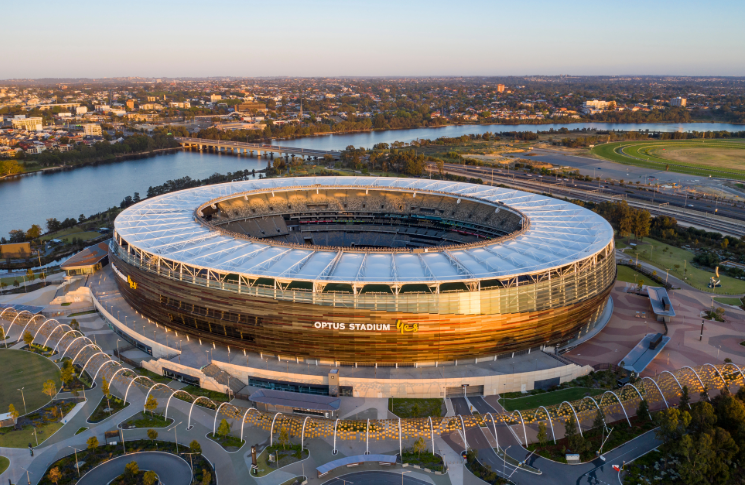
When an FPV drone swept low over players at Optus Stadium during this year’s AFL season, television viewers saw the game from a new perspective. Behind those shots, however, was months of planning.
Channel 7’s head of AFL and sport innovation Gary O’Keeffe said the drone gave the network a new way to tell the story of the game.
‘Obviously, with a camera overhead, it gives the viewer a unique view that a fixed camera in the stand may not capture and helps show how teams are setting up for certain plays,’ he said.
For Birds Eye Media, the drone operator behind the broadcasts at Optus Stadium in Perth and Marvel Stadium in Melbourne, the biggest challenge was the crowd size.
‘Running an operation of this size is one thing; doing it over and near people is another entirely,’ Birds Eye Media’s Matt Price said.
‘The operation had to account for more than 50,000 enthusiastic fans who, given the chance, might try to alter the drone’s path; weather and wind drafts that shift through the course of a night; an active playing field with a ball in the air, and safety and legal teams from several different stakeholders who all had to be satisfied before anything flew.’
A non-routine operation
Operations over or near people (OONP) are becoming increasingly common in Australia. CASA Senior RPAS Inspector Weidi Koh said what set this one apart was its combination of scale and novelty.
‘What made this operation different was the proximity of the drone to a large gathering of people, combined with the innovative use of an FPV drone to provide broadcast viewers with a unique perspective of a live AFL game,’ Koh said.
Under CASA’s OONP approval framework, operators can follow several pathways, each with its own assessment criteria and operational conditions.
Birds Eye Media flew under Pathway 2, which limits the drone’s speed and height so that its impact energy stays below a maximum threshold. Within those limits, the drone can fly over people without needing consent from those below.
Koh said the central consideration was what would happen if the drone was involved in an accident or incident.
‘The primary consideration was the risk of serious injury if the drone were to impact a member of the public,’ he said.
‘To put that into perspective, the accepted impact energy threshold for members of the public is 15 joules, which is actually much lower than the kinetic energy an AFL football can reach during normal play.’
Meeting that threshold requires careful control of the aircraft’s weight and speed. The design matters too.
‘There are also requirements relating to the physical design of the [drone], including no exposed rotating parts or sharp edges that could cause secondary injuries on impact,’ he said.
Managing 96 risks
The regulatory requirements set the boundaries, but Birds Eye Media still had to show how the operation would remain safe in a live stadium.
Price said the foundation was laid years earlier, when company director Dean Chisholm obtained his remotely piloted aircraft operator’s certificate (ReOC).
‘OONP approval is not something a company simply applies for and receives,’ Price said.
The planning took months and included risk assessments, test flights with CASA present, revisions of the flight plan and meetings with Channel 7, AFL management and players, CASA and venue teams.
The team identified around 96 individual risks through operational experience and lessons from test flights.
Price said one of the less obvious challenges was making sure what happened on the night matched what was on paper.
‘The spotters and the director’s live calls had to be brought into the same system, so what was being said over comms on the night matched exactly what was written in the safety documentation.’
Two stadiums, two rulebooks
Although both operations were conducted under Pathway 2, each venue set its own conditions on top of it.
At Optus Stadium, flights were not allowed during live play or over the stands. The drone could only operate in agreed windows before the game, during breaks in play and after the final siren.
‘Due to the restrictions on the night in Perth, we only flew in short windows once play had ceased. For example, pre-game as teams ran onto the ground or at quarter time as players walked into position,’ O’Keeffe said.
Price said Pathway 2 would have allowed flight over the crowd, but the team followed the stadium’s direction.
‘We treated the night as an opportunity to demonstrate, under their conditions, that our standards hold up in practice,’ he said.
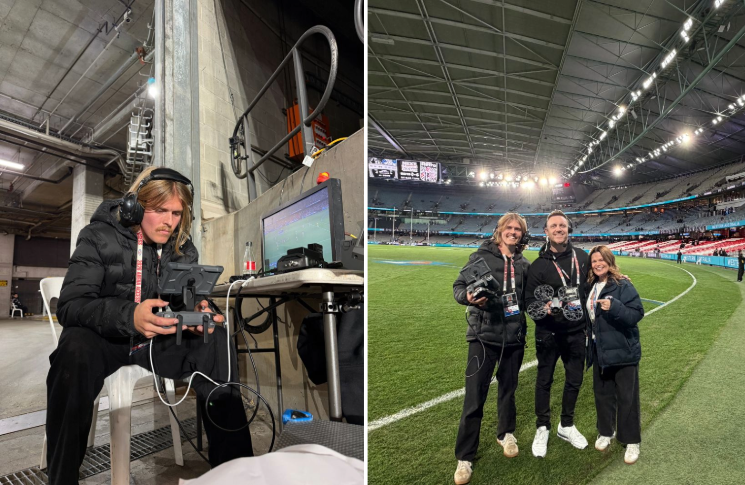
Spotters positioned around the field were connected through a private communications network and each carried a fire extinguisher and fire mat.
Marvel Stadium came next. With a risk assessment already tested in a live environment, the team could build on lessons learnt in Perth.
The venue allowed flight during live play, provided the drone stayed more than 30 m from players and out of their line of sight. That meant the drone could fly over the crowd while the game was underway.
Marvel Stadium also presented challenges that couldn’t be fully tested in advance, including potential for radio frequency interference from the closed roof and a field the crew had never seen in person.
The team arrived 10 hours before the match to walk the ground, test connections and run through the flight plan.
CASA in the stands
As Birds Eye Media already held the required authorisation, CASA attended as an observer.
‘To provide CASA with assurance that this novel OONP operation was being conducted safely, Birds Eye Media invited CASA to observe both its rehearsals and the live operation during the AFL game,’ Koh said.
‘CASA attended the pre-flight and safety briefings and observed the operation for most of the game.’
Observing the operation helped CASA understand how the operator applied its safety procedures in practice. These insights can inform future assessments and guidance for similar operations.
Price said the lengthy planning process meant stakeholders were aligned well before game day. The team’s final preparations focused on refining the shot list with the broadcast director. A detailed post-event debrief captured lessons learnt from the operation.
What comes next
The project has delivered Birds Eye Media a risk framework that can be applied to future operations.
‘The risk assessment built for these operations covers the full spread of risks involved, which means the operation can be replicated across other work over populated areas rather than starting from scratch each time,’ Price said.
Channel 7 is also keen to expand the use of drone footage.
‘As we plan for next AFL season, we will be looking at how we can include drones on more games,’ O’Keeffe said.
The operation contributes to CASA’s ongoing development of regulations for emerging drone activities.
‘CASA engages and consults with the industry on an ongoing basis to ensure that the rules are fit for purpose. The OONP rules are being refined with industry feedback to ensure future approvals continue to be conducted safely using a proportionate, risk-based framework,’ Koh said.
Tips for operators
- Start early. Give yourself months, not weeks. Complex operations involve approvals, multiple stakeholders and site access arrangements.
- Know your pathway and engage early. Understand the rules, approvals and operating conditions that apply. For novel or higher-risk activities, early discussions with stakeholders and CASA can help clarify requirements and resolve concerns.
- Expect site-specific requirements. Every operating environment is different. Be prepared to adapt your plans.
- Rehearse on site. Site visits, test flights and equipment checks can help uncover potential problems before the operation begins.
- Review and improve. Ensure procedures, communications and safety documentation are aligned, then conduct a thorough post-flight debrief to capture lessons learned and strengthen future operations.