


By Adrian Park
A captain overwhelmed by lack of sleep loses control of his aircraft
On a late August afternoon in 1993, an approach to Runway 10 at Guantanamo Bay by a big jet aircraft was anything but sedate. It certainly grabbed the attention of the captain in a waiting Navy C-130:
I saw the DC-8 on a wide right base for runway 10. It appeared to be at approximately 1000 feet AGL. I was interested in watching such a large airplane shoot the approach. It looked to me as if it was turning final rather late, so it surprised me to see him at 30 to 40 degrees angle of bank trying to make final. At 400 feet he increased the angle of bank to 60 degrees in an effort to make the runway and was still overshooting. The aircraft’s nose turned right and it appeared he was trying to bottom the rudder to make the runway. He was at 200 feet and still overshooting and my co-pilot remarked he was going to land on the ramp! His wings started to rock towards wings level and the nose pitched up. At this point the right wing appeared to stall, the aircraft rolled to 90 degrees angle of bank and the nose pitched down.
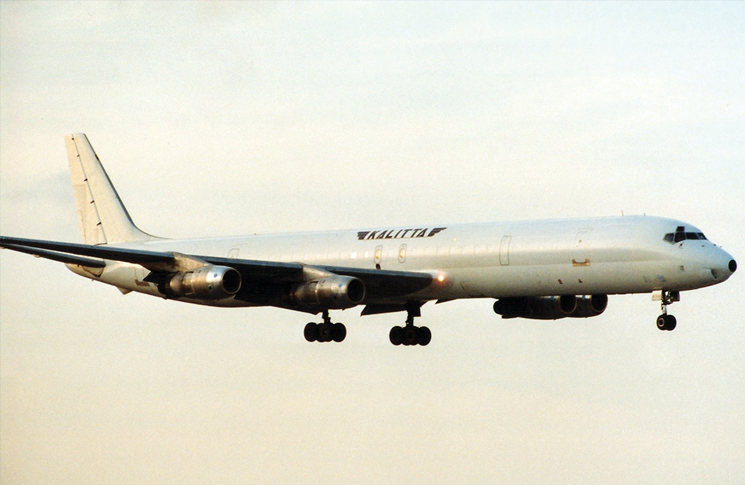
The DC-8 captain, unfamiliar with the airport, had been struggling to identify the runway environment. Normally a strobe made identification easy, but the strobe was inoperative and neither the controller nor the pilots knew. As the captain looked for a flashing light that didn’t exist, the tower insistently reminded him Cuban airspace was only three quarters of a mile west of the runway. The co-pilot and the captain tried to simultaneously process the warning as well as the local airspace, the danger of a large hill on their approach, circuit traffic and a confusing entry pattern. While the crew was working through the issues, valuable miles were quickly consumed, and the airport now loomed large.
‘I think you’re gettin in close,’ the co-pilot said, his voice showing concern. They were high, fast and at least 90 degrees off centre to the airport and still hadn’t identified the runway.
‘Yeah I got it, I got it … going to have to really honk it, let’s get the gear down,’ the captain said, also stressed. ‘Where’s the strobe?’ he asked, for at least the fourth time. ‘Right down there,’ replied the co-pilot who was looking at the structure of the non-operational strobe.
The captain kept looking for a flashing light while the co-pilot and engineer, who’d been to the airport before, were looking at unlit infrastructure. In their minds they couldn’t understand why the captain couldn’t see the runway, nor could they understand how the captain was possibly going to be able to land with such a closure rate.
‘Do you think you’re going to make this?’ asked the co-pilot. He should have been escalating his tone, intonation and volume to an assertive, ‘Let’s go around!’. Instead he was still conversational. The flight engineer was more forthright: ‘Shit! We’re never going to make this!’
The co-pilot ignored him perhaps out of a mistaken idea he needed to keep things ’normal’. ‘Five hundred, you’re in good shape,’ the co-pilot said. The flight engineer disagreed, and he had proof—the stall warning. ‘Stall warning!’ he yelled.
‘I got it, back off!’ replied the captain. He definitely did not ‘have it’. The aircraft, with a bunch of right rudder shoved in for bad effect, rolled through 60 degrees and then snapped back to wings level in an attempt to normalise the approach path.
But Flight 808 was trapped by momentum, ‘G’, airspeed and the high descent rate—its nose impotently pointed skywards, and the aircraft kept plunging earthwards. With only 200 feet between ‘back off’ and the ground (which never backs off), the result was unsurprising.
The right wing stalled, flipping the aircraft into a 90-degree angle of bank and a rapid nose slice. The 140-tonne DC-8 fell out of the sky. The wingtip and the nose struck the ground at the same time and fire-balled half a kilometre from the runway. Amazingly, with the help of resolute fire fighters who ploughed their way through razor wire perimeter fencing to get to the crash, all three of the crew survived, albeit with severe injuries.
In the investigation, a company check pilot described the captain as a good pilot who displayed good judgement in emergency handling. The captain’s co-pilots said he was conscientious and good at managing crews.
Therefore, we come to a profoundly important question: how does a ‘good’ pilot become a ‘bad’ pilot? Or, more bluntly, how on earth could a good pilot rack a DC-8 over to a 60-degree angle of bank on base turn, shove in full rudder and tell the questioning crew to ‘back off’ before crashing half a kilometre from a runway he never managed to identify properly?
It’d be easy to proclaim ‘bad pilot’ but we have it on record he was a ‘good’ pilot. So, what diminished the pilot’s decision-making? It was a factor that was very human. It was fatigue, plain and simple. Sleep deprivation turned a good pilot into a bad pilot.
More details of the crew’s duty profile can be found in the accident report but here’s the gist of it: in 24 hours, zero hours sleep; in 48 hours, five hours sleep. At 1653 local, on approach to Guantanamo when the captain told the co-pilot and flight engineer to ‘back off’, they’d all been awake since 1800 the night before—about 24 hours.
They were officially knackered and their tens of thousands of flight hours, their training, CRM, decision-making, skills and judgement were all severely compromised—notably, their company policy and the regs quietly endorsed their excessive duty time. This was how a good pilot became a bad pilot.
Some may be tempted to say this was 1993 and just the ‘bad old days’ but recent examples abound such as UPS 1354, some 20 years later where the captain, a few weeks before his fatal, fatigue-related crash, proclaimed, ‘I can’t do this until I retire … it’s
killing me.’
Which brings us to an even more important question. If you are a modern manager, what makes you think your good and competent pilots aren’t going to turn into bad pilots because of your culture or policies? And if you are a good pilot, what makes you think you’ll stay ‘good’ under the influence of short or long-term weariness?
When the captain of Flight 808 made the call to ‘back off’, he was in a fatigue-befuddled state. He was saying ‘back off’ to advice that could have saved him, if only he could have directed his ‘back off’ to where it really mattered. If only managers could have backed off from their unsafe policies. If only programmers could have backed off from their ‘schedule over safety’ culture. If only certain ‘old school’ pilots could have backed off from unsafe ‘harden up and keep going’ attitudes. Unfortunately, such a thing can never be for the crew of Flight 808. But that doesn’t mean it can’t be for those of us currently in the industry.

Comments are closed.