
Recently, a friend’s teenager expressed interest in learning to fly and contacted me for advice. When I met up with the plucky and enthusiastic teen to impart my wisdom, I was struck by a question he asked me: ‘If you were learning to fly now, knowing what you do, what would you do differently?’
As I pondered on this question, I decided to reread an old column series I wrote when I was learning to fly. What struck me – other than the chaotic disruption of my learning as I struggled to find the right instructor for me – was that I never felt totally confident as a student pilot. Somewhere in me, I carried a sense of not quite being in control of the aircraft. After much rumination, I realised that in my training, I seemed to have missed some of the basic building blocks which may have boosted my confidence as a pilot.
With that in mind, I questioned whether my ascension to technology came at the detriment to basic flying skills. As soon as I passed my PPL test, I purchased a handheld Garmin 495 and became a child of the magenta line.
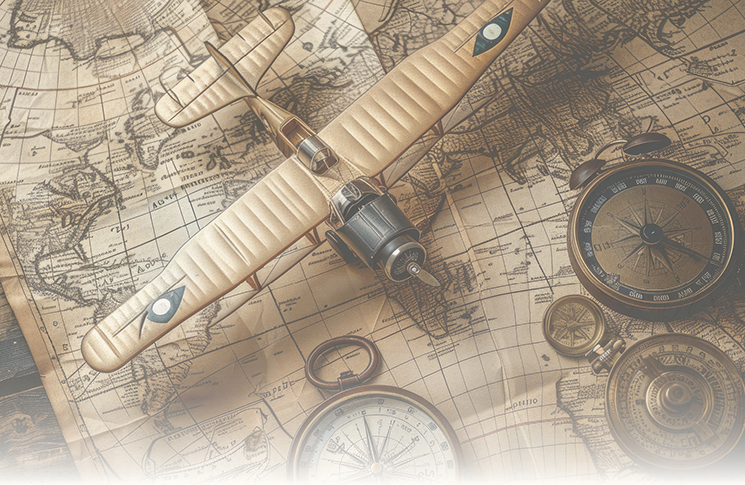
The Garmin 495 morphed into a full G1000 panel; flight plan filing went from a phone call to the briefing office to filing via the NAIPs website, to eventually filing straight via my EFB. I used the last of my WACs to wrap birthday presents for friends who are pilots. My whizz wheel, buried under a pile of flight planning sheets, now bears the remnants of rust.
The question made me realise that if I had my time again, I would spend more time honing my basic flying skills before stepping up to the tech.
What I would do differently
Here’s what I would do differently:
Start with gliding
It’s no coincidence that Captain Sullenburger attributed his successful landing on the Hudson River to his gliding skills. As Drew McKinnie, safety manager at Gliding Australia, tells me, ‘If we train pilots with the basics well, they find it so much easier to be trained on the really demanding, complex pilot skills and knowledge later. Pilots well trained in the basics are normally smoother, more relaxed in the air, with so much more brain space to deal with new demands, higher workloads. The basics must be done right, no matter how many bright lights and avionics are in the panel. Layers of training are needed.
‘I would really like more power pilots to think about training basic skills, in lookout and attitude control. That then extends to “chunking” of tasks to phases of flight and preparation during quieter times for the next busy phase. We also train pilots in transitioning from launching pilot, to soaring pilot, to landing pilot – making timely decisions, configuring correctly, acting with minimum stress. After all, most of us have only one chance to get the circuits and landings right.’
Gliding sharpens a pilot’s grasp of aviation meteorology. It teaches you to read the sky, feel the air and recognise the dynamics of air motion, where lift, sink and turbulence form. ‘Power pilots with gliding meteorological insights can see pathways for lower cruise power settings, or faster descents and, if necessary, seek out smoother air,’ McKinnie says. ‘Also, they better understand the nature of turbulence in the circuit, possible lift and sink, wind gradient and wind shear that require adjustments.’
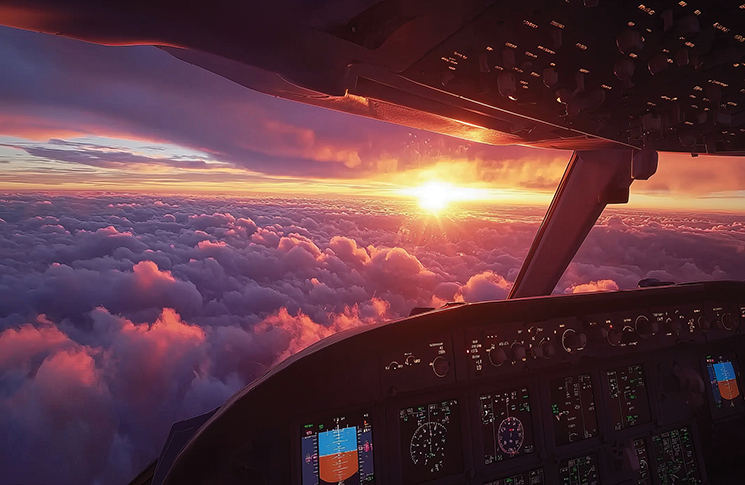
‘When used and preset correctly, modern avionics and displays can be a great boon and must be well integrated into training,’ he says. ‘IFDDs (in-flight distraction devices) such as some phones, cameras and tablets, and badly set-up digital displays, can drive very bad scanning and lookout habits. Digital distraction is a scourge! So, glider and power pilots must be well trained in cockpit workload priorities, proper set-ups and preparation and using devices as needed at the right time. Any loss of situational awareness or inappropriate playing with digital and entertainment devices must be corrected in training and flight reviews.’
Add formation and aerobatic training
Formation pilot and team member of the Freedom Fliers, Mark Newton, believes basic flying skills begin with a thorough understanding of aerodynamics. ‘Formation flying, aerobatics and upset recovery training are all treated like they’re some kind of “advanced” flying, when in reality they’re the kind of back-to-basics skill building that every pilot should have received when they were ab initio,’ he says.
Pilots who do aerobatic training learn a very deep appreciation for angles of attack.
‘Pilots who do aerobatic training learn a very deep appreciation for angles of attack. That’s how you know you can float over the top of a loop without losing control at 35 knots, even though the POH says the stall speed is 55. Pilots who do formation training learn more about directing energy than most pilots even hear about. That’s how 2 aircraft with a closing speed greater than 150 knots can gracefully join a left echelon 6 metres apart and know the whole time that they won’t hit each other.
‘Aviation training has had a fundamental problem for as long as anyone can remember – it’s taught new students about “stall speeds” and “straight and level flight”. Speed isn’t important for stalling; angle of attack (AoA) is – that’s fundamental! We need to start with angles of attack, introduce proxies for AoA like stick position – which works pretty well in the GA aircraft we fly – and only introduce speed almost in passing during the flight exercises.’
Formation pilot, instructor and aerobatic aircraft owner, Nick Wills agrees.
‘Formation flying requires briefing, discipline, concentration, precision, training, regular practice, currency and above-average stick-and rudder-skills and debriefing,’ he says. ‘Keeping current is vitally important, and every flight is briefed, flown and debriefed. I remind my students that they must only fly formation with formation-endorsed pilots. Even air-to-air photography requires all pilots are endorsed and only fly with people you know are properly qualified and current; strictly no “ad hoc” or “on the fly” spontaneous stuff.’
Engage in upset prevention and recovery training (UPRT)
The focus of UPRT is prevention and developing pilot resilience, that is, response to startle events. Improving a person’s situational awareness would contribute to achieving that goal. UPRT includes developing a pilot’s fundamental knowledge of aerodynamics and exposure to unusual attitudes, to improve performance in recovery from a stall.
Fly vintage and look out of the window!
Tiger Moth pilot and instructor Graham Bunn recommends flying vintage aircraft to hone stick and rudder skills.
‘There is nothing like the wind on one’s face when flying an open cockpit vintage aeroplane,’ he says. ‘A long time ago, it was believed by many that the sensation of air moving across a pilot’s face was a key part of knowing what was going on, aerodynamically speaking.
‘In real life, flying a Tiger Moth, for example, is much more about the basic techniques of managing performance by managing power and attitude – the most basic of piloting skills.
And that means mostly looking outside of the cockpit to see where the horizon is, with only occasional glances inside to verify airspeed and altitude and, in the case of the Tiger Moth especially, the balance ball or slip indicator. The old bird is reluctant to fly perfectly in balance by herself, obliging the pilot to use stick and rudder pretty much all the time to keep it pretty and to maximise performance.’
Bathurst-based instructor Shelley Ross agrees that basic flying skills are the fundamental building blocks of flight training. While transition to technology is inevitable, she believes that traditional skills must come first.
‘There isn’t a world where I’d believe that the minute a student pilot gets their licence, they don’t ditch the paper maps for an EFB and a magenta line,’ she says.
Gliding sharpens a pilot’s grasp of aviation meteorology.
‘And why wouldn’t they? But while we’ve got them in our clutches, we get to teach them how to get comfortable with a compass, read a map, learn what effect the wind is having, take notice of the sun and why you need to look out the windscreen!
The unforgettable outcome? They build the skills to question the screen. And isn’t that a good thing?’
Immersion and mastery
‘A man who carries a cat by the tail learns something he can learn in no other way.’ Mark Twain
As I look back, it’s clear that my early rush to technology left gaps in my flying confidence. If I was starting again, I’d spend more time gliding, mastering the art of the angle of attack, flying in formation, spinning vintage aircraft and looking out the window.
None of these are necessarily cheap, but they give you a feel for the sky no GPS ever will. Technology is a wonderful aid, but it shouldn’t be a replacement for the fundamentals. Build your basic skills and you’ll have the confidence to question any screen when you need to.
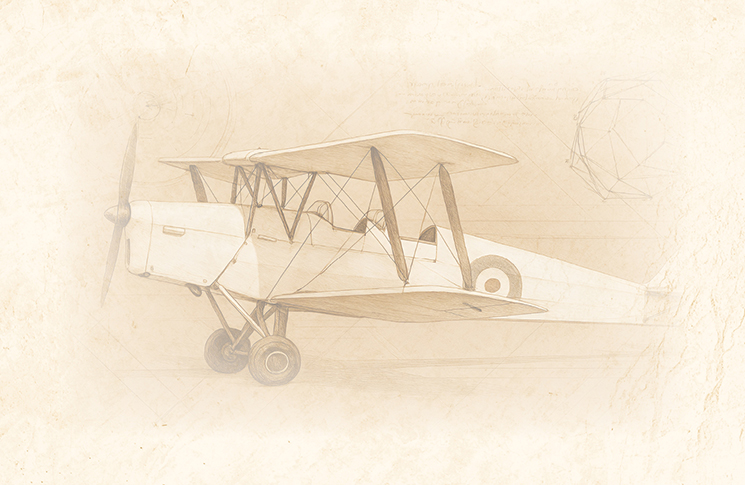
Back to basics
Start with gliding
Learning to soar sharpens your understanding of airflows, weather and energy management. It teaches you to read the sky and feel the aircraft, building confidence before adding complexity.
Train in formation and aerobatics
These disciplines reinforce fundamentals like angle of attack, energy direction and precise stick and rudder control. They introduce deliberate briefing, discipline and debriefing habits that benefit all flying.
Fly vintage or analogue aircraft
Flying without automation forces you to use basic instruments, watch the horizon and stay connected to the aircraft, strengthening core skills before relying on glass cockpits and magenta lines.
Prioritise core skills over gadgets
Use technology as a tool, not a crutch. Integrate avionics thoughtfully, avoid ‘in flight distraction devices’ and maintain paper map and compass proficiency so you can crosscheck the screen and stay situationally aware.