
It’s an oldie but a goodie, a conversation between a Jetstream and a small local aircraft (not their real call signs).
Zulu Tango Romeo, this is Eight Juliet Kilo, we are 35 miles out on the 186 radial, leaving flight level 120 on instrument approach, estimating Meeka at 42, request your position.
Yeah mate, Zulu Tango Romeo is over the Pollelle Woolshed.
The story comes from Mark Spedding, a former air traffic controller and flight services officer with nearly 4 decades of experience. Safe to say he’s heard just about everything on the air.
As much as this conversation provides a giggle, the local pilot’s response was clearly uninformative and most likely entirely useless, highlighting the dangerous use of non-standard phraseology and worse, using a (perhaps) locally known landmark that was not likely to be known by the Jetstream pilot.
The larger aircraft, calling at 35 miles south of the field, gave Zulu Tango Romeo more than enough time to sort a decent radio call and provide accurate information.
Although using a geographical landmark can be technically correct (that is, if they are on aeronautical charts), this was not appropriate in the circumstance. A more appropriate response would have been, ‘Eight Juliet Kilo, this is Tecnam Zulu Tango Romeo, currently 25 miles south of Meeka maintaining 3,500 tracking 270.’
The bare bones of the problem is that your average VFR pilot doesn’t necessarily understand IFR phraseology; well, how could they, without IFR training? Equally, it seems some pilots with IFR endorsements can forget their VFR roots in non-controlled flight environments. Although the official language of aviation is English, there are in effect 2 dialects, separated not by region, but by flight category.
According to the ATSB booklet, A pilot’s guide to staying safe in the vicinity of non-towered aerodromes, the majority of Australia’s aerodromes are in uncontrolled airspace. Most occurrences reported in that environment involve conflicts between aircraft. ‘A large number of these involved separation issues, ineffective communication between pilots operating in close proximity, the incorrect assessment of other aircraft’s positions and intentions …’ it says.
Circling approach? What? Where?
Ballina Byron Gateway Airport in coastal NSW is an example of a busy, mixed-use, non-controlled regional airport. Maintenance facilities, adventure flights, flight training, helicopters, fire bombers, parachute operations and recreational pilots share the air with commercial and air transport aircraft.
Kiana Kosseris, a commercial pilot with an instructor rating, recalls heading into Ballina from the Gold Coast training area as a newly minted PPL in a Cessna 172.
‘I was monitoring both Ballina advisory frequency and Gold Coast traffic advisory frequency,’ she says. ‘I heard an IFR twin-engine aircraft broadcast departing Gold Coast [on Gold Coast frequency] with the intention to do an instrument approach to Ballina. A little later, the twin broadcast again, stating a straight-in approach to Ballina’s runway 24 and estimating arrival about a minute before me.’
From the IFR radio call, the active runway appeared to be 24 (even though the TAF had predicted some mild wind favouring 06), so Kosseris planned to join mid-field left crosswind for 24 (Ballina Airport operations designate left-hand circuits on 24 and right-hand circuits on 06).
Kosseris broadcast her intentions, believing the twin would be on the ground well before she needed to be concerned. ‘And I’d look at the sock as I joined the circuit, just to be sure,’ she says.
By the time she was a mile or so from the field, the twin had called ‘on three-mile final, straight-in approach, 24’.
However, the twin then called its intentions to join right downwind for 06. This meant the aircraft was veering left from the 24 final approach (which is possibly why Kosseris had not sighted it as she approached the circuit) to join right downwind 06 – opposing 24. Not at all ideal for Kosseris who immediately turned away from the field to the non-active side to recoup.
Although the official language of aviation is English there are in effect 2 dialects, separated not by region, but by flight category.
After landing safely, she discovered the twin had been conducting what is known as a ‘circling’ instrument approach. That is when the IFR aircraft approaches the aerodrome on a particular approach – in this case, straight in to 24 – and then, when visual with the runway ‘circles’ to be able to joins the preferred runway, to land into wind.
Radio work
‘Kosseris’s situation is all too common’ says Catherine Fitzsimons, an instrument flight rules pilot and instructor with more than 10 years’ experience teaching VFR and IFR students as Chief Pilot and Head of Operations at WardAir Flight Training in Bathurst.
‘And because conditions were visual, it is likely this was a practice IFR approach. IFR trainee pilots and their instructors have high workloads teaching and executing IFR procedures. Managing this at the same time as flying their own aircraft, communicating among themselves in the cockpit learning environment, talking to other aircraft and remaining safe is actually far harder in VMC than IMC when fewer aircraft are around!’
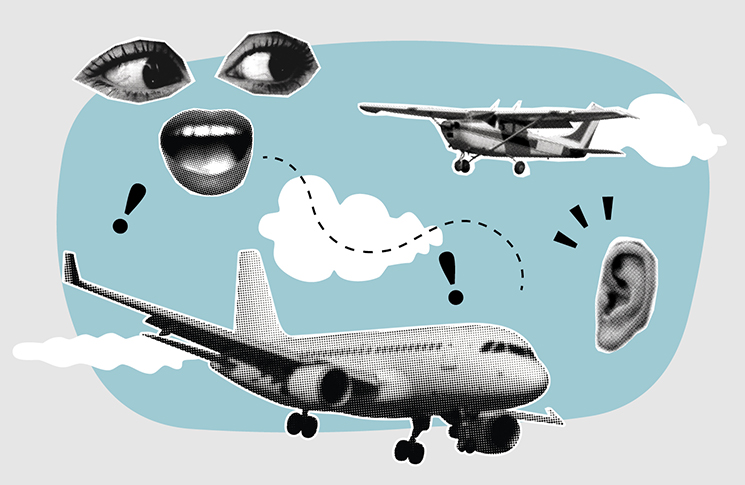
The AIP says IFR pilots in VMC should make calls that can be understood by both VFR and IFR pilots; however, this does not always happen. And even if the inbound twin had announced earlier its intentions for an instrument approach to runway 24, followed by a circle to land on 06, this may not have meant much to Kosseris.
And she agrees. ‘If the IFR pilot had called a “circling approach” I would have been just as clueless to their intentions because what does “circling” mean to a non-IFR pilot? Above the airfield? Around the airfield? Where? At what height? However, at least it would have given me cause to call and question their intentions.’
This example of connotation (‘felt’ or perceived meaning) highlights the importance of making our radio work ‘informative’ as distinct from ‘technically correct’.
‘I like to use the word informative because we pilots so often hide behind the excuse that our radio calls are correct,’ Fitzsimons says. ‘But what’s the use of being correct if you’re not understood?
‘Recognising that this instrument training was taking place at a busy CTAF, a simpler, shorter and more informative call might have been that the aircraft was approaching from the east with the intention to manoeuvre to join a downwind for 06.
‘In the presence of other traffic, continuing an instrument approach to a low level and a close position, the so-called “minima”, on the opposite runway to that being used could be considered poor airmanship.’
At Ballina, the TAF had been correct – 06 had been the preferred runway for the wind; however, the IFR aircraft pilot was also technically correct and had done nothing wrong because a ‘circling approach’ is a legitimate instrument approach to circuit entry. (Circling approach does not necessarily mean ‘in a circle’. For more information about circling approaches and other types of instrument approach paths, see the AIP ENR 1.5.)
Either way, it’s a moot point because the actual danger began when the IFR aircraft did not explain its full intention using informative, VFR-understandable phraseology when it first broadcast on CTAF. And certainly, after hearing Kosseris’s 10-mile inbound call, the IFR pilot had time to clarify their intentions (to approach as a straight-in to 24, but then join right downwind to land 06) to CTAF traffic.

Kosseris’s incident is an excellent example of miscommunication. However, it is more likely for us to come across the use of non-standard or ‘vernacular’ position fixes, such as ‘over the woolshed’, and both IFR and VFR pilots can be guilty of this.
Know the rules
We know that a fundamental function of being a pilot is understanding the risks associated with flight. However, risk awareness and situational awareness don’t cease to exist because you ‘haven’t had the training’ or because you’ve ‘upskilled into a higher class’ of endorsement. Sharing the air means being aware of everything and anything you possibly can.
If you’re VFR, take the time to learn about IFR operations and phraseology so you can cope with potential situations that IFR operations might create for you at your local. Flick the IFR button on your flight planning software, sit down with a mate with an IFR rating and have a chat about what it all means.
And if you’re IFR, take a step back and think about your VFR roots. Were you ever confused about what an IFR flight was really doing? Where are you flying into? What are your VFR challenges?
CASA’s Aviation Safety Advisors produce AvSafety seminars for IFR pilots (available online), where they recommend IFR pilots always use plain language when describing their position and intentions to VFR pilots in the vicinity of non-controlled aerodromes. This is particularly important when weather conditions are likely to result in VFR traffic in the vicinity.
If you’re IFR, take a step back and think about your VFR roots.
However, the advisors also recommend VFR pilots can help themselves by having a working knowledge of where IFR aircraft might arrive from when performing an instrument approach. This is especially important in low cloud base situations where IFR traffic might suddenly appear.
Read and learn
There’s an excellent article at Flight Safety Australia online that provides some insights from an IFR pilot perspective about separation at non-controlled aerodromes, and how to work together for safe operations (see ‘Better off apart’ by Nicholas Stobie).
A personal favourite, CASA’s Guide – Be heard. Be seen. Be safe. Radio procedures for non-controlled aerodromes and operations is readily accessible at CASA’s online store.
More great advice can be found in CASA’s Advisory Circular (AC) 91-10 Operations in the vicinity of non-controlled aerodromes; an excellent source of information for both IFR and VFR pilots. Pay particular attention to section 6.5 ‘IFR and VFR aircraft operating simultaneously at, or in the vicinity of, the same non-controlled aerodrome’. Also, Section 8.7 details the recommended broadcasts in the vicinity of a non-controlled aerodrome. It is important to ask questions of other pilots if you are unsure of their intentions.
AC 91-10 should be read in conjunction with AC 91-14 Pilots’ responsibility for collision avoidance. Section 8 gives particularly good advice regarding using radio communications to provide traffic separation. The use of clock codes, ground references, altitude references and navigational or avionic references are all discussed, along with how to interact courteously.
The AIP Gen 3.4 Section 5, Radiotelephony Procedures is also a great bit of down-time reading. Detailing the correct phonetics, pronunciations, and transmission formats for both IFR and VFR users. Brush up on Section 6 that details some of the commonly used words and phraseologies and their meanings.
It’s all out there!
- CASA sought feedback on proposed guidance on radiotelephony procedures in early 2025. Feedback is being used to develop guidance for various operating environments.
- Airspace at Ballina will be controlled from 11 June 2026, with subsequent changes to radio calls and procedures.
If you’re VFR, take the time to learn about IFR operations and phraseology …
Further reading
Non-controlled operations and controlled aerodromes and operations are special topics on our Pilot safety hub.