
The wood, fabric and goggles age of aviation lasted exactly 32 years, from the Wright brothers’ first flight on December 17, 1903, until the same date in 1935. On that day, the Douglas Aircraft Company flew its prototype Douglas Commercial 3, the DC-3.
In a world of cloth and wire biplanes, this new aircraft was fully enclosed, of all metal construction, with retractable landing gear. Its streamlined shape was not quite new: the DC-3 was a wide-fuselage derivative of the Douglas DC-2, an example of which flown by the Dutch airline KLM had taken second place in the 1934 London-Sydney air race.
But the wider fuselage of the DC-3 brought unprecedented efficiency, and an unbeatable seat/mile cost – as the first generation of wide-bodied jet airliners would do 35 years later. It soon transcended its original role as an overnight sleeper transport and became a successful airliner, the first that could earn a profit without government subsidised airmail contracts.
It was sold to 30 airlines (including Australian National Airways) and was carrying 90 per cent of the world’s airline passengers by 1939. Then came war. The first military version of the DC-3, designated C-47, flew on 23 December 1941. These served in every theatre of the Second World War, dropping paratroopers on Normandy and supplies for Australian soldiers in the jungles of New Guinea.
More than 16,000 civilian and military versions of the DC-3 were built, including 607 civilian DC-3s and 10,000 C-47s; there were just under 5,500 licence-built versions: the Li-2, made by Lisunov in the Soviet Union, and the L2D, made by the Showa and Nakajima companies in Japan.
Thousands of C-47s became available after the Second World War ended in 1945 and formed the basis of airline and freight operations around the world. Nearly 100 years later, dozens are still flying, and while time has changed the operating cost equation, the DC-3’s fundamentals remain sound. It has gone from being at the forefront of aviation to a case study into how to safely operate an ageing aircraft.
Its systems don’t do much, but they don’t fail much.
From workhorse to icon
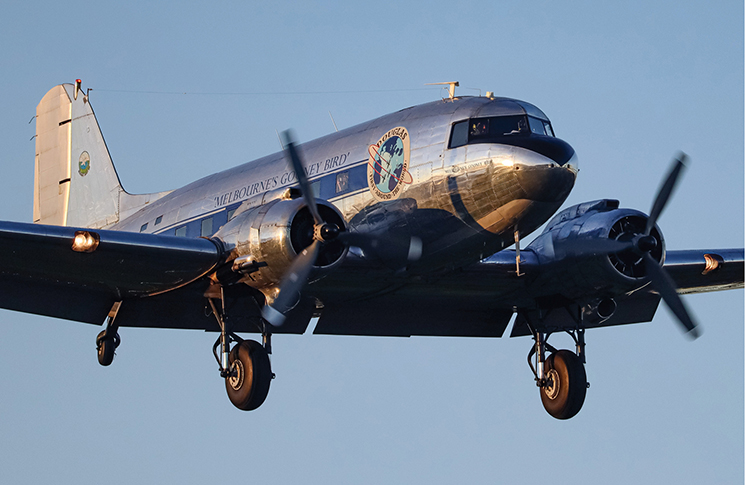
Mike Falls (senior) is head of training and checking at Shortstop Jet Charter which operates a DC-3 from Essendon. The aircraft trades under the name of Melbourne’s Gooney Bird, referencing a military nickname for the C-47, and operates a niche service of VFR scenic and tourism flights. ‘Its time is pretty well over for commercial operations,’ Falls says. ‘But people have an incredible affection for it – we’re booked out most of the time because this is a social aeroplane.’
Fixing
Shortstop’s DC-3 is a relatively fresh example, with about 13,000 hours since it was built in 1945 as a C-47 for the RAAF, which flew it until the 1970s.
It has been ‘extraordinarily dependable,’ Falls says, but the operator does not take this for granted. ‘We have a dedicated engineer. We do not just go from maintenance release to maintenance release. The engineer inspects it closely before and after flights, with particular emphasis on engines.’
Availability is still okay for spares but the cost is off the scale, Falls says. ‘That’s what happens when a technology that was once commonplace becomes rare.’ Engine overhauls that were once available locally are now done by specialist facilities in the US, at significantly higher cost.
Finding qualified LAMEs to work on the old bird is more of a problem. The engineers who worked on DC-3s in airline service are literally a dying breed. But the enthusiasm factor provides some compensation. It drives a few younger engineers to learn the ways of twin-row radial engines and 1930s hydraulics, despite these being far from lucrative specialties. In its favour is how the DC-3 is ‘less complicated than the average light twin,’ Falls says. ‘Its systems don’t do much, but they don’t fail much.’
Flying
Piloting a DC-3 requires a sort of mental time travel, Falls says. ‘You’ve got to push your mind back to the early ’30s when it was analogous to Concorde. You must fly it a certain way because that is the way it was designed.’
Landing requires a distinct combination of pilot skills to deal with low crosswind limits, heavy manual flight controls and a taildragger configuration. ‘They are bastards to handle in anything other than benign conditions,’ Falls says. ‘Vref is around 80 knots and on approach, it handles reasonably if heavily down to about 85. It gets somewhat less responsive below that. You have a choice on final of reasonable control and being slightly fast. Or you come back to the right speed and the handling is less responsive.’
The contrast between the stick-and-rudder fundamentalism of the DC-3 and the avionics-rich interface of modern aircraft such as Shortstop’s recently acquired Dassault Falcon 900 is stark. One is manually flown, the other is programmed, Falls says.
‘The ratio between operating and handling is probably 90/10 in a Falcon, a modern aircraft,’ he says. ‘And it’s the other way around in a DC-3.’
Melbourne’s Gooney Bird has had its basic three-axis autopilot removed (although it does have traffic detection, ADS-B and TAWS). With the aircraft flying only a few hours every month, its pilots have no objection to as much hand flying time as possible. Skill retention among the small pool of pilots qualified on the multi-engine taildragger is a constant challenge, Falls says.
Formalities
The air the DC-3 flies in is the same after 90 years, but the regulatory environment is much different. Shortstop operates under the Civil Aviation Safety Regulations, an environment of training, oversight and culture unimagined when the DC-3 first flew. Documentation must reflect current aviation standards and requirements.
The Melbourne-based aircraft was certified by CASA in 1990 as a civilian aircraft after its military service. The flight manual approved at that time was based on that used by Trans-Australia Airlines in New Guinea and was similar in scope to that of a typical light twin of that time.
In the early 2000s, CASA told Shortstop a more comprehensive airline-standard manual was needed. ‘CASA told us, “You’ve got to have a manual that reflects the fact that it’s an airline aeroplane”,’ Falls says. ‘And eventually we found a manual in America that was produced by an insurance company and was a compendium of about 4 different US airlines operations in the 1950s.’ It provided the required performance data, although in somewhat unfamiliar terms.
‘But the main thing, and you can’t write a manual about it, is culture and attitude,’ Falls says. ‘We carry 24 passengers to King Island in just over an hour and burn around 100 US gallons. But if on arrival the weather becomes marginal and crosswinds uncomfortably gusty, we will bring it back home, sometimes from [a go-around on] short final.’