

Nothing to see here
For the best part of 100 years airliners have looked much the same: a streamlined fuselage, with engines on the wings. There have been some variations on the theme – tail-mounted engines, wing-root engines on the de Havilland Comet and swept wings – but Boeing’s 737 has looked the same for nearly 60 years, as has Airbus’s A320 for close to 40 years.
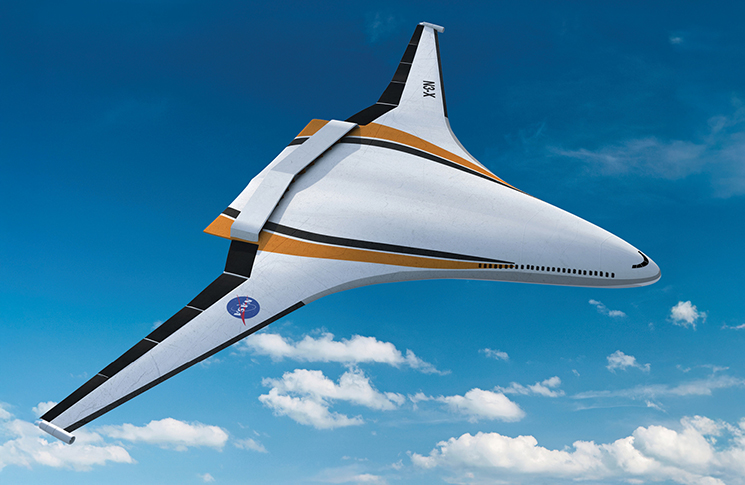
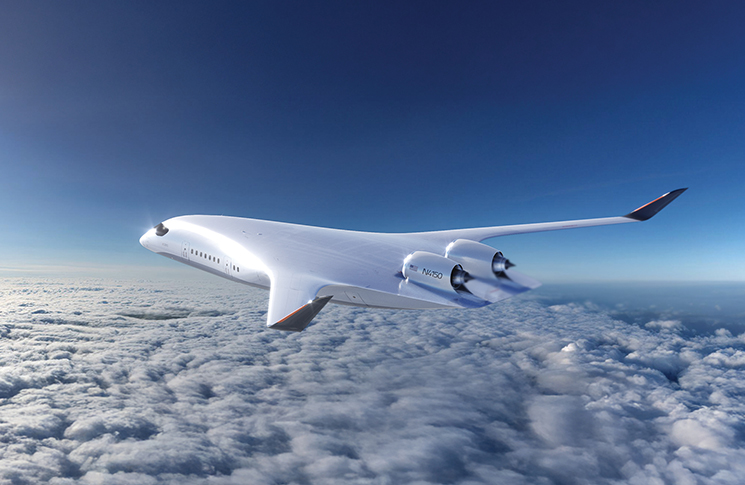
A blended wing body (BWB) design, in which the load-carrying area of the aeroplane also provides lift, could offer the irresistible advantages of less drag and greater lift than a conventional design. BWB aircraft could be as radical in the 2030s as the Douglas DC-3 was in the 1930s.
Blended definition
Former Lockheed Skunk Works director of advanced concept design Dan Raymer has a thorough definition of a blended wing body design:
‘The blended wing body is basically a flying wing with a delta-shaped wing/fuselage in the centre, large enough for a passenger cabin [and] the centre section is blended into the wing panels. This concept reduces the total wetted area [the area of the aircraft in contact with the external airflow] of the aeroplane and, with its deep centre section, improves structural efficiency.
‘The BWB has about half of the root-bending stresses of a conventional configuration. The wingtip-mounted vertical tails also act as winglets to reduce drag due to lift. BWB requires relaxed static stability and an automated flight control system to fly efficiently, optimise span loading and avoid the need for a tail. The BWB optimises at a wing loading of about 488 kg/sqm, much less than the 781 kg/sqm of most airliners.’
Blended history
The blended wing body is not a new concept. Hugo Junkers patented a design in 1910 but never built it. One of the first designs to fly, briefly, was the Westland Dreadnought of 1924, which crashed on its first flight and was destroyed. The Junkers G38 of 1929, which seated passengers in its enormous wings (with a transparent leading edge!), was a more successful blended wing design.
In military aviation the concept was explored by Northrop’s flying wing designs of the 1940s, the 1950s Avro Vulcan bomber, the Lockheed SR-71 supersonic reconnaissance aircraft of the 1960s and the B-1 Lancer and B-2 Spirit bombers from the 1980s.
NASA also investigated the variation of technology with its ‘lifting body’ aircraft program (the M2-F2/F3, HL-10 and X-24A) of the 1970s. A 1987 research paper published by McDonnell Douglas coined the term ‘blended wing body’ and began serious investigation of the concept as a possible future airliner.
McDonnell Douglas engineers Jerry Callaghan and Robert Liebeck summarised the company’s blended wing body research in a 1990 paper. They compared a ‘wing and tube’ aircraft using state-of-the-art technologies in airframe, propulsion, control systems and other systems, with a BWB design using similar technology. This thought experiment produced a lift/drag ratio of 23.1 for the conventional design but 33.3 for the blended wing body. Fuel burn per seat at 3,000 nautical miles was 25.7% less for the BWB design. McDonnell Douglas went on to develop a blended wing body drone, the BWB‑17, which flew successfully between 1994 and 1997.
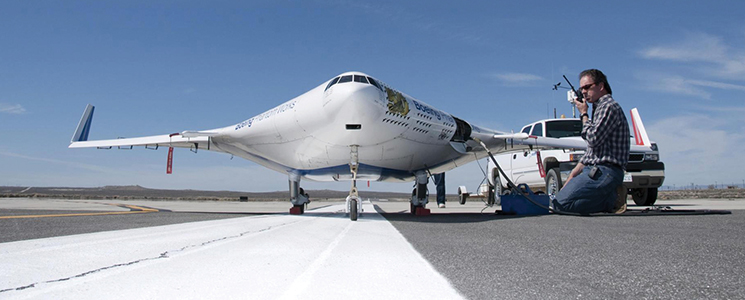
When Boeing took over McDonnell Douglas in 1997, it continued the BWB program and, in conjunction with NASA, flew an uncrewed proof‑of‑concept aircraft, the X-48. Its 3 versions made 120 test flights between 2007 and 2014.
The experimental drone had a wingspan of 6.4 metres, was powered by 3 turbojets and could hit 118 knots. Its remote test pilots reached an encouraging conclusion, ‘The aircraft flies like an airplane! We do not say that lightly and are willing volunteers to pilot the manned demonstrator version.’
In 2019 Airbus flew an experimental proof-of-concept blended wing body aircraft, the MAVERIC, a 20% scale uncrewed aircraft.
Blend of advantages
Mark Page, one of the engineers on the McDonnell Douglas project, further developed the BWB idea as founder of DZYNE Technologies where he served as vice president and chief scientist until 2022. In a 2018 paper, he listed some of the fundamental advantages of the concept:
- The airframe shields the community from most of the engine noise.
- Supersonic flow above the cabin prevents forward-radiated noise entering the cabin.
- Passenger cabin loading, unloading and emergency egress are faster due to multiple short aisles.
- Intake and exhaust hazards are eliminated for the ground personnel and equipment.
- The fuel tanks are totally protected from rotor-burst.
- The pressure vessel and passengers are totally protected from rotor-burst.
- The primary wing structure is largely protected from rotor-burst – wingtip stall is much improved since the elevons reduce air load near stall.
- Engine inlets are protected from stall at high angle of attack since the airframe directs the flow to the inlet.
- The majority of the centre body is stall-free up to and beyond wing stall.
- Ditching stability and integrity are improved by the large belly surface – the traditional tails and associated systems are eliminated.
- No high lift flap system is required.
- No control surfaces are behind the wing where they are vulnerable to stalled wakes.
Page went on to co-found JetZero in 2021 and became its chief technology officer. JetZero is building a full-scale demonstrator aircraft it says will fly in 2027 in conjunction with Scaled Composites, the company that made Virgin Galactic’s SpaceShipTwo.
JetZero has announced a conditional purchase agreement for 100 aircraft and an option for an additional 100 orders with United Airlines. It also has partnerships with Alaska Airlines, Delta Airlines, the United States Air Force and NASA. The company has announced a US$4.7 billion factory in North Carolina to build a 25-seat blended wing body airliner.
Blend of issues
Page noted that full-size BWBs brought design challenges. Placement of landing gear, for example, involved a trade-off between intrusion on the BWB’s wider cabin and placing the main gear too widely to use most existing runways. The gear must be near the aircraft’s centre of gravity, which rules out putting it in the void space behind the pressure cabin. Page said his company’s design study – the Ascent 1000 – had developed a gear design that reconciled these compromises.
In the Chinese Journal of Aeronautics of July 2019, Zhenli Chen and colleagues identified more potential development stoppers for blended wing body including:
- difficulties on satisfying the requirement of evacuation and on airworthiness certification
- sensitivity to gusts due to a relatively low wing loading
- degraded repairability comparing with conventional aircraft
- strong wake vortices
- problems of family development (unlike conventional designs, BWB aircraft can’t be stretched into longer versions).
Blended future
KC Wong, professor of aeronautical engineering at the University of Sydney, uses historical aircraft as examples to teach his students the fundamentals of aircraft design.
‘In the late 1940s you have 2 military aircraft, the Boeing B-47 which looks like a narrow body airliner and the British Avro Vulcan, which is in essence a blended wing body. What I ask my students to consider is why all modern aeroplanes look like the B-47 and nothing like the Avro Vulcan. Both were successful designs,’ he says.
Some of the factors that prevented wider adoption of BWB aircraft are fading at the same time as enabling technologies are maturing, Wong says.
‘The Vulcan’s buried engines cost much more to maintain because of the difficulty of access, but engine reliability has transformed over the past 70 years. There are records of engines that have never been removed throughout their operational life because they have been so reliable.’ Even so, he notes that a large proportion of BWB projected designs use podded engines.
Infrastructure is a challenge aviation has met before, Wong says. ‘Naysayers would say all airports and runways are designed for the current configuration of airliners.
But looking at recent history, where there’s a will there’s a way. When the Airbus A380 was introduced, airports around the world built new aerobridges and modified their taxiways and airport infrastructure to accommodate.’
Wong says use of advanced composite materials mean it is less critical to have a circular pressurised fuselage section. A horizontal version of the ‘double bubble’ figure 8 shaped pressure hull used in double-deck aircraft can serve reliably in a BWB aircraft.
The fly-by-wire flight control avionics required for BWB aircraft is a proven military technology, in widespread use since 1970s and in civil use since the 1980s, he says. Active electronic stabilisation should be able to handle increased gust sensitivity.
And he thinks the lack of windows in a BWB cabin is not an insurmountable barrier. ‘Only a few passengers – myself included – strongly prefer a window seat to look outside.’ But he speculates that a high-resolution video screen, available to all seats, or even an outside view using virtual reality goggles, could be an alternative to cabin windows.
The issue for cabin evacuation will be the same as it is for tube-and-wing designs – each seat’s proximity to an exit.
But Wong says it is by no means obvious the traditional design has reached its limit.
‘Don’t be fooled by the conventional appearance of the A350 or the Boeing 787 – they are extraordinarily efficient designs,’ he says.
‘And there’s still work to be done in wing design in areas such as laminar flow, eliminating the drag of the boundary layer, and in overall efficiency of engines.’
Eyes forward
CASA Manager of Emerging Technologies Andrew Ward says the safety authority keeps a close eye on all emerging aviation technologies for their impact on the industry and the regulations.
‘Other emerging aviation technologies appear for now to be closer to implementation, but a blended wing body airliner has such potential that we expect its time may well come,’ he says.
Ward notes the various industry and regulatory incentives for air transport operators to reduce or offset carbon emissions, such as the International Civil Aviation Organization’s collective long-term global aspirational goal for international aviation of net-zero carbon emissions by 2050.
‘In a world where the CO2 emission reductions are paramount in a difficult to abate industry, novel aerodynamic solutions such as a blended wing body aircraft show great potential,’ he says.
Wong says the market will decide. ‘If companies like JetZero can show significant operational advantages and efficiency gains, airlines are going to buy that product.’
Further information
CHEN, Z., ZHANG, M., CHEN, Y., SANG, W., TAN, Z., LI, D., & ZHANG, B. (2019). Assessment on critical technologies for conceptual design of blended wing body civil aircraft. Chinese Journal of Aeronautics, 32(8), 1797–1827. www.doi.org/10.1016/j.cja.2019.06.006
Larrimer, B. I. (2020). Beyond tube-and-wing: The X-48 blended wing body and NASA’s quest to reshape future transport aircraft. Available as a free download at www.nasa.gov/ebooks
A blended wing body airliner has such potential that we expect its time may well come.