
Australia has one of the lowest population densities in the world – 3.5 people per square kilometre. We’ve also got one of the largest regions of Class G airspace to match, with the majority of Australian airspace being uncontrolled at lower levels.
Despite the vastness, we’re also home to some very busy uncontrolled airports. Think about airports like Ballina, Newman, Horn Island, Wagga Wagga, Port Hedland or Mildura. Many of these mix high performance traffic, such as airline jets and turboprops, with slower general aviation aircraft, setting up potential for conflict.
Chris Holt is head of flying operations at Chartair, one of the largest Part 135 air transport operators in Australia. He oversees a fleet of more than 35 aircraft operating out of Darwin and Alice Springs to all corners of the Northern Territory.
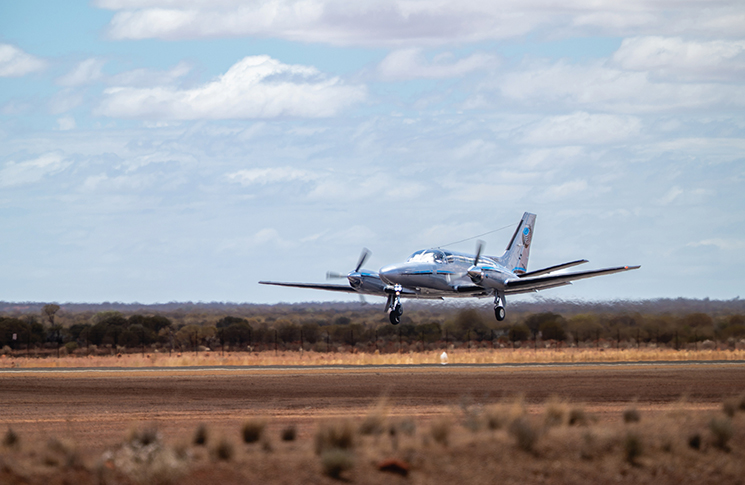
Holt sees both sides of managing aircraft performance differences – he trains pilots new to the company on their slowest aircraft, the Cessna 210, with a cruise speed of 160 knots, and experienced pilots on their fastest type, the Cessna 441 Conquest, which cruises at more than 275 knots.
He shares some of the challenges these performance differences can introduce and how they can be managed.
Keep it standard
Most of Chartair’s flights end up in non-controlled airspace at their destination, typically other regional aerodromes or small outback airstrips. Having shared mental models of the environment and others in the airspace becomes vital in these locations, where aircraft of varying performance and capabilities often converge.
Understanding who is around you begins with standardised communication, Holt says. ‘Don’t be afraid to use plain English when it’s a non-standard situation, but that shouldn’t be a reason not to use standard format CTAF calls during normal ops,’ he says.
Also critical is that you allow time for communication to be received. ‘Make your radio call well in advance of entering the runway or taking off.’
Holt experienced this issue in an incident with a helicopter recently.
‘The helicopter couldn’t see final because he was behind a hangar,’ he says. ‘The pilot blasted off across the runway as he was making his radio call, instead of making the call and then crossing. Little did he know that our Cessna 210 was on short final. They got a real close look at each other, and it resulted in an occurrence report to the ATSB.’
Allowing 3 to 5 seconds of dead air to listen for a reply would have given the aircraft a chance to reply and prevent the near miss.
Keep an ear out for fast movers
Another issue Holt routinely sees is other pilots not understanding how higher performance aircraft operate, particularly when flying into a large remote aerodrome.
As an example, the true airspeed during descent for higher performance aircraft is above 250 knots, which is more than 4 miles a minute. ‘People sometimes struggle to comprehend how that changes operating into an aerodrome,’ he says.
‘You might be departing, climbing up to 9,000 or 10,000 feet. A lot of guys turn the CTAF off before 10 nm, not understanding that a pressurised aircraft can be out at 30 nm, only 6 minutes from the circuit, coming through 10,000 feet, right where you’re going to be.
‘We had a 210 driver the other day that turned off the CTAF at 10 nm and then was shocked when a PC12 ran down his right side as he levelled off at 10,000 feet.
‘Keeping a listening watch on CTAF right out to the 30 nm mark can help you retain situational awareness with higher performance traffic, both on departure and arrival.’
Speak up
Situational awareness can be difficult to maintain, particularly in busy CTAF environments with multiple jets or turboprops. In these situations, Holt’s advice is to try to avoid feeling intimidated and speak up.
He says once situational awareness is lost, it’s very hard to regain. While no-one enjoys transmitting ‘please repeat’ or ‘say again’, it’s better to ask than to sit in silence when something isn’t clear.
‘If you do suddenly find yourself in a situation where you’re a little unsure of what’s going on around you, keep talking,’ he says. ‘Even just a report of your own position will at least give everyone else an opportunity to identify you.
‘For the most part the guys in higher performance types really do have their head on a swivel. As long as they get that position information from you, they can put you into their mental model and keep separated.’
Fly the circuit
CASA’s recommended procedure for joining the circuit is to overfly the aerodrome not below 500 feet above the circuit height, then join crosswind for the runway in use. Most pilots understand the benefits of this procedure – the opportunity it gives to assess the aerodrome, the wind direction and identify traffic before commencing an approach to land.
Holt reiterated how important a standard circuit join can be when mixing with higher performing traffic.
‘Most airliners and quicker turboprops will preference straight‑in approaches,’ he says. ‘For other slower aircraft, just joining the circuit in a predictable pattern, either overflying or from downwind, makes it very easy to manage separation with an aircraft on a straight-in approach.
‘It’s so easy to just adjust your downwind length to fit in front or behind that other traffic.’
Do your homework
Alice Springs Airport is a controlled aerodrome with general aviation traffic mixing with larger airline traffic. Operating as non-radar Class D, aircraft are separated procedurally by the tower controller using position reports from pilots which can be a hurdle for those unfamiliar with it.
Holt finds that many of their pilots have not had exposure to this type of airspace. Although Chartair trains their pilots directly on how to manage it, Holt points towards good preparation as the way to tackle busy new environments such as Alice Springs.
‘Do your homework, use the online resources, talk to the tower,’ he says. ‘There is nothing wrong with picking up the phone and having a chat to the tower controller.’
It’s not just controlled aerodromes that need preparatory homework, he stresses. ‘Prior permission required (PPR) at mine aerodromes is commonly used to make sure you don’t arrive when there are 2 or 3 scheduled jets arriving and departing. The best way to not lose situational awareness is to put the effort in on the ground – so you’re informed and know what to expect.’
Refresh your knowledge. Visit the Pilot safety hub at casa.gov.au/pilots