

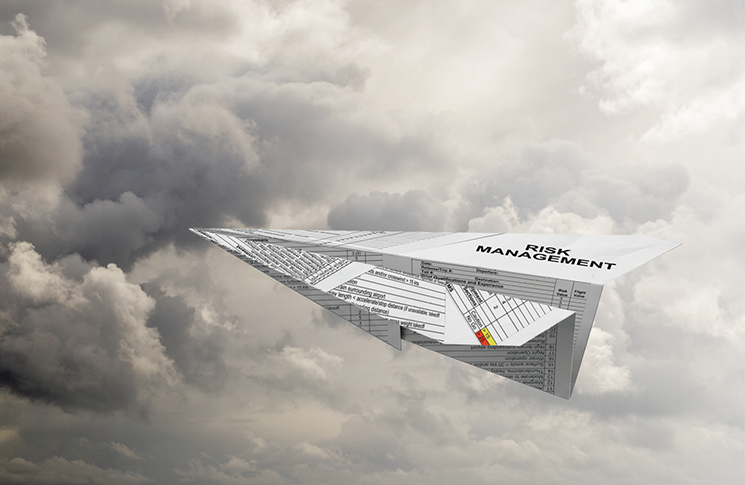
“If concrete is compromised, everything is compromised.” – Jimmy Harrell (Kurt Russell), Deepwater Horizon
At its best, risk management (RM) is one of the foundations of an effective safety management system (SMS). An SMS should not be viewed or managed bureaucratically as simply a collection of procedures and forms, it is the way an organisation identifies hazards, manages risk, learns from experience and continually improves safety. The challenge is ensuring these processes genuinely support operational decision-making rather than becoming administrative exercises.
But are we true believers in RM? Not in the sense of keeping auditors, inspectors and lawyers happy. I mean believe in a respect-the-laws-of-physics, keep-us-out-of-the-graveyard kind of way.
Gregory Smith, a West Australian work health and safety lawyer, gives us many case-law precedents to suspect much modern RM may focus on audit proofing rather than accident proofing. In his paradigm-shifting and admirably short book, Paper safe, the triumph of bureaucracy in safety management he asks whether our RM safety practices are safe in a reality-respecting – and court‑respecting – kind of way. The short answer: probably not.
This insight matters. It matters a lot. Good risk management practices should not be measured by the size of the SMS manual or the number of completed forms, but by its frontline and boardroom performance. Documentation should support safe work practices – it does not, and cannot, replace it.
If you’re as immersed in RM as me, your first encounter with Smith’s work is likely to be disorienting, troubling and telling. If it’s disorienting, it’s probably because we’ve become habituated to the idea that we must produce endless volumes of RM paperwork to keep the lawyers happy – and in Smith we now find a lawyer notably unhappy with said volumes of paperwork.
Moreover, if we find the paper-safety question troubling, it’s probably because RM is so ubiquitous, so dominant and so organisationally sacred, the idea that it might be safe by name, but not by nature, is almost transgressive. In any case, and at the very least, Smith’s questions, and his answers, are telling because they show there are many good reasons to be an unbeliever in current manifestations of RM.
If we find the paper-safety question troubling, it’s probably because RM is so common and highly valued by organisations, that the idea it might be safe in name, but not in reality, is almost controversial. In any case, and at the very least, Smith’s questions, and his answers, are important because they show there are many good reasons to be sceptical of current forms of RM.
Who reads that stuff??
First, what evidence shows our risk controls and processes make us safer? For operators implementing or reviewing their SMS, this is a useful test. If the risk register, safety reports or procedures are rarely discussed outside audits or management meetings, they will not be providing the operational value they were intended to deliver.
Or, as Douglas Hubbard asks in The Failure of Risk Management, how do we know RM works? This is a simple question to ask but far more difficult to answer. Perhaps we could pose it to our boardrooms or our workforce as a discussion‑starter – although if the reading list is any indication, it may be more fire-starter than discussion‑starter when actual evidence is demanded.
Second, when was the last time our front liners read the risk register in a meaningful way? At various courses, sessions and seminars, I’ve asked aviation, medical, forestry and emergency services front liners whether they have read their risk register in the last 12 months. I get zero hands going up, 99% of the time. Then I ask about the last 24 months. One or 2 wavering hands go up.
The risk register is our go-to when the board, auditors or regulator show up. Nonetheless, it’s clear the frontline professionals are not nearly as devoted to the register. This is peculiar since the front liners have the most to lose in terms of life or limb.
Home truths
This leads to our third question of RM true belief. Do we, for those most precious to us, in the place most precious to us – our family and home – have immediate and deliberate risk practices? Surely, if we are RM true believers, we would have at least some of these (tried and true?) practices?
Maybe not. Which begs the question – if we don’t believe in RM enough to implement it at home, how much do we really believe in it at work?
If these questions have created a gnawing sense of doubt, you may, like me, be asking ‘what can be done?’ I’m really hoping the answer isn’t yet another reflexive rewrite of the risk register, or yet another risk-reform program, or another sternly worded ‘do better’ email.
The answers to these questions are up to you, but at the very least I’m hoping the questions bring us alive to the unexamined risks of risk management – especially the risk of ‘paper-safety’. There are other names for paper-safety. Professor Sidney Dekker calls it safety theatre. Safety pantomime might be an even better description, evoking the inherent absurdity of pretending to be safe. I’m also hoping these questions help us become savvy to RM’s unexamined assumptions, including that its ubiquitous presence and appealing auditability are indicators of frontline success.
Safety in the real world
Smith’s work (and the growing list of others like it) should give us pause when we next habitually say, ‘We’ve risk managed that.’ Instead, we might want to consider whether, in an accident-proofing kind of way, we have actually empowered individual and managerial situational awareness, proficiency and judgement – as much as we have empowered RM processes, plans and frameworks. This is what we could call a human-centric approach (rather than a policy-centric one). A night to remember illustrates a human-centric safety culture in action. In this generative culture, humans self-generate reality-respecting situational awareness, proficiency and judgement, supported by optimised organisational policies and procedures. The result is impressive: in this case, a successful offshore helicopter rescue of a person a massive 350 nautical miles from land.
When we next test our RM true belief, perhaps we should consider whether we have spent as much time, money and resources on the intentional formation of safety-generating culture, conscience and character, as we have generating RM paperwork.
This human-centric approach is absolutely essential for 21st century safety culture where it seems a big risk of modern RM is that we will convincingly create believers: believers in paper-safety. And when we do that, everything is compromised.
Find resources to support effective safety management at casa.gov.au/sms