

The sound came at exactly the wrong moment.
On the afternoon of 8 November 2024, a Qantas Boeing 737-838 was already hurtling down runway 34R at Sydney Airport, gathering speed for the everyday hop to Brisbane. Inside the cockpit, the rhythm was routine: instruments scanned, speeds called, the familiar choreography of departure playing out exactly as it had thousands of times before.
Then, at 1235:20 – just as the first officer called ‘V1’ – it happened.
A violent bang. The aircraft shuddered. And in that split second, the ordinary turned into something else entirely.
The commitment point
In aviation, V1 is described as the decision speed. Below it, a pilot can abort a take-off and stop safely. Above it, there’s no turning back – you fly, whatever happens. The Boeing 737 had just crossed that line.
Three seconds after the bang, the aircraft hit rotation speed. The captain pulled back. The nose lifted. And with one engine no longer doing its job, the jet left the ground.
From the outside, it might have looked like nothing unusual. But inside the cockpit, the warning lights were already telling a different story.
The right engine had suffered severe damage.
Still, there was no hesitation. The take-off continued.
Fire on the ground, focus in the air
As the aircraft climbed away, debris from the engine rained down along the runway. Fragments struck the grass nearby, sparking a fire that quickly flared in view of cameras and air traffic observers below.
Back in the cockpit, the crew didn’t see the fire. They didn’t need to – they had their own crisis to manage.
Within half a minute of lift-off, the first officer transmitted a calm ‘PAN PAN’ call – an internationally recognised signal conveying urgency and that something was wrong. The captain held the aircraft steady on runway heading, buying time.
Quick assessments followed. Engine instruments confirmed their suspicions: the right engine was severely damaged. The crew began the checklist.
Training had taken over. Every action, every call, every decision, had been drilled into memory during simulator sessions – some of which specifically recreate this exact nightmare: an engine failure at V1.
A problem measured in microns
While the aircraft circled south of Sydney, buying time and burning fuel, the real story of the failure lay hidden deep inside the crippled engine.
Later, engineers would uncover it.
Inside the high-pressure turbine – a part of the engine that runs hot and fast – sat 76 turbine blades. Each one was precisely shaped, anchored into a rotating disc and subjected to constant stress.
One of those blades had developed a fatigue crack. Tiny, invisible during normal inspections, it had grown slowly over thousands of flight cycles. The crack formed in a vulnerable area known as the ‘min-neck’ of the blade’s dovetail – the narrow section that holds it in place.
On this flight, the crack reached its limit. The blade fractured and broke free. Once loose, it became a high-speed projectile inside the engine.
It struck neighbouring components, triggering a violent chain reaction. Another blade failed. Then more. In seconds, the turbine effectively
disintegrated. Debris blasted rearward through the engine and out the exhaust.
Bits all over the runway
While the crew worked their problem, air traffic control pieced together a grim picture from the ground. There was debris everywhere. And fire.
‘Looks like there has been an explosion,’ the controller advised. ‘Bits all over the runway.’
Runway 34R was immediately closed. The aircraft, flying on one engine and carrying more fuel than ideal for landing, needed a new plan.
The crew chose runway 34L – longer and safer for a single-engine landing.
A view from the cabin
The flight crew couldn’t see the damaged engine clearly from their seats. So they turned to an unusual but practical solution: someone in the cabin took a photo.
An off-duty pilot on board captured an image of the right engine. The picture confirmed something critical – the failure appeared contained. This meant that although parts had broken free, they hadn’t breached the engine casing in a way that might damage the wing or fuselage.
It was a small but crucial piece of information. It meant the aircraft itself remained structurally sound.
The longest half hour
For about 30 minutes, the aircraft remained in a holding pattern while the crew completed checklists and prepared to return.
Checklists were completed. Speeds recalculated. Landing distance carefully considered.
Every detail mattered now because with one engine gone, performance margins were tighter.
At 13:01, the crew told air traffic control they were ready. Four minutes later, the aircraft descended toward runway 34L. At 13:05:50, the wheels touched down.
No drama. No sudden movements. Just a controlled, precise landing – the kind that comes from training, discipline and years of experience.
The aircraft rolled to the end of the runway, where emergency crews were waiting.
They checked the engine carefully, watching for any sign of fire. There was none.
The danger had passed.
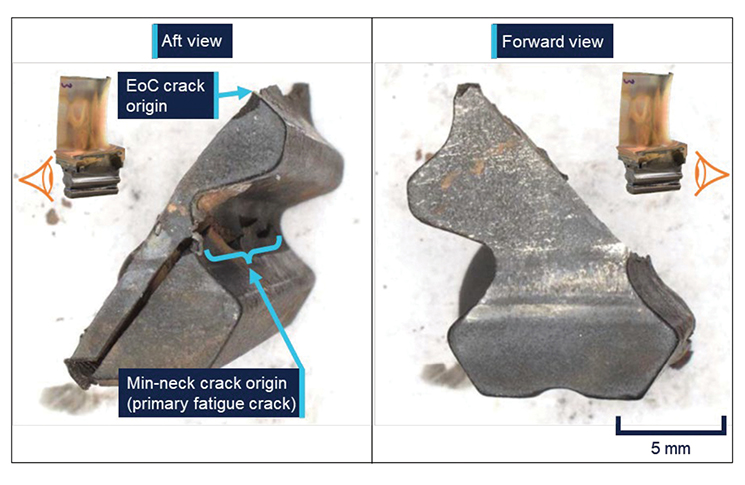
operation. The min-neck crack originated where the dovetail’s cross-section was at its thinnest.
Source: CFM International, annotated by the ATSB
After the silence
Back at the gate, passengers disembarked normally – no slides, no chaos, just the quiet after something that might have been much worse. No injuries were reported among the 181 people on board.
The aircraft itself sustained only minor damage. But the investigation that followed told a deeper story.
The engine had accumulated 17,656 flight cycles – just shy of a scheduled removal at 17,900 cycles. The manufacturer had already lowered this threshold after similar failures elsewhere in the fleet, recognising the risk of fatigue cracking in this specific blade design.
The cracks that caused the failure were located beneath the blade platform – an area not visible during routine inspections. Detecting them would have required full disassembly of the engine, something done only when blades are replaced.
In other words, the failure had been quietly developing out of sight.
What it meant
In the end, investigators concluded that everything had unfolded in the worst possible way – and the best possible response.
An engine failure at V1 is, by definition, where margins are at their minimum. There’s no good option, only the least bad one. Abort too late and you overrun the runway. Continue without control and the outcome is worse.
The crew did exactly what they were trained to do. They flew the aircraft, managed the emergency and brought everyone home.
The lesson in the bang
Incidents like this are often reduced to a single line: engine failure during take-off. But behind that line is a chain of physics, engineering, human judgement and training.
On that November afternoon in Sydney, all those pieces came together. The bang at V1 could have been the start of something far worse.
Instead, it became a quiet demonstration of how aviation safety is built – not on the absence of failure – but on the ability to handle it when it arrives without warning.
Timeline
- 1235:20: The bang
- 1235:20: V1 called
- 1235:23: Rotation speed
- 1235:26: Fire and debris
- 1235:53: PAN PAN call
- 1236:00-1301: Holding
- 1301:00 Ready to return
- 1305: Touchdown
Read the report:
atsb.gov.au
Investigation AO-2024-057