

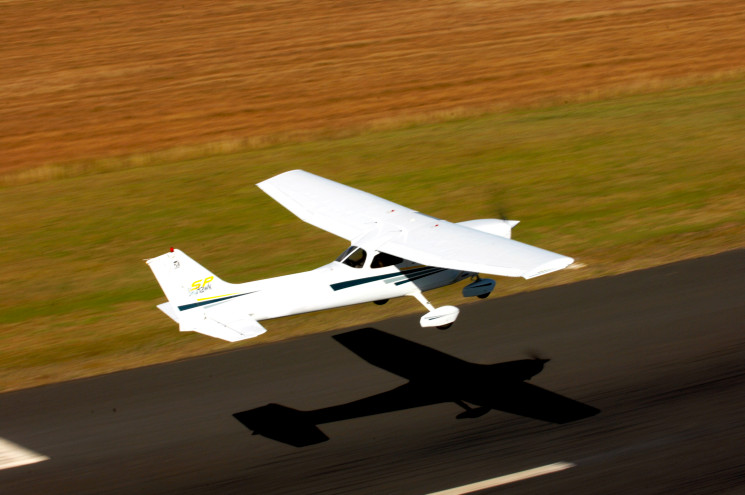
Friday flashback: a Close call from Flight Safety Australia, January-February 2008
By Max Fenton
It was a clear and cold July winter morning as I ruefully surveyed the Cessna 182K and noted the flying surfaces coated with a thick covering of rime ice from the heavy dew. There was still 15 minutes before first light when I was due to depart the paddock strip and ferry the aircraft to a nearby large regional centre for a major airframe service and engine overhaul.
With frozen hands and chattering teeth, the daily inspection, including ice removal sans ladder, was completed and, after ensuring the livestock were out of the way, the engine was started, warmed up and checks performed, and a plan for take-off made. With high voltage powerlines one end and a forest of tall trees the other, my friend the owner usually ran up to full power, released and then halfway down the short strip dropped half flap. With a grand total of 104 hours flying time including 20 hours on type, I did not want to be fumbling for the flap switch halfway into this take-off, so an oblique run was made, at about 10 kt, onto the strip with flaps set.
Everything in the green and ‘all knobs full rich’. On rotation with just me and half fuel, we went up like an elevator well before my cut-off point. Turning to heading and reaching cruise at 5000, trimmed and leaned, the aircraft was as stable as a rock. With the engine running at a smooth purr, I contemplated the necessity of the rules which required this relatively simple machine to be disassembled and overhauled when in the prime of life. But this thought was soon replaced. With the sun just peeping over the horizon, the Lilliputian panorama below was lit in an ethereal glow and the shadows from trees in the wheat fields stretched for miles. Fireplace smoke being held down by the inversion rose only a few feet from the well-spread, toy-like farmhouses and then, in turn, spread out in line with the shadows. Nothing else moved. It was one of those rare occasions when the world seemed at peace. A moment in time well remembered, but one that cannot readily be explained, except perhaps to another pilot.
Six weeks later I was dropped off at the regional airline’s large maintenance centre to pick up the aircraft. It was late in the afternoon, but only a 30-minute flight back to base. The aircraft was sitting outside the large hangar, allowing me to do a walk-around check without anyone else about. After this, I found someone in charge and asked for a hinge pin for the pilot’s door, as one is not enough, and if anyone knew where the fuselage/wingstrut fairing boot was for the passenger side.
Having fixed the first, located the latter and put it in the aircraft, I loaded myself and started up – what a racket! A chaff-cutter would sound better. Closing down, I again located someone and off came the cowls. Another start, still a little rough in my view but mag-drop, although full, was within margin. One mag was not timed right, I was informed – on with cowls.
Taxiing out, I requested clearance from the tower – ‘Sorry, not available’, came the reply. A new rule had just come in – all flights over 50 nm now required a flight plan. My destination was 51 nm, so I changed it to my home strip which was 49 nm.
All checked and cleared, controls full and free, and with just a bit of rudder trim to counteract the P-factor swing, I commenced take-off. No problems … until lift-off, when the nose swung violently, and without realising it, I had a boot-full of rudder on to stay straight. A quick change of plan is relayed to the tower who approve my circuit which, after trimming out the rudder forces, is uneventful.
Again back to the hangar, I am not in a good mood and last light is now a real concern. But a quick changeover of the back-to-front rudder trim wires (!) via the inspection hatches fixes the problem. A normal take-off, a departure from over the top and a somewhat unusual, if effective, short-field landing back in my friend’s paddock at last light completes the day’s lesson.
Lesson learnt
Flying, like anything else, comprises good and bad. Enjoy the one and beware the other – but don’t be put off.
Following these incidents, my flying career went on for another 30 years and overall my experiences with LAMEs was very good. But from those early days, I always remember the answer one person gave to the question: ‘What is the best accessory you can have on a new aircraft?’ The reply: ‘On a new aircraft, or one just out of major maintenance, 20 hours flying – BY SOMEBODY ELSE!’
Have you had a close call?
8 in 10 pilots say they learn best from other pilots and your narrow escape can be a valuable lesson.
We invite you to share your experience to help us improve aviation safety, whatever your role.
Find out more and share your close call here.




Comments are closed.