

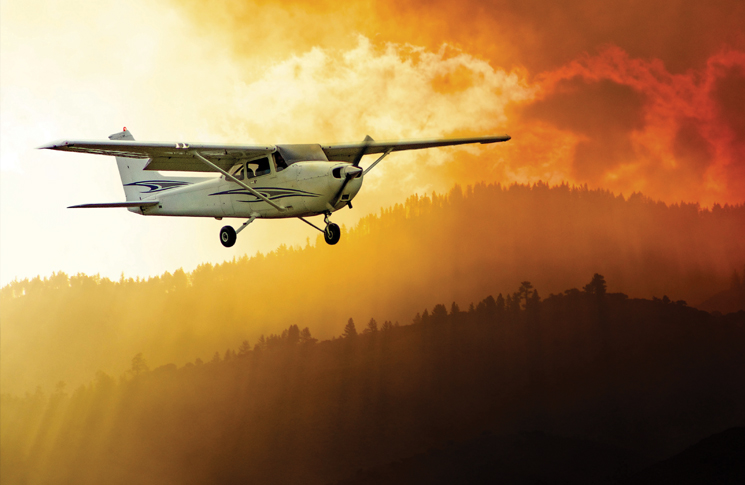
This pilot pushed on as the visibility gradually reduced – until he was flying blind
By Andrew Clarke
My close call occurred in late 2006. At the time I was flying privately and commercially with a flying school from Geelong Airport (sadly no longer there). They had a number of aircraft online for lessons, private hire and charter, mostly privately owned.
One day I was asked if I could fly a C-172, which was due for its 100-hourly check, back to its owner who would do the inspection. He had a private airstrip at a town in central Victoria. I hadn’t flown there before but I readily agreed as it was a chance at some free cross-country flying. It was during summer and several large bushfires were burning around Victoria, mostly in the Gippsland region. This was generating a large amount of smoke haze in the air, reducing visibility.
I looked at the weather forecast before I left home. It was a little hazy but otherwise seemed okay. The area forecast and the TAF for Bendigo, which was the nearest airport to my destination, indicated some reduced visibility in smoke haze but I thought it would still be good enough to go. Soon I discovered how wrong I was.
My plan was to fly north from Geelong to Bendigo and then follow the highway north-east to the town to find the airstrip. My path would take me under the controlled airspace steps to the west of Melbourne. I took off and headed north, keen to deliver the aircraft to its owner.
The smoke was so thick I lost sight of the ground and couldn’t see the horizon – I was in IMC!
At first the conditions were fine, with a small reduction in visibility due to smoke haze but as I headed further north, the smoke from the bushfires became thicker and the visibility was becoming poorer. I found myself having to fly lower to stay in sight of the ground, hoping the smoke would clear the further north I flew.
It didn’t. Stupidly I pressed on.
By this time I was now west of Melbourne and flying over rising terrain in worsening visibility. The smoke became thicker and I was finding it harder to see ahead. I could smell smoke coming into the cabin, irritating my throat and eyes.
By the time I was flying north-west of Melbourne, the smoke was so thick I lost sight of the ground and couldn’t see the horizon – I was in IMC! I couldn’t believe I had found myself in this situation.
To make matters worse, I was also unsure of my exact position and struggling to maintain straight and level flight. The AH was showing an increasing bank and the DG was turning off track. I had to get myself out of this and fast. Sanity prevailed and I finally made the decision to turn around and head back to Geelong.
I contacted ATC to request my position as there was no GPS in the aircraft. I began a climbing 180 degree turn on instruments to try to get into clear air. By this time ATC had inquired about my intentions and if I was instrument rated. I informed them of my new destination and that I was not instrument rated. I felt a bit embarrassed admitting this and asking for help but there was no other option.
After much concentration, I broke through the top of the thick smoke layer at about 4000 feet into clear air. I settled into a cruise, keeping well above the smoke, however, I was not out of the woods yet.
The layer of thick smoke stretched out as far as I could see with no sign of the ground. I knew my approximate position and realised that at the height I was flying, my course back to Geelong would take me through controlled airspace. I requested a clearance but was unable to obtain one. However, ATC did give me headings to fly and vectored me around the steps as I flew south and kept an eye on me until I was clear of the airspace.
By the time I was nearing Geelong, the smoke had begun to clear and I was finally able to get a positive position fix. I found my way back to the airport and, after thanking ATC, landed safely and taxied in.
As I shut down, I sat there for a few minutes shaking slightly and thinking how close I came to losing control and crashing. I had read many stories of VFR pilots flying into IMC and the sometimes tragic outcome. So I was well aware of the hazards and yet I almost found myself adding to the statistics.
I had a short debrief with one of the instructors who told me I had done the right thing in turning around and asking for help, but I still felt stupid for what I had done.
I made some poor decisions that day, the first of which was even taking off in the first place. If I had contacted the owner at his airstrip before I left, I would have found out the visibility was poor and not to attempt to fly there. My second and most obvious one was continuing my flight into deteriorating conditions in the hope they would improve. I had become focused on completing my mission, which most likely affected my better judgement.
One good decision was finally deciding to abandon my trip and turn around, albeit almost too late. Another was to contact ATC and let them know of my situation and get their help.
I was also grateful for the basic instrument training I had received during my flying lessons which undoubtedly helped me keep control of the aircraft until I was in clear air.
Lessons learnt: I have tried to apply what I learnt that day to all my flying since, in particular to pre-flight planning and en route decision-making. I now take much greater notice of weather conditions, particularly if there is smoke about.
I hope others can learn from my experience in IMC and realise a VFR pilot must take a good look at weather forecasts. Also, don’t be afraid to ask for help if the situation turns bad. Don’t feel pressured to complete a flight if you are not happy with the conditions. Your life and that of others is simply not worth the risk.



Comments are closed.