


In Tolkien’s novels, the One Ring radiated a peril that was invisible yet irresistibly binding. Helicopter flight has its own equivalent – an aerodynamic trap woven into the very medium that holds us aloft. A state in which even generous engine power cannot prevent a helicopter from sinking through its own downwash towards the ground and doom.
This power sapping darkness is called vortex ring state (VRS) and involves the helicopter sinking into its own wake where a vortex is established around the blade tips. This disrupts the lift-producing properties of the rotor. Escape from this hold requires deliberate action.
However, VRS is not a complete mystery – it is a predictable outcome of certain combinations of descent rate, airspeed and power. Predictability allows us to avoid its nefarious power; there are methods to escape its clutches if we are ill disciplined in our helicopter operations. Recent research has also shed new light on these escape techniques.
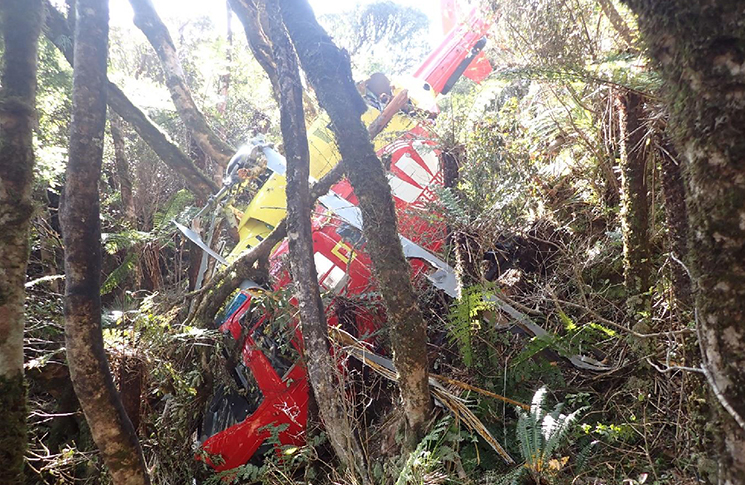
A VRS accident
A recently published helicopter accident report from the Transport Accident Investigation Commission (TAIC) draws together some excellent and updated learning points.1
A rescue helicopter BK117 was preparing to winch an injured hiker off a ridgeline in New Zealand. There was a wind producing an updraft at the out-of-ground effect winching point. The approach to this point was rushed and the pilot was descending and decelerating in a nose-up attitude.
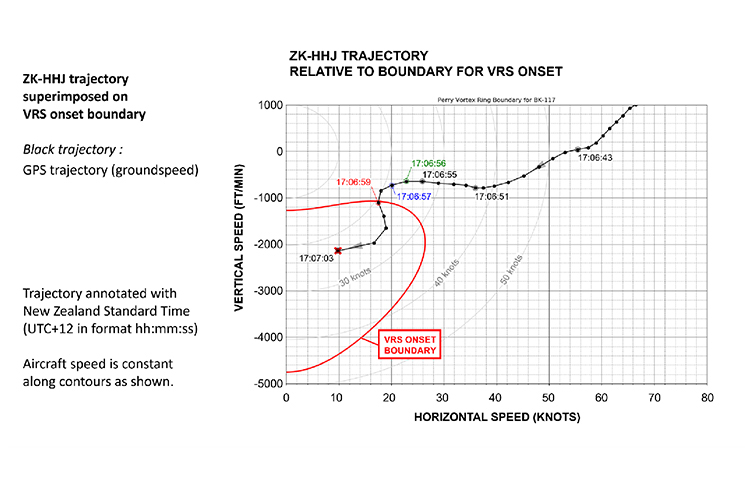
The winch operator in the back was still preparing the cabin and couldn’t provide any help guiding the helicopter to the winch site. This required the pilot to keep their eyes out with less attention to the cockpit instruments. Post-accident data recovered from the helicopter showed a descent rate of 649 fpm, a groundspeed of 25 knots and a nose-up attitude of 13 deg.
At this point, the helicopter experienced a sudden drop in height, and the pilot reported a lack of control responsiveness. The pilot suspected VRS and attempted the traditional recovery technique. This did not appear to be effective, so the Vuichard technique was then attempted and this was also ineffective. The helicopter now had a rate of descent of 2,145 fpm and a ground speed of 9 knots. The pilot, realising a crash was imminent, focused on controlling the descent through the trees. Fortunately, no serious injuries occurred.
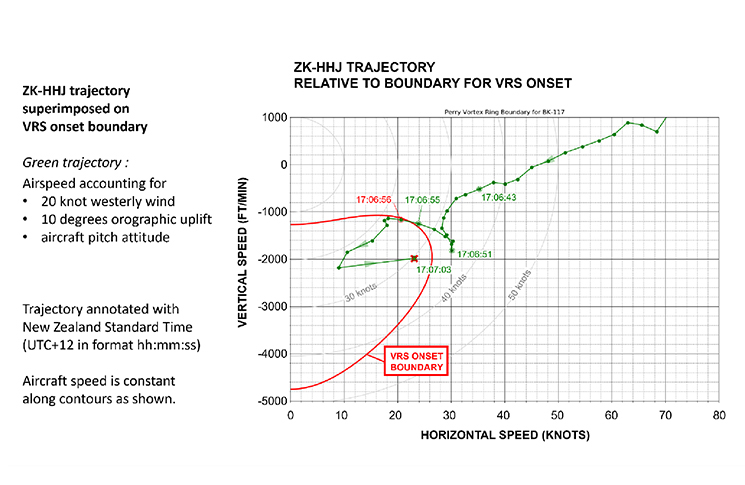
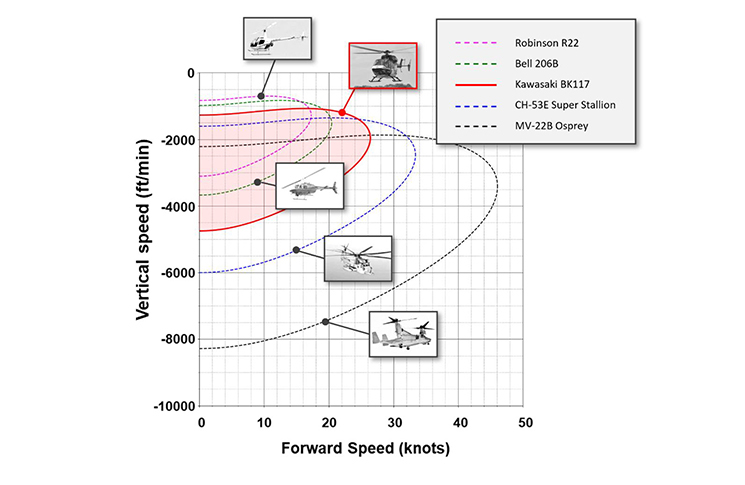
Post-flight analysis indicated the aircraft was within the VRS envelope for the BK117. Further theoretical analysis showed the updraft air and decelerative disc attitude would have resulted in the helicopter being further into the VRS envelope than the instruments would have indicated. The updraft increased the apparent rate of descent and the nose up attitude allowed more up-flowing air through the rotor disc. The report also noted that manufacturers do not always publish the VRS envelope and recommended this be included in helicopter flight manuals.
Anatomy of a vortex
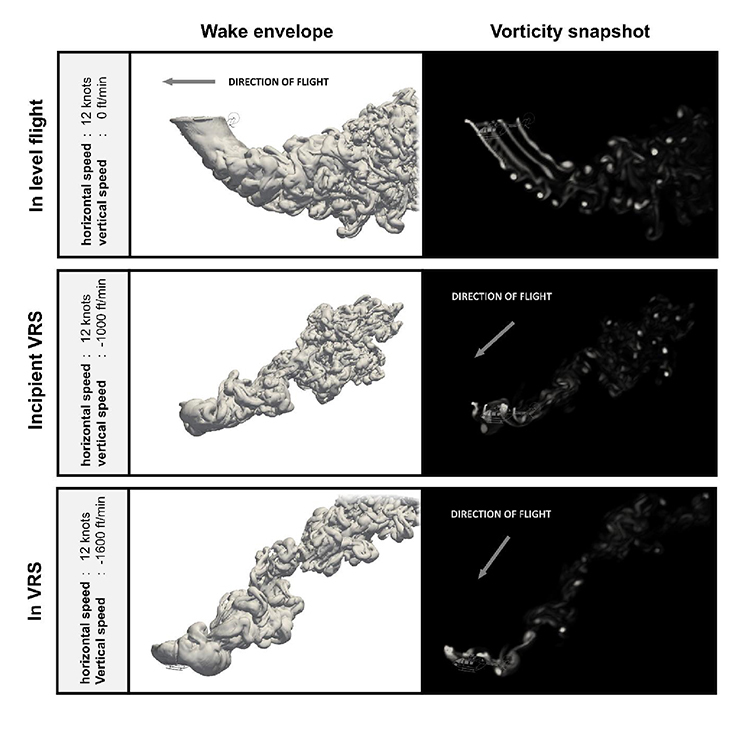
The helicopter creates lift using the rotor to accelerate a large mass of air downward. Tip vortices are always present, nibbling at efficiency but not threatening control. As descent becomes more vertical and forward airspeed decays below effective translational lift, the rotor can begin to ingest its own downwash. Air now recirculates through the disc in a toroidal pattern – energy goes into recirculating and re-ingesting air back into the rotor and not into creating useful thrust. Inner blade sections experience upward flow relative to the disc, resulting in local blade stall and spawning secondary blade root vortices.
The helicopter now had a rate of descent of 2,145 fpm and a ground speed of 9 knots.
The helicopter pitches and rolls in response to the varying lift. Vibrations are felt, controls feel mushy and even high-power settings produce little reduction in rate of descent. Large power applications may even produce higher rates of descent due to increasing the stalled area.
Operationally, 3 ingredients mark the danger zone for VRS:
- descent rate at or above ~300 ft/min (threshold depends on weight, disc loading, rotor RPM, density altitude)
- power in use – typically 20% to 100%
- airspeed below effective translational lift.
It is important to note that these ingredients are what the rotor disc sees. So decelerative attitudes and updraft air may reduce the margins indicated by the vertical speed indicator and airspeed indicator.
In a fully developed state, VRS can produce descent rates approaching thousands of feet per minute. It is not a stall in the fixed-wing sense – but the loss of lift is just as real. Figure 1 shows typical VRS envelopes of some helicopters. This is the type of graph that the accident report recommended should be published in helicopter flight manuals.
The traditional recovery
The traditional recovery from VRS taught for decades is codified in the FAA’s Helicopter Flying Handbook. It asks pilots to do something that feels wrong in the moment: reduce collective to unload the rotor to reduce the vortex strength, move the cyclic forward to gain airspeed and fly into clean air until translational lift returns and fly out of the vortex. In practical terms, this can mean accepting a transient increase in sink while establishing a forward escape path to escape the rotor downwash.
The Vuichard recovery
The Vuichard recovery was discovered and popularised by Claude Vuichard. It involves exiting the vortex sideways and adding power to minimise the height lost. The technique as described in the FAA’s Helicopter Flying Handbook is to first increase collective to full take-off power, bank the aircraft 15 deg to the right for counter-clockwise rotating rotors or to the left for clockwise-rotating rotors, while maintaining the heading with pedal. This allows the helicopter to exit the vortex sideways using tilted rotor thrust and the thrust of the tail rotor. The nominated advantage of this technique is reduced altitude loss over the traditional recovery technique.
EASA studies
The European Union Aviation Safety Agency (EASA) conducted a research program to compare the traditional and Vuichard techniques and published the results in March 2025. The testing was conducted on the Squirrel and Dauphin helicopters. The aircraft were instrumented to allow repeatable VRS entry and to record VRS recovery metrics. The helicopters were flown by test pilots and 229 data points were collected.
On average, there was a slight although small advantage in the Vuichard technique on the Squirrel but not so on the Dauphin. The reduced advantage on the Dauphin was due to the high workload the pilots experience flying the Vuichard technique on the Dauphin. The report concluded:
We didn’t notice a large difference between the two recovery methods except during recoveries performed at the early stages of VRS where the Vuichard manoeuvre shows better performance than the forward one in terms of both time of recovery/height loss.
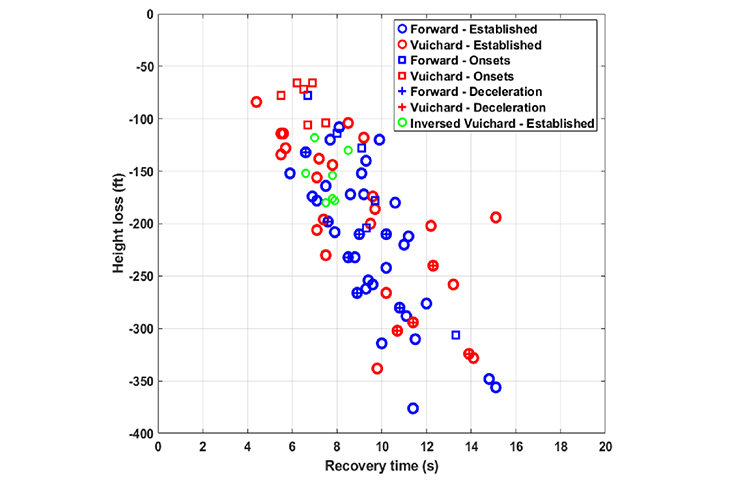
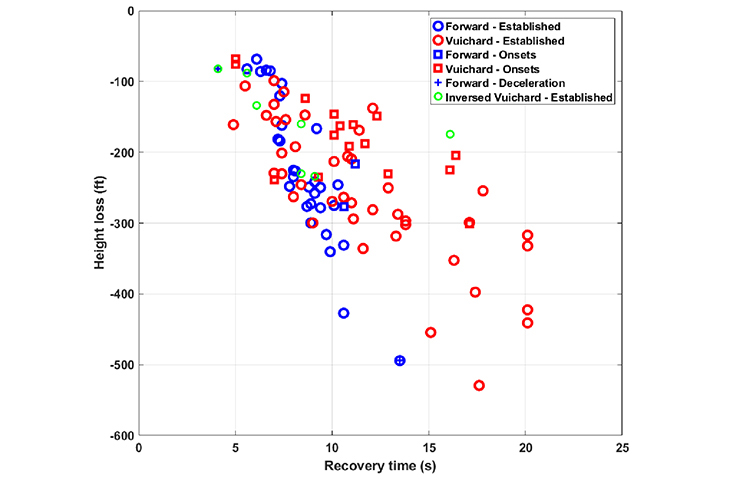
The traditional recovery technique was found to be intuitive with low to medium workload; the Vuichard recovery was less intuitive with high workload due to unpredictable parasitic effects and power management challenges. Pilot workload was found to significantly impact recovery performance and needed to be considered. A further interesting finding was that in the traditional recovery technique, increasing collective minimised height loss, counter to the previous guidance and congruent with the Vuichard technique.
As a result of this testing, Airbus helicopters published a Safety Information Notice (SIN) No 3463-S-00 to provide guidance on the 2 techniques for its helicopters. Airbus stated that the traditional technique requires checking and then increasing the collective pitch and applying forward cyclic to gain airspeed. The Vuichard technique requires using collective while applying lateral cyclic and maintaining heading with pedals. The Airbus notice recommends that:
In flight, in case the pilot has not recognised the early warnings and is in a fully developed VRS, the classical technique is effective for recovery. However, the Vuichard recovery technique may be applied in case of fully developed VRS in specific operational conditions like a down wind approach or with obstacles in the flight path, in front of the aircraft.
The advice also states that Airbus helicopters are not designed for flight in full VRS and they do not recommend placing the helicopter in a fully developed VRS. This is because the dynamic loads on some components of the rotor system increase significantly and are not accounted for in the component service life. We should then note for the Vuichard technique, there is a high workload, different control inputs for different rotor directions and in some cases, an inability to practice VRS recovery on the helicopter due to the manufacturer limitations. Therefore, attempting a Vuichard manoeuvre may not reproduce results achieved by the test pilots.
Conclusion
Recent Airbus guidance has updated VRS recovery technique advice based on measured flight test results. The information provided by Airbus supports a modified traditional recovery technique where collective is increased and the aircraft is flown forwards out of the vortex. The Vuichard technique may provide some improved recovery parameters if flown correctly in some circumstances. Airbus recommends the Vuichard technique may be applied where there is no room to fly forward. Flying helicopters in VRS deliberately for training may not be approved for all helicopter types. The inability to train for VRS coupled with the higher workload of flying the Vuichard technique should be considered in deciding which technique to use.
This article has been merely an introduction to a complex problem. The underpinning documents require careful consideration if changes to your own procedures are considered.
VRS cannot be destroyed like the One Ring on an epic quest by a band of Hobbits. This means Vortex ring state still has the power to capture and corrupt a helicopter’s ability to fly. The mysteries, vagueness and variability of VRS, like the One Ring worn by Frodo Baggins, are best avoided by not putting it on your finger in the first place – or at least giving it a healthy margin.
Vortex ring state still has the power to capture and corrupt a helicopter’s ability to fly.
Key points
- Vortex ring state (VRS) is an aerodynamic condition where helicopters lose lift by descending through their own downwash. VRS can be dangerous if encountered at low level or unexpectedly in flight where a VRS recovery manoeuvre cannot be easily carry out.
- Research shows VRS is triggered by low airspeed, combined with medium to high descent rate, and power applied.
- Two recovery methods exist: traditional (forward escape) and Vuichard (sideways escape); each has pros and cons.
- Airbus now advises, after checking collective, increasing collective while applying forward cyclic during recovery and using Vuichard technique only in specific scenarios when on a downward approach path close to the ground, or with the need to avoid obstacles in the flight path

More information
More information can be found in the final report.