
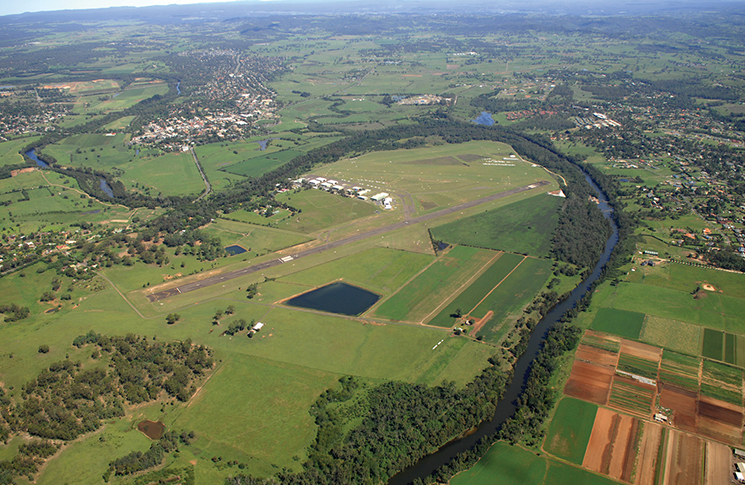
NOTE: For Camden aerodrome, assume outside of tower hours CTAF procedures apply (ERSA).
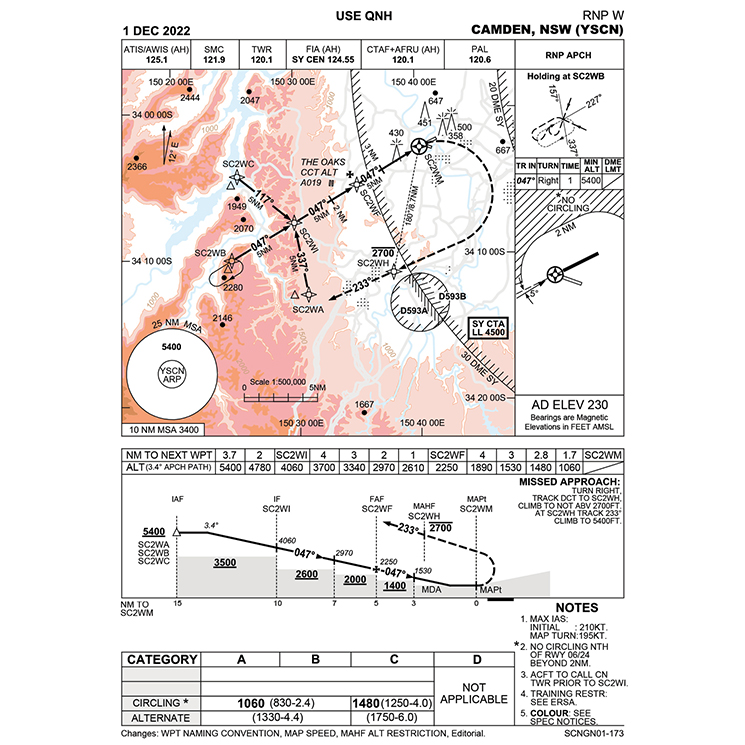
- Outside tower hours, Camden aerodrome functions as a CTAF in Class G airspace. When operating below the MSA outside tower hours, what is the maximum indicated airspeed permitted?
- 210 knots
- 200 knots IAS with 4 nm
- 200 knots groundspeed within 4 nm
- 250 knots
- Which AIP publication contains information on aerodrome lighting, standby power, pavements and navigation aids, and is updated 4 times per year?
- ERSA
- DAP
- AIP
- NOTAM
- What must the pilot in command do to conduct a straight-in approach at a non‑controlled aerodrome?
- obtain the wind direction at the aerodrome
- obtain the runway in use at the aerodrome
- give way to any aircraft flying in the circuit pattern
- all of the above
- Does the Camden RNP W approach have a published straight-in approach minima?
- yes
- no
- What is the published missed approach altitude at waypoint SC2WH?
- not above 2,700 feet
- not below 2,700 feet
- at 2,700 feet
- not above 2,700 feet unless CTAF procedures apply
- What is the main threat if passing waypoint SC2WH above 2,700 feet?
- no threat as 5,400 feet is the prescribed MSA
- a possible airspace incursion into SY CTA
- the 2,700-feet restriction is only applicable during tower hours when under radar control
- overlying restricted military airspace
- What is the maximum speed permitted during the missed approach turn?
- 210 knots groundspeed
- 195 knots indicated airspeed (IAS)
- 210 knots IAS
- 210 knots groundspeed
- When a missed approach climb is begun prior to the MAPT, which of the following conditions applies?
- during tower hours, the published missed approach is only required to be flown once passing the FAF
- during CTAF hours, the published missed approach is not required to be flown
- the aircraft must continue tracking to the MAPT, then commence the missed approach procedure
- the published missed approach is only required to be flown when within the circling area
- If the missed approach is commenced at 7 nm to run to the SC2WM (MAPT), on descent through 3,000 feet, what are the initial altitude and tracking requirements?
- turn right to SC2WH and maintain 3,000 feet, then climb to 5,400 feet
- continue tracking to SC2WM and climb to 5,400 feet
- continue tracking to SC2WM (MAPT) and descend to 2,700 feet
- climb to 5,400 feet and manoeuvre the aeroplane within the 25 nm MSA
- Refer to the plan and profile diagram. What do the broken lines between SC2WM and SC2WH represent?
- a recommended track but not mandatory
- a profile that requires a specific clearance
- a section of the approach where speed requirements do not apply
- broken lines on IAP plan and profile diagram depict the missed approach procedure
- After breaking visual from the approach and circling to land, the aircraft is involved in a airprox event in the circuit area with a VFR aircraft. Is this an immediately reportable matter (IRM) or a routine reportable matter (RRM) and how should it be reported?
- RRM by phone within 72 hours
- IRM by online form
- RRM by phone as soon as reasonably practical
- IRM by phone as soon as reasonably practical and a written report within 72 hours
- When conducting this PBN approach in an aeroplane without a minimum Equipment List (MEL), what is the maximum allowable operating time after the navigation database has ceased to be current?
- 7 days
- 24 hours
- 72 hours
- 48 hours
To view the answers, go to the next page using the page navigation buttons below.
Note (25 August 2026): Question 11 on this quiz was updated to replace the term ‘loss of separation standard’ with ‘airprox event’.