

The concept of an autopilot is almost as old as aviation, but what about an auto-LAME? Recent research in composite materials has raised the possibility of self-diagnosing and self-healing structures that could give airframes a fatigue life measured in centuries.
First a refresher. Composite materials consist of a binder and filler. The binder (also known as matrix) can be anything from mud to epoxy polymer. The filler can be straw (first combined with mud to form bricks more than 3,000 years ago) or carbon fibre (combined with polymer resin to form carbon fibre composite, as used in aircraft).
Whether ancient or modern, the combination of binder and filler produces a material that is lighter and stronger than each of its parts. Composite materials, in particular carbon fibre, have a prominent failure mode – delamination – which occurs when cracks form in the composite form and cause the filler to separate from the binder. Delamination can be visible to the eye or microscopic.
The promise of self-healing materials has been studied for more than 30 years. In the 1990s scientists developed micro-scale hollow-glass tubes which could be filled with healing agents. In 2001 the University of Illinois at Urbana-Champaign presented a prototype capsule-based self-healing material. Epoxy-based systems were proposed in 2007. Vacuum-assisted capillary action to inject the healing agent was demonstrated in 2008.
Pooria Pasbakhsh, research fellow in polymer upcycling at the University of Melbourne and adjunct associate professor at Monash University Malaysia, says the technology is evolving.
This doesn’t eliminate maintenance, but it buys time.
‘Most systems today repair only part of the original strength and have limits including volume healed, repeatability and environmental sensitivity,’ he says. ‘Practical adoption depends on trade-offs – weight, complexity, maintenance protocols and regulatory approval.’
Break, repair, repeat
In January 2026 scientists from North Carolina State University (NCSU) in the US published a paperdetailing a promising experiment in self-healing composite materials.
‘We introduced a self-healing strategy via in situ heating, where soft yet tough thermoplastic inclusions achieve interlaminar fracture recovery via polymer chain re-entanglement, i.e. thermal re-mending,’ the authors say.
The experimenters created a composite material with 2 extra features. They 3D-printed a thermoplastic healing agent onto the fibre reinforcement, making the laminate 2 to 4 times more resistant to delamination. Second, they embedded thin, carbon-based heater elements into the material. These warm when electrical current is applied. The heat melts the healing agent which flows into cracks and microfractures in the material and reattaches delaminated surfaces.
The team tested the composite material on an automated rig that repeatedly applied a tensile (stretching) force to the material until it produced a 50 mm-long delamination. At this point the rig triggered thermal re-mending. The rig ran 1,000 fracture-and-heal cycles continuously over 40 days, and measured resistance to delamination after each repair.
Statistical modelling suggests the self-healing will remain viable over extremely long timescales.
‘We believe the self-healing technology that we’ve developed could be a long-term solution for delamination, allowing components to last for centuries,’ NCSU experimenter Jason Patrick told the university newspaper. ‘That’s far beyond the typical lifespan of conventional FRP [fibre reinforced polymer] composites, which ranges from 15-40 years.’
‘This latest self-healing paradigm effectively eliminates delamination as a failure mode,’ the authors say.
The scientists found their self‑healing material resisted cracking better than the existing laminated composites for at least 500 cycles. ‘While its interlaminar toughness does decline after repeated healing, it does so very slowly,’ lead author Jack Turicek says.
The scientists estimate their material could last for up to 500 years if only annual healing is required.
Seal and heal
At the University of Alabama, Dr Samit Roy heads a parallel stream of self-healing materials research. His team has developed a two-step healing mechanism for composite material delamination cracks. First, the cracked surfaces are sealed by heating dispersed shape memory polymer filaments. Then the sealed crack is healed by melting thermoplastic dispersed in the matrix which flows into the cracked region and solidifies.
Instead of relying solely on scheduled maintenance, we’re shifting toward condition-based maintenance,’ Roy told the University’s news centre in October 2025.
He sees in-flight repair as an option for military and space applications of the technology – which now exists only at laboratory scale.
‘This doesn’t eliminate maintenance, but it buys time,’ he said. ‘Especially in remote or hostile environments, such as encountered in space exploration, where extending flight time safely can make a significant difference.’
The experimenters estimate their material could last for up to 500 years if only annual healing is required.
Whether done by in-flight healing or human initiated in-hangar automatic repair, Roy sees artificial intelligence and a digital twin being central to the management of self-healing.
A digital twin is a software-based replica of a real machine or system that receives the same sensor information as its real-life counterpart and can be used to predict real world performance and maintenance needs.
Adding artificial intelligence for prediction creates what Roy describes as ‘a digital twin on steroids’ creating an enhanced model that could predict structural damage and actively participate in healing it.
‘Nature already does this – our bodies detect and heal damage,’ Roy says. ‘We’re simply applying that concept to engineered systems.’
For the record, a bruise
Pasbakhsh says self-healing can be part of the solution to barely visible impact damage (BVID), which can occur from bird strike or impacts with service vehicles.
‘BVID can accelerate a future catastrophic failure because it’s not visible in normal inspection,’ he says.
This creates hidden weaknesses in structures which increases their vulnerability, Pasbakhsh says. ‘If a wing can repair BVID with a self‑healing leading edge, for example, that could reduce the risk of catastrophic failure from a future bird strike.’
A major safety concern with self‑healing is that a perfectly healed wing might hide the fact that a significant impact occurred. ‘Modern research is focusing on reporting alongside repairing,’ he says. ‘This includes dyes that create a visible “bruise” or sensors that log the healing event in the aircraft’s digital twin so that engineers are alerted automatically.’
The maintenance, repair and overhaul sector will need new, formalised protocols for detection, documentation and follow up repair, and those procedures will almost certainly differ between civil manned aircraft, military platforms, spacecraft and drones.
Pasbakhsh says new certification and repair procedures will be needed to prove residual strength, inspection methods and long-term durability before wide adoption of self-healing.
Without a trustworthy record of impacts and repairs, a self healing component creates uncertainty in the safety history of the airframe, Pasbakhsh says. ‘If every healing event is detected and reported, operators retain the traceability they need to schedule inspections or repairs and to maintain an auditable service history,’ he says. ‘If we can detect and report, at least we can repair later, and we have a record of it’.
Self-healing composites in aircraft
- What they do: repair or arrest small internal damage (delamination, matrix cracks)that is hard to spot in routine inspections.
- Main approaches: microcapsules (single use), vascular networks (replenishable) and intrinsic chemistries (reversible bonds requiring stimulus).
- Key limitations: typically, partial recovery of strength, limited repeatability, environmental and operational constraints (heat, time, pressure).
- Safety requirement: healed parts must be accompanied by reliable detection/reporting (dyes, embedded sensors, digital twin logging)
so events are traceable. - Practical hurdle: certification and maintenance repair and overhaul procedures must prove residual strength, inspection methods and long‑term durability before wide adoption.
Self-healing mechanisms
Microcapsules (extrinsic)
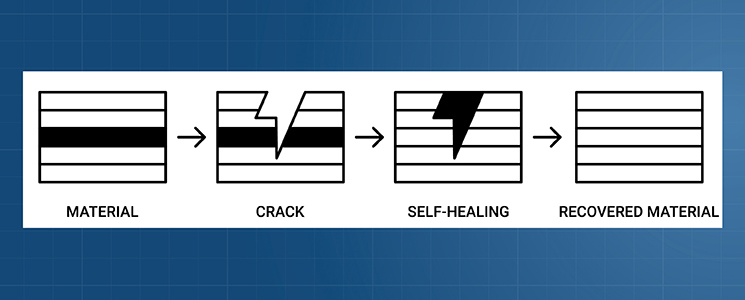
- How it works: Tiny capsules containing a liquid healing resin are embedded in the composite. When the material cracks, capsules break and release the resin, which fills the crack and cures.
- Pros: Simple concept; can be added to existing matrices; effective for local, small cracks.
- Cons: Usually single use (capsules are consumed); limited healing volume; performance depends on proper mixing and cure of the released resin.
Vascular networks (extrinsic)
- How it works: A network of channels (like blood vessels) is built into the component. Healing fluid can be pumped in or stored to refill damaged zones and can be replenished for multiple events.
- Pros: Potentially repeatable healing; larger healing volume than microcapsules.
- Cons: Adds structural complexity, weight and manufacturing challenges; channels must not unduly weaken the structure.
Intrinsic chemistries (intrinsic)
- How it works: The material’s own chemistry enables reversible bonds or flow when stimulated by heat, pressure or light. Examples include reversible Diels–Alder links, thermoplastic segments, or shape memory polymers.
- Pros: Often repeatable; no separate reservoir needed; can restore mechanical performance more uniformly.
- Cons: Healing typically requires specific conditions (e.g. elevated temperature) and may be slower; long term durability and environmental stability can be concerns.
Detection & reporting – the complement to repair
- Visual indicators: mechanochromic dyes or capsule released colourants that leave a visible ‘bruise’.
- Embedded sensors: fibre optic networks, piezoelectric arrays, or electrical resistance networks to log events and feed the aircraft’s maintenance record or digital twin.
Comparison table
| Mechanism | Repeatability | Typical trigger | Structural impact |
|---|---|---|---|
| Microcapsules | Low (single) | Crack ruptures | Low–moderate |
| Vascular networks | Medium–High | Pumped/released | Moderate–high |
| Intrinsic chemistries | Medium–High | Heat/pressure/light | Low–moderate |
Further information
Hia, I. L., Vahedi, V., & Pasbakhsh, P. (2016). Self-healing polymer composites: Prospects, challenges, and applications.
Polymer Reviews, 56(2), 225-261.