
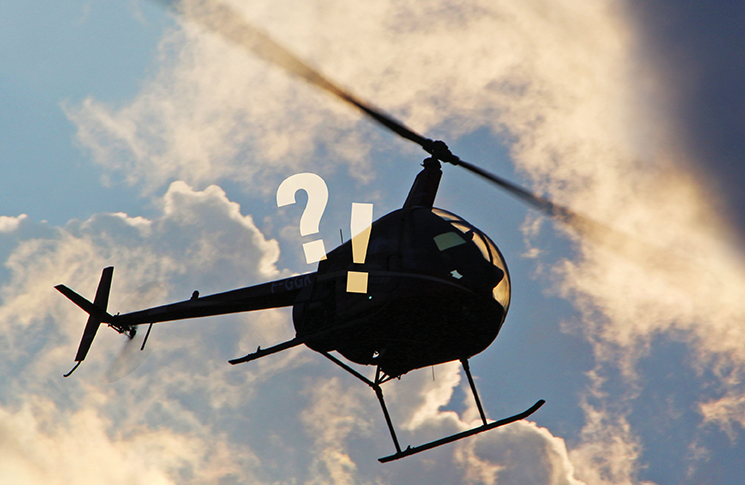
I was with a student on their first navigation flight away from controlled airspace. Stepping away from the relative security of our Class D towered aerodrome and being let loose into the freedom of Class G airspace is a milestone for all our helicopter student pilots.
In the days leading up to our navigation flights, we focus on planning and procedures. We try to make the workload minimal on the day by rehearsing the flight before we head out, including practising radio calls and anticipated circuit-joining patterns.
At mid-afternoon, on a dull grey day in February, our flight departed towards a non-controlled aerodrome where we would complete a brief landing before departing for another non-controlled aerodrome. This initial nav flight is certainly a high‑stress situation for the student, with navigation, CTAF and circuit procedures all being new concepts – there is a lot to take on.
Leaving the control zone, we gave our departure report to tower, switched over to the Centre frequency and hit ‘VFR’ on our transponder. We were on our way, taking up a track for our anticipated arrival 36 minutes later.
On approach, we switched over and listened out on the CTAF before announcing our presence with a standard 10-mile inbound call.
A robotic response came back from the aerodrome frequency reporting unit AFRU, confirming no broadcasts had been made for the last 5 minutes on the CTAF.
We continued to listen out and made another call at 5 nm, stating our intention to fly overhead, and then again as we descended on the dead side and joined circuit on a downwind leg for the runway.
We landed and cleared the runway with nothing eventful to note. There was no traffic, which, if I’m honest, I thought was a shame. It’s nice to have someone else in the circuit so the student gets the experience of interacting with another aircraft.
As we made our way back onto the runway and then took off, another aircraft announced their impending arrival. They joined the circuit overhead as we passed safely beneath them and continued on our next leg. At least now my student had received a little taste of having to think on their own, unable to rely on a tower for direction! I was mildly happy and proud of their achievements so far.
We could have easily collided if we hadn’t seen them when we did!
A short while later, we were approaching our second destination, and repeating the process, switching to the CTAF and listening for anyone in the vicinity. Once again, it was another empty airspace, a shame. We made our 10-mile inbound call, and as we didn’t get any response and no one appeared to be in the vicinity, we would fly a different approach and join the circuit on a left base for the runway. My student pilot did the landing checks, made the radio calls and we set up to land.
That’s when we got a shock! ‘Whoa, what is that?’ As we made a descending turn onto base, we caught sight of a small aircraft on a long final for the same runway! It was below and to our right. Close by! This forced us to immediately slow down and hold our height, so we could safely follow. Once I got over the shock, I immediately double checked our frequency, confirming we had the correct CTAF active. We made another general CTAF call.
I just couldn’t believe it! We had no idea there was another aircraft in the circuit. Not a single radio call had been made during our entire time in the vicinity! Did the other pilot even know we were there? Did they have the right channel? It seemed crazy that someone would reach final without saying a word. We could have easily collided if we hadn’t seen them when we did!
We didn’t have a chance to talk to the other pilot. We were doing a ‘stop and go’, and the other aircraft had already taxied away to the hangars.
While I had wanted traffic in the circuit, I didn’t want it like that! That day both of us were the students. This is an incident that we will both keep in the back of our minds every time we fly at a non‑controlled aerodrome.
Lessons learnt:
- keep a constant visual lookout near aerodromes and actively scan below and ahead before every turn in the circuit
- make clear and timely radio calls and listen carefully to build a mental picture of other traffic
- expect other aircraft may be in the circuit and join in a way that gives you time to see and adjust, even if you hear no radio calls
- check you are using the correct CTAF and confirm your radio is working before you join the circuit, using an AFRU response if available.
Related content
Don’t forget to check out the audio close calls and hear the stories come to life.
Non-controlled operations is one of the special topics on our Pilot safety hub. Refresh your knowledge.
Have you had a close call?
8 in 10 pilots say they learn best from other pilots and your narrow escape can be a valuable lesson. We invite you to share your experience to help us improve aviation safety, whatever your role.
Find out more and share your close call.
Disclaimer
Close calls are contributed by readers like you. They are personal accounts of individual experiences and are not corroborated by CASA. We publish close calls so others can learn from their stories and spark discussions about safety. These stories should not be used to identify individuals or operators.