

Purely by accident, an instructor learns that taking your time can be the key to survival
By Douglas Robertson
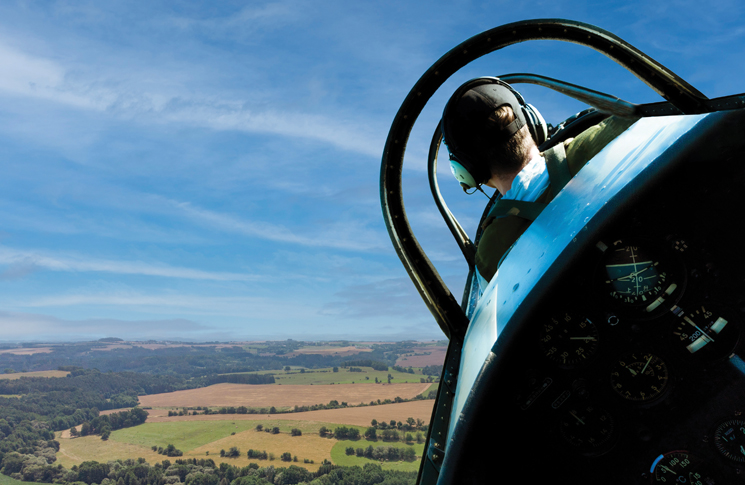
Long ago and far away I was an instructor on light aircraft. In those days, I was required to teach spinning and for the student to do solo spins. So, it was pretty normal for me.
On the day in question, I took a student up for a session of spins, not his first, by the way. The aircraft was the aerobatic version of a popular trainer and that might be significant in what happened – different centre of gravity.
All went well and I said, ‘Okay, do one more, then we’ll head back’. He had been doing fine so I paid less attention than I should have.
After a couple of turns, I said, ‘recover’ but we spun on. ‘Recover,’ I repeated – and repeated again in a falsetto voice. ‘I am,’ he replied.
I took control, if you can call it that, and found that the rudder was fully over in the correct direction but the elevators, when I moved them, felt the same as if we were parked on the apron.
Well, I’d read about this sort of thing, so I shoved the throttle to the panel and followed it with the stick. And again and again – allegro!
I must have been doing things very quickly because I managed to grab the microphone and yell a squeaky mayday so our next of kin would know of our passing. It was the sort of mic that sat on a hook on the panel. The elders of our club said we didn’t need an intercom because they hadn’t had intercoms in the first aircraft, like the Maurice Farman.
After a couple of turns, I said, ‘recover’ but we spun on.
Out of pure habit, I leaned forward to replace the mic on the hook (go figure!). Missed, tried again and got it stowed. This meant I was holding the stick to the panel and the throttle ‘bricks to the wall’ long enough to have an effect.
I felt new life in the elevators, we recovered. I closed the throttle and pulled out. We were below the legally required height for recovery, as you might imagine. There was silence as we went home.
Lessons learnt: It was a neural pathway or perhaps a neural superhighway burnt into my mind. I had been going at it too fast. Years have passed and many a first officer has heard me say, ‘andante, andante’. (Piano teacher’s jargon for, ‘Hey, slow down!’)
Over the years, in Hercules, Viscounts, BAC 1-11s, Boeing 737, 757 and 767s, I’ve rarely seen a problem that had to be solved in the next half second. For example, I have seen a hand flash to the overhead panel as we broke clear of overcast and switch off 2 hydraulic pumps instead of the engine anti-ice.
The fastest part of the brain is not the smartest part. When something happens that gives you a fright, pause. If you feel stupid and out of it, don’t worry; that will pass in less time than you realise and you will deal with it. Oh, and read a lot.
Have you had a close call?
8 in 10 pilots say they learn best from other pilots and your narrow escape can be a valuable lesson.
We invite you to share your experience to help us improve aviation safety, whatever your role.
Find out more and share your close call here.


Comments are closed.