
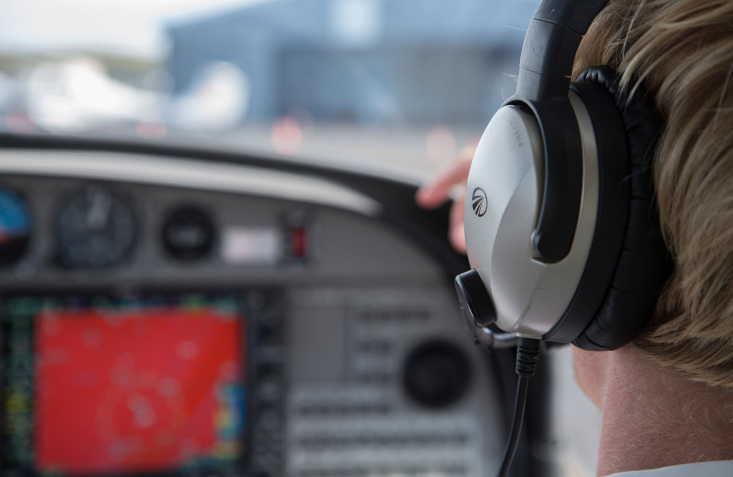
Imagine having over 37 years of flying instructor experience. Every airspace change, every nervous student, every teaching moment in the sky – witnessed, absorbed, passed on. That’s what Steve Reh brings to the right seat. As a senior first grade instructor and flight examiner, he’s seen the Sydney basin airspace evolve through every shift it’s had. He says the changes arriving on 9 July this year are the biggest yet. Here’s what he wants every pilot flying in this region to know.
1. The frequency is a picture – tune in before you transmit
Whether you’re a Bankstown regular or transitioning from a CTAF environment, the principle is the same: the frequency isn’t just a place to talk. It’s a live and evolving picture of everything happening around you.
The pilots who struggle aren’t those who fumble a readback – they’re the ones who stop listening between calls. Tune in early, let the picture build and if you miss something, say so. ATC would rather repeat themselves than have you guessing.
Reh says he tells every student in the right seat at Bankstown the same thing – your ears do more work in the air than your mouth ever will.
‘When you check in on the CTAF or pick up the Tower frequency, give yourself a good 30 seconds before you key the mic,’ he says. ‘Listen for who’s where, who’s inbound and what runway is active.
‘I’ve examined plenty of pilots who could recite a perfect readback but had no idea a Cessna was already on a two-mile final. That fails a flight test and worse, it also bends metal. Build the picture first, then talk.’
2. Getting clear on coded clearances at Bankstown
From 9 July 2026, Bankstown introduces coded VFR clearances via the new Class D CTA. A coded clearance bundles your entire route into a single named call.
Coded clearances for the most common VFR routes have been published in the 9 July edition of ERSA and are also referenced in the updated Airservices Australia Sydney General Flying Guide.
Inbound from the west? Request Lighthorse inbound – tracking via the M4, Lighthorse Interchange and Prospect Reservoir at 1,500 feet.
Heading north? Nominate Hornsby outbound – via Parramatta, Pennant Hills strobe, squawking 1200 on leaving Class D CTA.
Study the ERSA entry for Bankstown, write the clearance down, read it back in full and ask if anything is unclear.
Reh says the coded clearances may catch a lot of people out. ‘Not because they’re complicated,’ he says. ‘The trap is pilots accepting a clearance they haven’t fully understood because they don’t want to sound green on the radio.
‘Don’t ever do that with me in the right seat, and don’t do it with ATC. If Lighthorse inbound doesn’t paint a clear picture in your head – the track, altitude, reporting points – you [tell ATC] ‘say again for [call sign]’ or ‘[call sign] request clarification.”
‘I would much rather you take an extra 10 seconds on frequency than have me watch you bust controlled airspace.’
3. Fly the aircraft – then talk
This is the consistent pattern instructors see – the radio gets all the attention and the aircraft is forgotten. That’s because ATC pressure can narrow focus to the frequency – then altitude drifts, speed creeps, and the picture dissolves. But the priority order must never change – aviate, navigate, communicate. ATC will wait and ‘standby’ is a perfectly professional response.
‘This is the one I see go sideways most often during [flight tests],’ Reh says. ‘A pilot gets a complex clearance, the workload spikes and I see the altimeter drop 50 feet and we’re 20 degrees off heading.
‘The aeroplane doesn’t care that you’re talking to Sydney Approach. Aviate first. If ATC asks you something while you’re rolling out of a turn or sorting a checklist say, ‘Bankstown Tower [call sign], standby.”‘
‘This is a complete and professional answer. I’ve never heard a controller take issue with it. However, a pilot gets in trouble when they try to do everything at once and do none of it well.’
4. Your transponder is doing work you cannot see
From 9 July, aircraft operating in the Sydney basin must carry a working transponder. (If you are flying only in the Bankstown CTR, a transponder is not required).
The transponder must meet the equipment requirements outlined in the Part 91 Manual of Standards. This requirement can be satisfied with either a Mode A/C transponder or a Mode S transponder. An electronic conspicuity (EC) device does not meet the minimum equipment requirements.
Mode A/C and S transponders give ATC position and altitude. Without it, you’re effectively invisible to radar.
Using it correctly is simple:
- Squawk the assigned code
- select ALT mode, and
- confirm it’s transmitting before you taxi.
‘I do a transponder check on every single flight, instructional or otherwise and I expect my students to do the same,’ Reh says. ‘It takes about 3 seconds – code set, ALT selected, IDENT working – done.
‘From 9 July, this will not be optional in the Sydney basin. Without [a Mode A/C or Mode S transponder], the controller separating you from a jet on descent into Sydney has only half a picture. I’ve sat in on debriefs after airspace infringements where the transponder was sitting on standby the whole flight. The pilot had no idea.’
Steve urges pilots to get into the habit of confirming the transponder is transmitting before taxiing. ‘Then check it again before you enter controlled airspace.’
5. What you know might be what trips you up
Bankstown and Camden pilots face a particular challenge. The routes in and out of both aerodromes that might feel second nature – the altitudes and mental picture – are changing.
The training areas where generations of Sydney pilots built their hours now sit inside or adjacent to the new controlled airspace.
‘I’ve been instructing out of Bankstown and Camden for decades and I know exactly what’s going to happen – experienced pilots will fly the routes they’ve always flown, at the altitudes they’ve always used, because that’s what their hands and eyes are trained to do,’ says Reh.
‘Habit is a beautiful thing in aviation right up until the day it isn’t. Pull out the new charts. Sit down with the ERSA. Brief the changed procedures out loud to yourself or, better, to an instructor. If you’ve been flying here for 20 years, you have more to relearn than the student doing their first solo, so take it seriously.’
This isn’t just a procedural update for pilots who’ve flown here for years, it’s a conscious reset.
Further information
Visit casa.gov.au/sydneyairspace to learn more about what is changing, how to prepare and find useful resources.
Subscribe to CASA’s airspace and aerodromes mailing list to stay up to date.