
A police drone glides through an open window into a darkened home. Cameras scan each hallway and room. Outside, officers watch the live feed, searching for any sign of the armed suspect within.
Scenes like this aren’t from a movie – they’re starting to play out in Australia as drones become an integral part of policing.
Reaping safety benefits
While law enforcement agencies have used helicopters and aeroplanes for some time, drones allow them to access hard-to-reach areas and ensure real-time intelligence at a significantly lower cost.
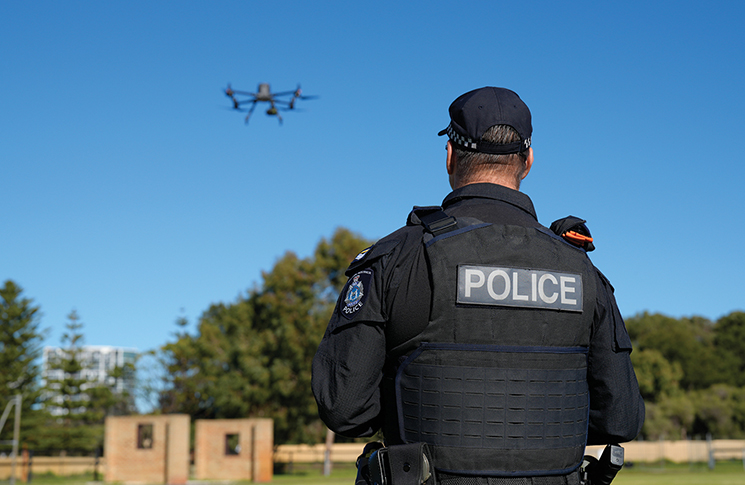
WA Police are actively embracing the use of drones, integrating them into operations to increase the safety of officers and the community.
Superintendent Paul Daly says drones allow police to see what’s happening on the ground so they can manage resources more effectively. Does a situation require more than one police officer? Perhaps a specialist response team? These are the urgent safety decisions that drones help to support. They also offer access to advanced technology that was previously out of reach.
‘Drones provide us with that bird’s eye view of what’s on the ground to start with,’ Daly says. ‘Then you start branching into some of that more niche, specialist stuff where people traditionally would use a normal camera – think crash reconstruction or reconstructing crime scenes for court – all of that software technology has now come online, where it once wasn’t freely available.’
Senior Sergeant and Chief Remote Pilot Paddy Madaffari said the WA police program started as a small project in 2019 to evaluate the viability of drones in law enforcement.
‘During that period of time, it became glaringly obvious that RPAS did complement policing operations immensely,’ he says. ‘It provided a safer working environment for our people through better situational awareness but more importantly, not just for our own people, but for members of the public and also even the offenders themselves.’
The program has grown into a dedicated team of 13 officers with nearly 100 trained officers across the state who can operate as part‑time pilots in addition to their
normal police duties.
Exploring new areas of operation
Using drones indoors for police response is a relatively new concept in Australia. Led by the National RPAS Working Group comprising state and federal police agencies along with CASA, a trial exemption was issued in 2024 which allowed police to fly small drones indoors, within 30 metres of people, and beyond visual line of sight.
‘This is a major step in the right direction in terms of safety,’ WA Police Inspector Pete Davies says.
‘If we’re looking at entering a home, building or warehouse where there’s someone who’s armed and making threats, the decision to send in a tactical team or police officers into line of fire is a massive one for a police commander,’ he says. ‘So having the ability to see where the offender is inside the building – whether he’s armed at the time or whether he’s put the gun down, whether his finger is on the trigger – allows us to make better [and] safer decisions.’
Not only is it safer for officers, but the level of response can also be safer for the suspect.
‘If we wait until he’s not got the gun in his hand and he’s calmed down a little bit, that’s safer for him. If we come in at the wrong time then he is likely to get hurt in the use of force options in trying to stop that situation.’
The exemption has since been renewed, allowing other emergency services to use drones indoors.
Building a culture of safety
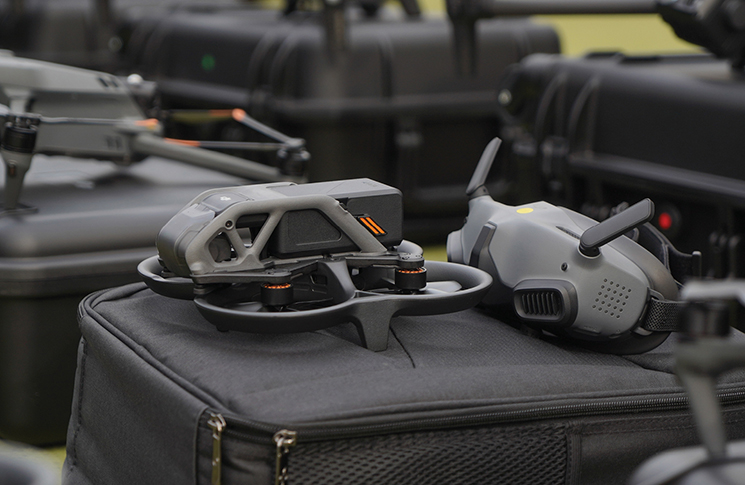
Behind the scenes, a specialised team ensures drones are deployed safely and effectively. The RPAS division sits within the Air Wing of WA Police where it can benefit from the existing safety lessons and procedures of fixed-wing and rotary operations.
‘There is a checklist for everything in aviation and translating that across into [RPAS] operations is a good thing,’ Daly says. ‘I am not an aviator myself … so coming from outside in and seeing how safety is managed and the seriousness that it’s given; having RPAS in [the same division] by default, that culture just leaches into their work.’
He says training is a large part of maintaining their safety culture.
All pilots are required to maintain currency with minimum flight time requirements and undergo an annual proficiency knowledge checker and practical testing. The dedicated RPAS team also undertake proficiency checks on flight ops, indoor flying and payload delivery.
Police pilots track their training through a safety management system which ensures that pilots are keeping up with the evolving landscape of drones while also helping the department modify the training they offer.
‘So if we’re seeing consistent errors in a particular area, our training then can be tailored to make sure that we lift those standards or we change it or [ask] what’s happening here, why are our pilots not able to get 100% in that area, so [it’s about] being a bit smarter about how we train and making sure our pilots can be upskilled,’ Daly says.
WA Police also encourage a just culture of reporting, asking pilots to report safety issues or concerns which are then discussed and addressed across the larger
aviation team.
Looking forward
While drone flights for frontline services is relatively new territory, analysis commissioned by Airservices Australia in 2024 estimated that around 310,000 annual drone flights will be used to support frontline policing by 2043.
Looking ahead, WA Police envisions drones playing an even greater role in enhancing public safety across police and emergency services. An example is the Drone as a First Responder program which is already being used in cities across the United States. The idea is to send a drone in response to high-priority 911 calls in advance of a police response, allowing them to evaluate the scene before they arrive.
Western Australia Police recently won the Leadership Award at the Australian Association for Uncrewed Systems industry awards ceremony, a testament to the program’s success and innovation. With new possibilities on the horizon and an award to their name, their drone program is setting a benchmark for innovation
in public safety.
Visit casa.gov.au to learn more about the drone rules.
Resources:
- Sizing-the-Future-Drone-Industry-in-Australia_February.pdf – Airservices Australia
- Drone as First Responder | Homeland Security – US Department of Homeland Security
- Remotely Piloted Aircraft Systems (RPAS) and Advanced Air Mobility (AAM) Strategic Regulatory Roadmap – CASA