
Most pilots learn about airspace changes in 2 ways. Either they sit down with the AIP well before the date and do the work, or they find out the hard way – mid-call, mid-flight, mid-frequency change – that something no longer works the way they expected.
The Sydney Basin changes coming on 9 July are significant enough that the second option is not just inconvenient, it carries real consequences.
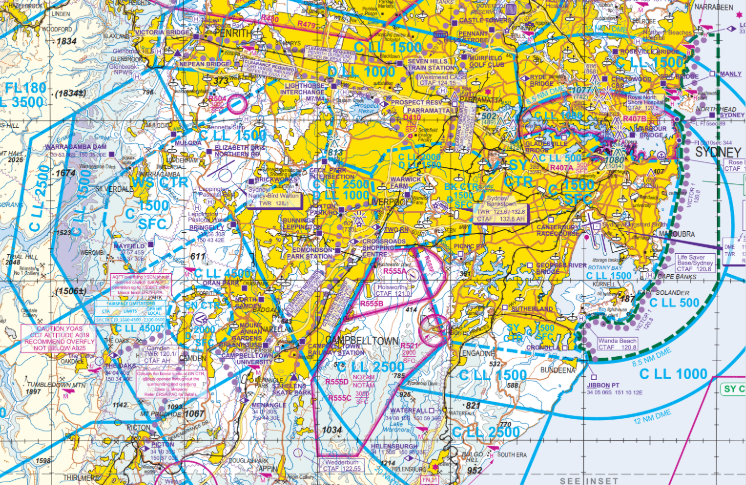
By now, you know the Western Sydney International (WSI) Airport – officially named Nancy-Bird Walton Airport – has been integrated into the Sydney terminal area. The new airport now sits alongside Kingsford Smith, RAAF Base Richmond, Bankstown and Camden in a restructured terminal area. Five airports in one airspace – and many new procedures.
According to the air navigation service provider, Airservices Australia, you can’t add a major international airport to one of the country’s most complex airspace structures without rethinking how it all fits together. Five airports sharing airspace requires a framework built for 5 airports.
Before you start the engine
There are several changes to routes and airspace structure, but 2 requirements affect every operation in the Class D controlled airspace before you jump in the cockpit.
- You must file a flight plan at least 30 minutes before your estimated time of departure and your aircraft must be equipped with a Mode A/C or Mode S transponder.
- All aircraft – VFR and IFR – require an ATC clearance. That includes transits. No clearance, no entry.
Coded clearances for the most common VFR routes have been published in the 9 July edition of ERSA and are also referenced in the updated Airservices Australia Sydney General Flying Guide. The system is ready. It just needs to be in your head before you taxi.
Coded clearances: your new best friend
If coded clearances are new to you, here’s the version that matters in the cockpit. Instead of ATC reading a full route description which takes time and loads the frequency, common VFR routes are pre-encoded. You request the code and ATC issues it. You then listen and read back the instructions that ATC provide to you.
Airservices Australia says pilots should familiarise themselves with the coded clearance as part of their pre-flight briefing for departure and arrival legs.
The key word is preflight. The briefing room is where this gets sorted, not in the cockpit, on the radio, or in real time.
While ATC provides traffic management within controlled airspace, an ATC clearance does not remove your responsibility as the pilot. You remain responsible for terrain and obstacle clearance and separation from weather.
You must actively manage the flight path to remain safe. If it becomes necessary to deviate from a clearance to maintain safety:
- advise ATC as early as possible
- request an amended track or level as required
- do not hesitate to speak up if unable to comply with an ATC instruction.
The flight plan you can’t forget
Airservices Australia is direct. ‘Pilots can expect delays if ATC is required to enter a flight plan on their behalf prior to obtaining a clearance and in some circumstances a clearance may be denied.’
Then the frequency gets slow, everyone waits and you might not depart or get in, which leads to a knock-on for other flights that are inconvenienced.
Thankfully, the flight plan isn’t complicated. Airservices has developed the Australian Domestic Flight Notification Form – a modified ICAO form for Australian requirements, including multiple stages of flight. Details are in AIP ENR 1.10 and CASA’s Visual Flight Rules Guide also covers notification requirements.
The key takeaway is to lodge your flight plan ahead of time, not over the radio.
What a Bankstown departure will look like
Here’s a VFR departure from Bankstown to Cessnock via Hornsby outbound under the new arrangements, based on information provided by Airservices Australia.
Your flight plan is already lodged before engine start. Start clearance procedures are on Bankstown Ground (119.9). Before taxiing, request airways clearance on the same frequency. ‘VH-ZTU request Hornsby outbound and taxi, received information Echo.’ This is short and clear and understood by both sides.
After departure, track toward Parramatta, then Hornsby outbound: Carlingford Corner, Pennant Hills strobe, Hornsby, Patonga. Contact Bankstown Approach on 125.8 at the CTR/CTA boundary. The reply will be, ‘Leaving Class D CTA, services terminated, squawk 1200, frequency change approved.’
Airservices Australia is also developing a quick reference handbook covering operational scenarios, procedures and ATC interactions. Watch the project webpage for its release.
When night falls at Camden
The VFR lanes to the north-west of Camden are being removed. Class C airspace will be added directly above the airport, with a lower limit of 4,500 feet.
What to watch: Between 2300 and 0600 local daily, that lower limit drops to 1,500 feet. If you operate in or out of Camden outside business hours, check the charts properly before 9 July.
Airservices encourages pilots to refer to published aeronautical information material and familiarise themselves with the new airspace and flight procedures. However, at 1,500 feet in the dark, that’s not a suggestion.
You have time, don’t waste it
Prepare now. Read the updated AIP and ERSA (9 July editions have been published), work through the coded clearances for your regular routes and have the flight plan process sorted before 9 July – not on 9 July.
Remember to check again before each flight for any changes (including NOTAMs).
The frequency will thank you. And you won’t eat humble pie on the radio while ATC sorts out your flight plan (and every pilot in the queue waits on you).
Know your airspace intimately
The tools are there. The materials are published. Instructors are ready to help you brush up.
What’s left is what has always separated good pilots from the rest – doing the work on the ground before the work starts in the air.
Nancy-Bird Walton Airport is here. Show up prepared and the transition is manageable. Show up cold and it won’t be.
Further information
Visit casa.gov.au/sydneyairspace to learn more about what is changing, how to prepare and find useful resources.
Subscribe to CASA’s airspace and aerodromes mailing list to stay up to date.
Resources
- Airservices Australia – Operating in Class D Airspace Safety Net
- Aeronautical Information Package (AIP) – Aeronautical Information Package (AIP) – Airservices
- CASA VFRG – Visual Flight Rules Guide